
The Strategic Rebalancing: Why China is Emerging as a Prime Destination for Global Private Equity in 2025
Geopolitical Stabilization and Trade Policy Normalization
The U.S.-China trade tensions that dominated the early part of 2025 have begun to ease, with a landmark one-year suspension of port entry fees and reduced tariffs on Chinese imports announced in Q3 2025, according to Matson Q3 slides. This shift has stabilized trade flows, with container volume for China services rebounding from a 12.8% year-over-year decline in Q3 2025, the Matson slides show. For PE firms, this stabilization reduces operational volatility and opens new avenues for cross-border investments. The Starbucks-Boyu joint venture, which saw the latter acquire a 60% stake in Starbucks' China operations for $4 billion, exemplifies this trend, as outlined in the Starbucks–Boyu transaction. By leveraging local expertise and capital, the deal underscores how geopolitical reallocation is enabling foreign brands to adapt to China's competitive retail landscape while mitigating exposure to regulatory and economic risks.
Sector-Specific Arbitrage: From Retail to Renewable Energy
Valuation arbitrage in China is most pronounced in sectors insulated from geopolitical headwinds. The healthcare and consumer goods industries, for instance, have become focal points for PE firms seeking to capitalize on domestic consumption growth. According to a Ropes & Gray report, investors are prioritizing assets in these sectors due to their lower sensitivity to tariffs and export controls. Similarly, the renewable energy sector is attracting attention as global energy transitions accelerate. Chinese PE firms are acquiring undervalued renewable projects in emerging markets, such as Indonesia's geothermal and biodiesel initiatives, according to an Indonesia renewables report. These investments align with Sinopec's forecast that renewables will account for over half of global energy consumption by 2060, creating long-term value through policy-driven demand and infrastructure development.
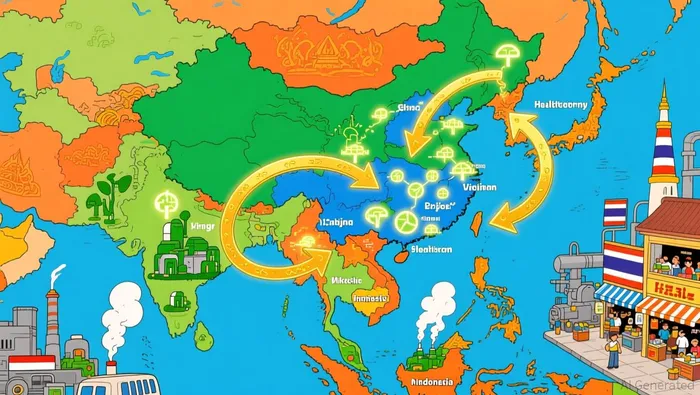
Geopolitical Reallocation: "China ex-China" Strategies
The concept of "China ex-China" has gained traction as investors diversify their geographic footprint while retaining exposure to China's economic rebound. This strategy involves targeting offshore businesses that benefit from China's domestic demand or supply chain resilience. For example, Qiming Capital's acquisition of Tiamaes, a Chinese A-share listed robotics firm, reflects a focus on technology sectors poised for growth, according to the Chambers guide. Meanwhile, Chinese private equity firms are expanding into Southeast Asia, where regulatory environments are more favorable and labor costs are lower. A $60 billion high-speed rail project in Nigeria, backed by Chinese entities like China Liancai Petroleum Investment Holdings, illustrates how infrastructure investments are being leveraged to align with global renewable energy goals, as detailed in the Nigeria Construction Industry Report 2025.
Challenges and Regulatory Scrutiny
Despite these opportunities, geopolitical reallocation is not without risks. Cross-border transactions face heightened regulatory scrutiny, as seen in the Dutch-Chinese Nexperia dispute. This case, where the Netherlands transferred control of Nexperia from Wingtech Technology following national security concerns, highlights the fragility of foreign investments in strategically sensitive sectors. Such developments have prompted PE firms to adopt cautious strategies, favoring domestic Chinese capital to acquire assets previously held by foreign investors, as the Chambers guide notes.
Conclusion: A New Equilibrium
China's reemergence as a prime destination for global PE in 2025 is not a return to the past but a recalibration driven by geopolitical reallocation and valuation arbitrage. As trade policies stabilize and sector-specific opportunities mature, investors are navigating a landscape where strategic patience and geographic diversification are paramount. The interplay of domestic consumption, renewable energy transitions, and Southeast Asian expansion underscores a broader trend: China remains a critical, albeit complex, node in the global PE ecosystem.







Comentarios
Aún no hay comentarios