
The Strategic Rationale Behind Coinbase's Investment in CoinDCX and Its Implications for Global Crypto Markets
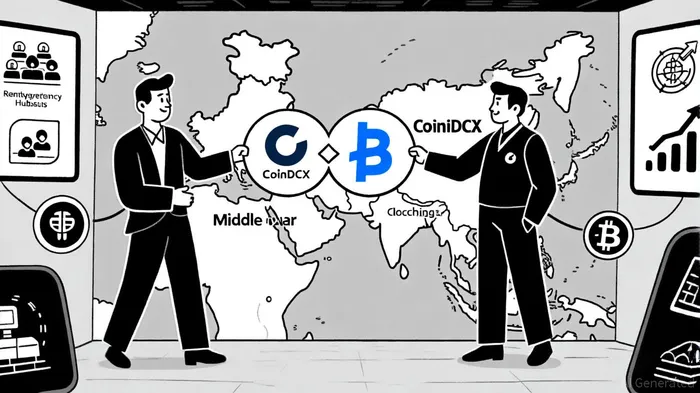
In October 2025, CoinbaseCOIN--, the U.S.-based crypto giant, announced a significant investment in CoinDCX, one of India's largest cryptocurrency exchanges, valuing the firm at $2.45 billion post-money. This move, building on a prior $135 million investment in 2022 that valued CoinDCX at $2.15 billion [1], underscores a broader strategy to consolidate cross-border crypto ecosystems in high-growth markets. For investors and industry observers, the partnership raises critical questions about the interplay between strategic expansion, regulatory risks, and the evolving dynamics of global crypto markets.
Strategic Rationale: Market Access and Ecosystem Consolidation
Coinbase's investment in CoinDCX is driven by India's demographic and technological potential. With over 20.4 million users and $1.2 billion in assets under custody, CoinDCX operates in a market where crypto adoption is accelerating, fueled by a young, tech-savvy population and rising internet penetration [2]. The exchange's acquisition of BitOasis in 2024 further expanded its footprint into the Middle East and North Africa (MENA) region, a corridor Coinbase has identified as pivotal for the global on-chain economy [3].
The investment aligns with Coinbase's 2025 strategy to deepen its presence in regulated markets. By partnering with CoinDCX, Coinbase gains access to a platform that already complies with India's stringent anti-money laundering (AML) and know-your-customer (KYC) norms, as mandated by the Financial Intelligence Unit (FIU-IND) [4]. This regulatory alignment is critical in a market where the Reserve Bank of India (RBI) and the Securities and Exchange Board of India (SEBI) are tightening oversight of crypto assets. As stated by Coinbase CEO Brian Armstrong in a blog post, "India's crypto ecosystem is a cornerstone of the future global on-chain economy, and partnerships like this will help us build infrastructure that scales responsibly" [5].
Regulatory Risks and Market Volatility
Despite the strategic appeal, the investment faces regulatory headwinds. India's crypto framework, while evolving, remains complex. Cryptocurrencies are classified as VirtualCYBER-- Digital Assets (VDAs) under the Income Tax Act, 1961, subjecting them to a 30% profit tax and a 1% transaction levy on trades exceeding ₹10,000 [6]. These measures, coupled with the absence of a clear licensing regime for exchanges, create uncertainty for foreign investors.
Moreover, CoinDCX's recent $44.2 million hack in July 2025-a breach the exchange absorbed from its own reserves-has raised questions about operational resilience in high-growth markets [7]. While CoinDCX leadership emphasized "shared values in transparency and trust" with Coinbase, the incident highlights the vulnerabilities of scaling rapidly in regions with nascent regulatory frameworks [8].
Implications for Global Crypto Markets
The Coinbase-CoinDCX partnership reflects a broader trend of cross-border consolidation in the crypto sector. As global firms seek to navigate fragmented regulatory landscapes, strategic alliances with local players offer a dual advantage: access to untapped user bases and compliance with regional norms. For instance, CoinDCX's expansion into the MENA region mirrors similar efforts by exchanges like Binance and Kraken to diversify into markets with less restrictive crypto policies.
However, the deal also underscores the risks of over-reliance on high-growth markets. India's regulatory environment, for example, could shift rapidly. In April 2025, SEBI began monitoring crypto tokens resembling securities, signaling a potential expansion of oversight [9]. If regulatory pressures intensify, Coinbase's investment could face liquidity constraints or forced divestments.
Conclusion
Coinbase's investment in CoinDCX is a calculated bet on India's crypto potential, but it is not without risks. The partnership exemplifies the tension between strategic expansion and regulatory uncertainty in high-growth markets. For global investors, the deal highlights the importance of balancing market access with robust risk management-particularly in regions where policy frameworks are still evolving. As the crypto industry matures, cross-border collaborations like this will likely shape the next phase of the on-chain economy, but their success will depend on navigating both regulatory and operational challenges with agility.





Comentarios
Aún no hay comentarios