
The Strategic Potential of Industrial Real Estate in Upstate New York's Evolving Economic Landscape
A Policy-Driven Infrastructure Renaissance
New York's FAST NY Shovel-Ready Grant Program, administered by Empire State Development (ESD), has allocated over $283 million to 37 projects since 2022, targeting infrastructure upgrades such as water, sewer, and electrical systems to prepare industrial sites for high-growth industries like semiconductors and clean-tech. This program's dual focus on pre-development and capital grants-offering up to $500,000 per site for feasibility studies and $300 million for infrastructure improvements-has transformed underutilized properties into competitive assets. For instance, the Triangle Site in Oneida County received a $32.36 million grant to enhance water, sewer, and gas capacity, directly supporting Chobani's $1 billion expansion plans. Such investments not only reduce development timelines but also align with state goals to attract industries requiring robust infrastructure.
Complementing FAST NY is the $300 million POWER UP program, launched in November 2025, which focuses on electrical infrastructure upgrades for industrial sites. By ensuring sites are "power-ready," the initiative addresses a critical bottleneck for energy-intensive sectors like semiconductor manufacturing. For example, the Port of Albany secured an $18.79 million grant for a high-voltage substation and wastewater treatment plant, positioning the site for large-scale manufacturing.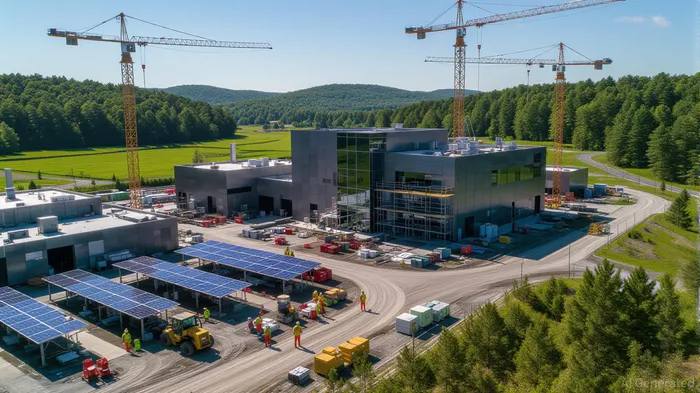 These programs collectively underscore New York's commitment to creating a "shovel-ready and power-ready" industrial ecosystem.
Case Studies: From Brownfields to High-Value Hubs
Corporate campus redevelopments have further amplified the capital appreciation potential of Upstate industrial real estate. The Western New York Science Technology Advanced Manufacturing Park (STAMP) in Genesee County, for instance, received a $56 million FAST NY grant to build a wastewater treatment facility and electrical upgrades, aligning with the state's "semiconductor superhighway" strategy. This project not only attracted clean-tech firms but also increased adjacent property values by 10.1% in Webster, NY, where the former Xerox campus is being redeveloped into a high-tech industrial hub according to market analysis.
Similarly, the Schuyler Business Park in Herkimer County leveraged grants for water storage and traffic improvements, enabling it to attract renewable energy companies. These redevelopments highlight how public funding mitigates private-sector risk, accelerating the transition of brownfields into high-demand industrial zones.
Quantifying the Return: Economic Impact and ROI
While explicit ROI metrics for ESD-funded projects remain limited, broader economic impact studies provide compelling evidence of long-term value. For example, Upstate Medical University's FY2024 economic impact of $3.2 billion-nearly double its 2008 figure- demonstrates how strategic investments in infrastructure can catalyze regional growth. Though this case focuses on healthcare, the methodology mirrors industrial real estate's potential: infrastructure upgrades create jobs, attract private capital, and generate tax revenue.
Capital appreciation trends also support this thesis. Residential property values in Upstate cities like Albany have appreciated by 2.6% to 3.5% annually since 2022, driven by low inventory and demand for industrial-adjacent housing. While industrial property valuations face headwinds from interest rate hikes, shovel-ready sites-such as the Treadwell Oswego County Industrial Park, which received an $8.1 million grant for utility upgrades- remain resilient due to their alignment with semiconductor manufacturing needs.
Challenges and Strategic Considerations
Despite these opportunities, investors must navigate macroeconomic uncertainties. Multifamily unit values in Upstate New York have declined from pandemic-era highs, reflecting broader financing challenges. However, industrial real estate's resilience stems from its role in supply chain diversification and state-backed infrastructure guarantees. For example, the National Grid Upstate Economic Development Grant Program prioritizes energy efficiency and brownfield redevelopment, mitigating environmental risks while enhancing long-term viability.
Future Outlook: Sustaining the Momentum
Governor Hochul's recent allocation of an additional $100 million for FAST NY in FY2026 signals sustained state commitment. Coupled with the POWER UP program's focus on electrical infrastructure, these initiatives will likely attract industries like agribusiness and cleantech, further diversifying Upstate's economic base. Investors who align with these trends-targeting sites with pre-approvals for grants and proximity to emerging sectors-stand to benefit from both immediate capital gains and long-term appreciation.
Conclusion
Upstate New York's industrial real estate market is undergoing a strategic transformation, driven by policy incentives and sector-specific demand. By leveraging programs like FAST NY and POWER UP, developers can unlock capital appreciation through infrastructure-driven redevelopments and corporate partnerships. While macroeconomic headwinds persist, the region's focus on shovel-readiness and power-readiness positions it as a high-potential corridor for investors seeking long-term value in a dynamic economic landscape.







Comentarios
Aún no hay comentarios