
The Strategic Potential of Digi International and Silicon Labs' Wi-SUN Partnership in Scaling Secure IoT Connectivity
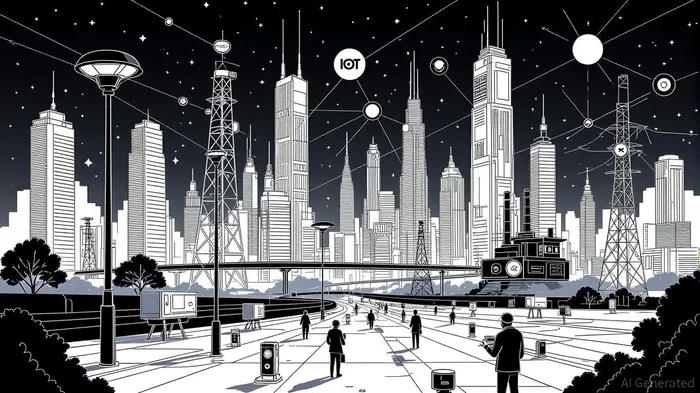
The global IoT market is undergoing a seismic shift, driven by the urgent need for secure, interoperable infrastructure in smart cities and industrial IoT (IIoT). As enterprises and governments prioritize resilience in critical systems—from energy grids to urban mobility—partnerships like the one between Digi InternationalDGII-- and Silicon Labs are emerging as pivotal catalysts. Their collaboration, centered on Wi-SUN technology, positions them at the forefront of a market projected to reach $1.06 trillion in 2025, with IIoT alone valued at $275.7 billion .
A Convergence of Expertise: Digi and Silicon Labs
Digi International, a leader in secure machine-to-machine (M2M) connectivity, has strategically aligned with Silicon Labs, a semiconductor innovator, to address the growing demand for robust IoT solutions. By leveraging Silicon Labs' expertise in wireless technologies and Digi's deep experience in industrial-grade connectivity, the partnership aims to deliver Wi-SUN-based networks that combine low-power, long-range communication with enterprise-grade security . This synergy is particularly critical in sectors like smart cities, where interoperability and scalability are non-negotiable.
Digi's recent acquisition of Jolt—a provider of smart infrastructure solutions—further strengthens its portfolio, enabling the company to accelerate Annual Recurring Revenue (ARR) growth while enhancing its SmartSense offerings . Meanwhile, Silicon Labs' collaboration with GlobalFoundriesGFS-- ensures a secure supply chain for next-generation IoT chips, addressing a key vulnerability in the industry . Together, these moves underscore a shared commitment to building infrastructure that can withstand the complexities of modern IoT ecosystems.
Wi-SUN: The Cornerstone of Secure, Scalable IoT
Wi-SUN (Wireless Intelligent Utility Network) is a wireless neighborhood area network (WNAN) protocol designed for large-scale, low-power deployments. Its mesh networking capabilities enable self-healing topologies, making it ideal for mission-critical applications such as smart metering, public lighting, and environmental monitoring. In North America, Wi-SUN has already gained traction in smart grid projects, with vendors like Landis+Gyr and ItronITRI-- deploying it for its reliability and scalability .
Compared to alternatives like LoRaWAN and 5G, Wi-SUN offers distinct advantages in specific use cases. While LoRaWAN is experiencing rapid growth (projected to reach $202.4 billion by 2034) due to its low power consumption and long-range capabilities, Wi-SUN's mesh architecture provides superior redundancy and resilience in dense urban environments . 5G, on the other hand, excels in high-bandwidth, low-latency applications but remains cost-prohibitive for many IIoT deployments. The coexistence of these technologies suggests a fragmented yet complementary market, where Wi-SUN's strengths in utility-scale projects will continue to drive adoption.
Market Dynamics and Financial Projections
The secure IoT market is expanding at an unprecedented rate, fueled by urbanization, industrial automation, and regulatory mandates for cybersecurity. By 2026, global smart city IoT spending is forecasted to exceed $312 billion, with edge computing and 5G playing supporting roles in data management . For investors, the key differentiator lies in companies that can bridge the gap between connectivity and security—a niche where Digi and Silicon Labs are gaining traction.
Financially, the partnership aligns with broader industry trends. The number of connected IoT devices is expected to grow from 16.6 billion in 2023 to 18.8 billion in 2024, with cellular IoT connections reaching 3.9 billion in H1 2024 . Digi's focus on expanding ARR and improving its balance sheet, coupled with Silicon Labs' chip-scale innovations, positions the duo to capture a significant share of this growth.
Real-World Deployments and Strategic Implications
While specific Wi-SUN case studies in smart cities remain underreported, the technology's adoption in North American smart metering projects highlights its real-world potential. For instance, Wi-SUN-based networks have enabled utilities to integrate electric vehicle (EV) charging infrastructure and smart streetlighting, demonstrating its versatility beyond traditional metering . These deployments underscore the importance of interoperability—a cornerstone of Digi and Silicon Labs' collaboration.
For investors, the strategic implications are clear: the partnership is not merely about technology but about building ecosystems. By standardizing secure, interoperable protocols, Digi and Silicon Labs are addressing a critical pain point in IoT adoption—fragmentation. This approach aligns with the growing emphasis on cybersecurity, as 27% of enterprises reported IoT-related breaches in 2024 .
Conclusion
The Digi-Silicon Labs partnership represents a calculated bet on the future of secure IoT infrastructure. As smart cities and industrial IoT markets mature, the ability to deliver scalable, interoperable solutions will determine competitive advantage. With Wi-SUN as their technological backbone and a shared vision for secure connectivity, the duo is well-positioned to capitalize on a market poised for exponential growth. For infrastructure investors, this collaboration offers a compelling case for long-term value creation in an increasingly connected world.





Comentarios
Aún no hay comentarios