
Strategic Positioning in Seasonal Markets: Assessing the Santa Claus Rally and January Barometer
Seasonal market patterns have long captivated investors, offering potential insights into timing and positioning. Among these, the Santa Claus Rally and the January Barometer stand out as two of the most studied phenomena. While their historical performance suggests predictive value, recent exceptions underscore the importance of contextual analysis. This article evaluates their reliability, interplay, and implications for strategic investing in 2025 and beyond.
The Santa Claus Rally: A Time-Tested Tendency
The Santa Claus Rally, defined as the market's performance during the last five trading days of December and the first two of January, has historically delivered positive returns for the S&P 500 in 79% of years since 1950, with an average gain of 1.3%. This pattern is often attributed to holiday optimism, year-end portfolio rebalancing, and reduced institutional trading activity according to research. However, its reliability has faced challenges in recent years. For instance, 2024 marked the first-ever negative Santa Claus Rally for the S&P 500, driven by persistent inflation concerns, hawkish Federal Reserve signals, and rising bond yields according to analysis. Such exceptions highlight the influence of macroeconomic factors over seasonal tendencies.
The January Barometer: A Mixed Prognosticator
The January Barometer posits that the S&P 500's January performance can predict its annual trajectory. Historical data shows a success rate of 62–84.5% between 1926 and 2023, depending on the dataset. When January is positive, the S&P 500 has delivered positive annual returns 82% of the time, averaging 16.2% gains. Conversely, a negative January has only led to a 54% chance of positive annual returns according to analysis. Critics argue that the Barometer's predictive power is partly a statistical artifact, as the market has historically been positive 70–75% of the time regardless of January's direction according to research.
The January Trifecta: Combined Predictive Power
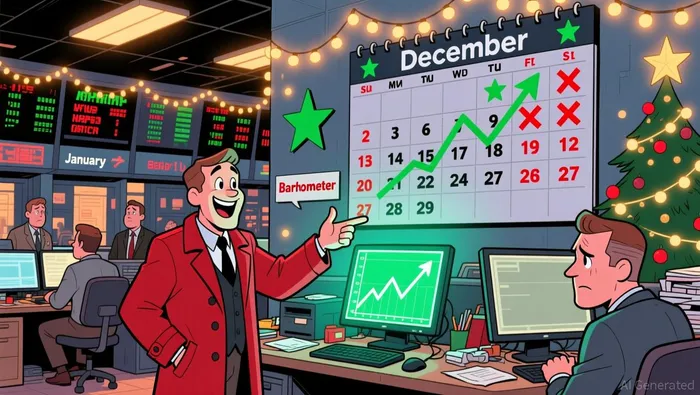
The alignment of the Santa Claus Rally, the First Five Days of January (FFD), and the full January Barometer-collectively termed the January Trifecta-has historically enhanced predictive accuracy. When all three components are positive, the S&P 500 has ended the year higher 90% of the time, with an average gain of nearly 18% since 1950 according to research. For example, the 1999 Santa Claus Rally's 4.0% decline was followed by a 5.1% January drop, foreshadowing the broader market downturn. Conversely, divergence or negative outcomes in these indicators often signal uncertainty. The 2024 Santa Claus Rally's failure, coupled with a weak start to January 2025, raises questions about the year's trajectory amid high stock valuations and global economic risks.
Limitations and Strategic Considerations
While these patterns offer valuable insights, their predictive power is not absolute. The Santa Claus Rally's 2024 failure underscores the dominance of macroeconomic forces-such as Fed policy and liquidity conditions-over seasonal trends according to research. Similarly, the January Barometer's accuracy has wavered in recent years due to external shocks, including geopolitical events and monetary policy shifts according to analysis. Investors must also consider thin liquidity during the holiday period, which can amplify volatility and distort short-term price movements according to data.
For strategic positioning, investors should treat these patterns as part of a broader toolkit rather than standalone signals. For instance, a positive Santa Claus Rally in 2025 could justify a cautiously optimistic stance, particularly if the January Barometer aligns with it. However, given the Fed's "hawkish cut" in December 2024 and rising bond yields, the likelihood of a robust rally remains uncertain according to analysis. Diversification across sectors-such as those historically outperforming during this period (e.g., retail and technology)-may also enhance resilience according to market data.
Conclusion
Seasonal patterns like the Santa Claus Rally and January Barometer provide useful frameworks for understanding market behavior, but their predictive power is contingent on broader economic conditions. While historical data suggests a strong correlation between these indicators and annual outcomes, recent exceptions emphasize the need for caution. Investors seeking to leverage these patterns should integrate them with macroeconomic analysis, sectoral insights, and risk management strategies to navigate the complexities of 2025 and beyond.







Comentarios
Aún no hay comentarios