
Strategic Positioning for a Post-Regulation DeFi Ecosystem: Navigating Risks and Opportunities in 2025
The DeFi sector in 2025 stands at a pivotal crossroads, shaped by a wave of regulatory reforms that have redefined its risk profile and growth potential. Global jurisdictions, from the U.S. and EU to Asia, have moved swiftly to impose frameworks that balance innovation with investor protection. For investors and operators, understanding these shifts is critical to identifying strategic opportunities while mitigating compliance risks.
The U.S. and EU: Divergent Paths, Converging Pressures
The U.S. GENIUS Act, enacted in July 2025, has become a cornerstone of stablecoin regulation, mandating 1:1 reserve backing with low-risk assets and rigorous AML/KYC protocols, according to Smart Liquidity Research. This framework has catalyzed institutional adoption, enabling platforms like TetherUSDT-- to launch U.S.-compliant stablecoins (e.g., USAT) and VisaV-- to pilot cross-border payment systems, according to Stablecoin Flows. Conversely, the EU's Markets in Crypto-Assets Regulation (MiCA), operational since December 2024, emphasizes harmonization through a codified taxonomy of crypto-assets, distinguishing between E-Money Tokens (EMTs) and Asset-Referenced Tokens (ARTs). Smart Liquidity Research highlights that this structure has spurred euro-based stablecoin growth, with nine European banks collaborating on MiCA-compliant EMTs to challenge U.S. dollar dominance, according to Stablecoin Flows.
The divergence between these frameworks creates operational friction. As Smart Liquidity Research points out, a stablecoin classified as a "payment stablecoin" under the GENIUS Act may face jurisdictional barriers in the EU if deemed an ART under MiCA, which requires EU-based issuers. This regulatory asymmetry forces DeFi platforms to adopt tailored strategies, such as establishing dual licensing or leveraging regulatory equivalence pathways to access both markets, as explained by the World Economic Forum.
Compliance Innovations: Privacy vs. Transparency
Regulatory pressures have accelerated the adoption of privacy-preserving technologies. Zero-knowledge proofs (ZKPs) and decentralized identity (DID) systems now enable DeFi protocols to satisfy KYC/AML requirements without compromising user anonymity, a trend noted by CryptoLive Update. For instance, ZKPs allow users to prove compliance with sanctions lists without revealing transaction details, a critical innovation for platforms like EthereumETH--, where deflationary tokenomics and institutional interest are rising, as Smart Liquidity Research observes.
Institutional partnerships have also emerged as a compliance strategy. Traditional banks, including BBVA, have registered under MiCA to bridge legacy finance and DeFi, while U.S. firms like DeFi Technologies report revenue growth from Solana-based assets, according to Smart Liquidity Research. These collaborations not only enhance credibility but also provide access to capital and cross-border infrastructure, mitigating the risks of regulatory divergence, as noted by CryptoLive Update.
Strategic Opportunities in a Fragmented Landscape
Regulatory divergence, while challenging, offers strategic advantages. Platforms can leverage favorable jurisdictions-such as Hong Kong's Stablecoins Ordinance or Singapore's FIMA Act-to pilot products before scaling into stricter markets, a strategy discussed by CryptoLive Update. For example, U.S. issuers authorized under the GENIUS Act are forming alliances with EU-based entities to bypass cross-border barriers, creating hybrid models that blend regulatory flexibility with institutional trust, as the World Economic Forum explains.
Moreover, the rise of tokenized debt and synthetic asset protocols presents untapped opportunities. With MiCA's investor protections and the GENIUS Act's reserve requirements, these products can attract institutional capital while adhering to evolving standards, a point highlighted by Stablecoin Flows. However, success hinges on continuous adaptation: DeFi operators must monitor jurisdictional updates and invest in modular compliance layers to remain agile, per CryptoLive Update.
Conclusion: Balancing Risk and Reward
The post-2025 DeFi ecosystem is no longer a regulatory gray zone but a structured playing field. While compliance costs and operational complexity have risen, the sector's institutionalization and technological maturation open new avenues for growth. Investors should prioritize platforms that combine regulatory agility with privacy innovations, as these will dominate in a world where "same assets, same rules" is the new mantra, according to Smart Liquidity Research.
For operators, the path forward lies in strategic positioning: aligning with favorable jurisdictions, adopting ZKP/DID technologies, and forging partnerships with traditional finance. As the Financial Action Task Force (FATF) and other bodies intensify AML scrutiny, the ability to balance compliance with decentralization will define the next phase of DeFi's evolution, a trend noted by Stablecoin Flows.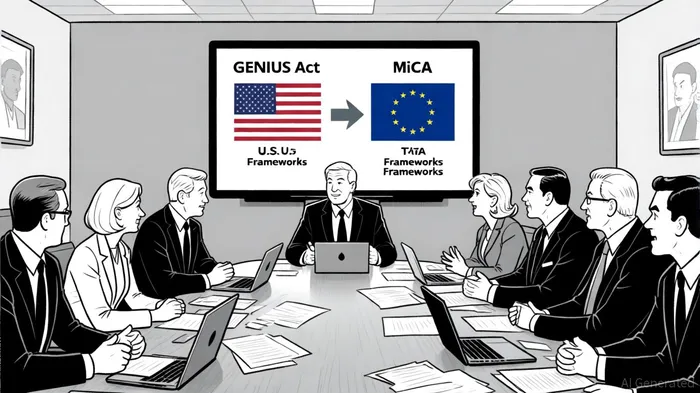





Comentarios
Aún no hay comentarios