
Strategic Positioning for Defense Contractors Amid Federal Budget Uncertainty: A 2025 Investment Analysis
The U.S. defense sector stands at a crossroads in 2025, navigating a landscape of fiscal restraint and strategic realignment. Federal budget cuts, geopolitical tensions, and shifting DoD priorities are reshaping the competitive dynamics for defense contractors. For investors, understanding how industry players are adapting to these pressures-and where opportunities lie-requires a nuanced analysis of historical trends, current strategies, and long-term projections.
Historical Context: Budget Cuts as a Catalyst for Resilience
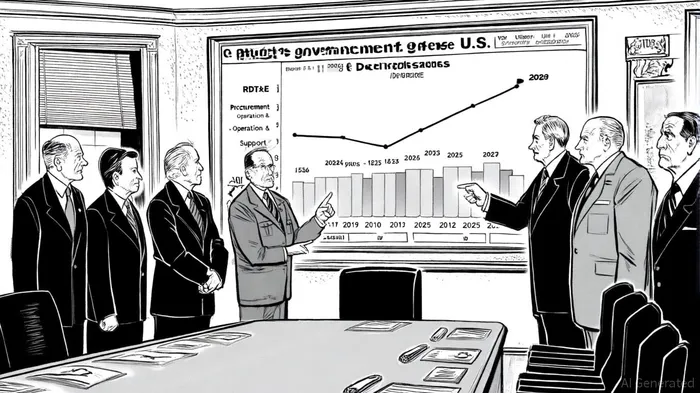
Federal budget adjustments between 2010 and 2025 have tested the adaptability of defense contractors. The FY2025 budget, totaling $850 billion, reflects a 1.7% reduction from FY2024 when adjusted for inflation, according to a CBO report. Despite this, defense spending has remained robust, with agencies increasingly outsourcing logistics, R&D, and weapons systems to private firms. This shift has allowed contractors to maintain revenue streams even amid broader fiscal constraints. For example, operation and support costs-driven by personnel and maintenance-accounted for 63% of the FY2025 budget, underscoring a reliance on contractors to fill gaps left by reduced federal workforces, according to GovCon Wire.
Long-term projections from the Congressional Budget Office (CBO) suggest defense costs will rise by 11% through 2039, with operation and support expenses outpacing growth in acquisition and infrastructure. This trajectory highlights a paradox: while budget cuts have occurred, they have also intensified demand for cost-effective, specialized solutions-a niche where defense contractors excel.
Strategic Positioning: Diversification, Innovation, and Partnerships
Defense contractors are responding to 2025's budgetary pressures with a mix of diversification, R&D investment, and strategic alliances. Key trends include:
Focus on High-Priority Modernization Areas
The FY2025 budget allocates $14.5 billion to cyberspace activities and $1.8 billion to AI initiatives, signaling a pivot toward technologies critical to future conflicts, as GovCon Wire notes. Contractors specializing in secure software development, threat detection, and autonomous systems are gaining traction. For instance, firms with expertise in AI-driven logistics or drone technology are aligning with Pentagon priorities like the "Golden Dome" missile defense shield and space dominance (FTI analysis).Supply Chain Resilience and Domestic Manufacturing
A $1.3 billion investment in industrial-based supply chain improvements aims to reduce reliance on foreign suppliers, particularly in microelectronics and semiconductors, according to GovCon Wire. This has created opportunities for firms with domestic manufacturing capabilities or partnerships with academic institutions and startups. The Office of Strategic Capital, funded with $144 million, further incentivizes private-sector collaboration to secure critical supply chains (GovCon Wire).Consolidation and Portfolio Rationalization
Prime contractors are divesting non-core assets to focus on capabilities aligned with DoD priorities. For example, companies with legacy programs facing cuts-such as outdated drones or armored vehicles-are pivoting toward AI, cybersecurity, or nuclear modernization (FTI). This reshuffling has also benefited smaller, specialized firms, with 8(a) and SDVOSB-certified contractors securing set-aside contracts amid increased competition (Fitch Ratings).Agility in Rapid Experimentation
The $450 million Rapid Defense Experimentation Reserve underscores the DoD's push for agile innovation. Contractors that can deliver scalable, rapid prototypes-such as modular weapon systems or AI-powered analytics tools-are gaining a competitive edge, notes GovCon Wire.
Risks and Opportunities for Investors
While the defense sector's resilience is well-documented, investors must weigh risks tied to budget uncertainty. The Pentagon's $50 billion in cuts over five years, directed by Secretary Pete Hegseth, could disrupt traditional programs like RDT&E and procurement, a Fitch Ratings analysis cautions. However, these cuts are redirecting funds toward high-growth areas, creating a "spending supercycle" in Europe and other regions as nations prioritize strategic autonomy, per GovCon Wire.
For investors, the key lies in identifying firms that:
- Align with DoD priorities (e.g., AI, cyber, supply chain security).
- Demonstrate agility in pivoting to emerging markets.
- Leverage partnerships or certifications (e.g., 8(a), HUBZone) to access contracts.
Conclusion: Navigating Uncertainty with Strategic Clarity
The 2025 defense budget reflects a sector in transition. While federal spending constraints persist, they are driving innovation and reshaping market dynamics in ways that favor adaptable, forward-looking contractors. For investors, the challenge is not to predict the next budgetary shift but to identify firms that are already positioning themselves to thrive in an era of strategic uncertainty.
As the defense industry evolves, one truth remains: in a world of geopolitical volatility and fiscal pragmatism, the ability to deliver value-whether through cutting-edge technology, resilient supply chains, or agile execution-will define the winners of the next decade.







Comentarios
Aún no hay comentarios