
Strategic Positioning in the AI Semiconductor Revolution: Navigating the $1 Trillion Opportunity by 2030
The global semiconductor industry is undergoing a seismic shift, driven by the explosive growth of artificial intelligence (AI) infrastructure. By 2025, the semiconductor market is projected to reach $700.9 billion, with AI-related chips accounting for over $150 billion in sales alone [1]. This represents a 11.2% year-over-year increase, fueled by surging demand for GPUs, CPUs, high-bandwidth memory (HBM), and advanced packaging technologies [2]. As the industry races toward a $1 trillion valuation by 2030, investors must strategically position themselves in the AI semiconductor ecosystem to capitalize on this unprecedented growth.
The AI Semiconductor Boom: A $459 Billion Future
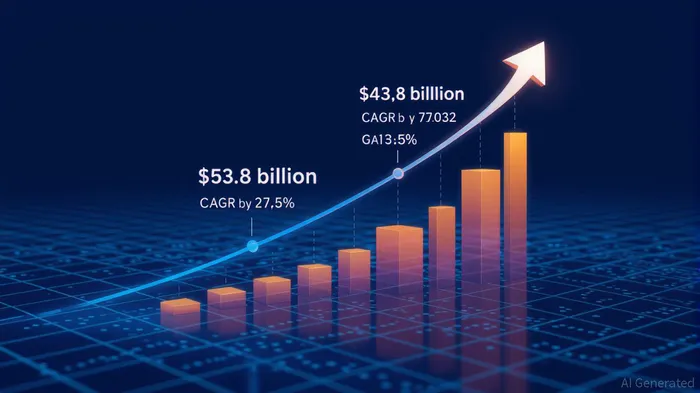
The AI-specific semiconductor market is already a $83.8 billion juggernaut in 2025, with a projected compound annual growth rate (CAGR) of 27.5% to reach $459 billion by 2032 [3]. This growth is underpinned by the proliferation of generative AI, which is expected to dominate 20% of total chip sales in 2024 and surge to $150 billion in 2025 [1]. Key drivers include the adoption of AI accelerators in data centers, edge computing, and consumer devices, with GPUs and TPUs leading the charge [3].
For investors, the CPU segment currently holds a 39.0% market share in AI chips, while the machine learning segment accounts for 36.0% [3]. However, the real opportunity lies in the rapid scaling of specialized AI hardware. Companies like NVIDIANVDA--, AMDAMD--, and BroadcomAVGO-- are already reaping the rewards of this shift, with NVIDIA’s H100 GPU and AMD’s Instinct series becoming cornerstones of AI infrastructure [2].
Regional Dynamics and Foundry Dominance
The Asia-Pacific region is emerging as the epicenter of AI semiconductor innovation. China, South Korea, and Taiwan are prioritizing domestic AI chip development through government initiatives, reducing reliance on foreign technology [3]. TSMCTSM--, the world’s largest foundry, is poised to dominate this landscape, with its market share expected to rise from 59% in 2023 to 66% in 2025 [2]. TSMC’s CoWoS advanced packaging technology, which enables high-performance computing (HPC) for AI, is a critical differentiator. Production capacity for CoWoS is set to double in 2025, driven by demand from NVIDIA, AMD, and AWS [2].
Strategic Sectors for Investment
- High-Bandwidth Memory (HBM): The memory segment is expected to surge by 24% in 2025, driven by HBM demand for AI accelerators [2]. Companies like Samsung and SK Hynix are leading HBM production, making them attractive long-term investments.
- Advanced Packaging: TSMC’s CoWoS and similar technologies are critical for AI workloads. Foundries with advanced packaging capabilities will see disproportionate growth.
- AI-Infused Consumer Devices: By 2025, 50% of PC shipments and 30% of smartphones will integrate AI capabilities [2]. Chipmakers supplying AI-enabled processors for these devices, such as IntelINTC-- and QualcommQCOM--, are well-positioned.
- AI-Driven Manufacturing: The semiconductor industry itself is adopting AI to optimize production. AI applications are reducing material losses and cutting production times, creating a flywheel effect for efficiency gains [4].
Risks and Mitigation
While the AI semiconductor boom is undeniable, investors must remain cautious. Supply chain bottlenecks, geopolitical tensions, and the high R&D costs of advanced node manufacturing pose risks. However, companies with strong R&D pipelines, diversified supply chains, and strategic partnerships (e.g., TSMC’s collaboration with AWS) are better equipped to navigate these challenges [2].
Conclusion
The AI semiconductor revolution is not a fleeting trend but a structural shift in global technology. With the industry on track to grow at 7.5%–9% annually until 2030 [3], strategic investments in AI-specific chips, advanced packaging, and AI-infused consumer devices will yield outsized returns. For investors, the key is to align with companies that are not only riding the AI wave but also shaping its trajectory.
**Source:[1] 2025 global semiconductor industry outlook [https://www.deloitte.com/us/en/insights/industry/technology/technology-media-telecom-outlooks/semiconductor-industry-outlook.html][2] Global Semiconductor Sales in 2025: A Record Breaking ... [https://www.microchipusa.com/industry-news/global-semiconductor-sales-in-2025-a-record-breaking-year-predicted?srsltid=AfmBOoqirAYEPNzFcoDCR-lDsHnJpwqKf5Vitt56TGMXjhePat6Vav3s][3] AI Chips Market Size, Share and Forecast, 2025-2032 [https://www.coherentmarketinsights.com/industry-reports/ai-chips-market][4] Semiconductors and Artificial Intelligence [https://irds.ieee.org/topics/semiconductors-and-artificial-intelligence]





Comentarios
Aún no hay comentarios