
Strategic Partnerships Power Rare Earth Recycling Revolution: A New Era for U.S. Supply Chain Security
The Magnets of Change: A Domestic Supply Chain Takes Shape
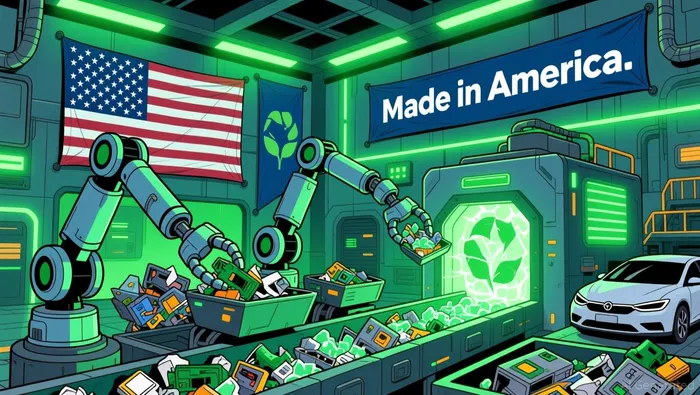
The partnership's vertical integration model-spanning rare earth separation (ReElement), magnet manufacturing (Vulcan), and U.S.-sourced equipment-creates a closed-loop system that mirrors the circular economy principles now central to U.S. policy, as noted in the DiscoveryAlert report. By recycling end-of-life products and leveraging domestic processing, , according to an ESI article) and the environmental toll of mining.
The financial implications are staggering. American Resources CorporationAREC-- (AREC), parent of ReElement, , according to a , signaling investor confidence in the scalability of recycling-driven value chains. , as detailed in the ESI article, which could reduce demand for mined lithium, nickel, , according to the same article.
China's Calculus: A Temporary Reprieve or a Strategic Pause?
While the U.S. builds its recycling infrastructure, , according to an Evrimagaci article. This one-year reprieve eases immediate supply chain pressures for U.S. defense contractors and EV manufacturers but masks a deeper strategic competition. , according to a Morningstar article) remains a vulnerability, prompting initiatives like Global Battery Materials-a joint venture between Canadian and South Korean firms-to establish an ex-China supply chain for anode materials, as described in the Morningstar article.
The U.S. response? A dual-pronged approach: securing alternative sources (e.g., Energy Fuels' Australian monazite sand partnership, as reported in an InvestorNews article) and accelerating domestic innovation. MP Materials' collaboration with the DoD, including a price floor guarantee and offtake agreements, is discussed in a StockTwits article, exemplifying how government-industry alliances can mitigate market risks while scaling production.
Private Sector Ingenuity: From Phoenix Tailings to Mining Schools
The private sector isn't just following the government's lead-it's innovating ahead of it. Phoenix Tailings, backed by BMW i Ventures, has developed a cost-competitive process to extract rare earth metals from mining waste and recycled materials, , according to a WebWire report. This breakthrough not only diversifies supply but also aligns with ESG mandates, creating a dual revenue stream from environmental remediation and mineral sales.
Meanwhile, workforce development is gaining traction. The proposed Mining Schools Act of 2025 aims to train a new generation of mineral engineers, addressing a critical bottleneck in scaling domestic production, as detailed in a Global Affairs report. This focus on human capital-often overlooked in tech-driven narratives-highlights the long-term nature of the U.S. strategy.
The Bottom Line: A Win-Win for Investors and National Security
For investors, the rare earth recycling sector offers a rare combination of geopolitical tailwinds and technical innovation. Companies like ReElement, Vulcan, and Phoenix Tailings are not just beneficiaries of government largesse-they're architects of a new industrial paradigm. The environmental benefits (reduced mining waste, lower carbon footprints, as noted in the ESI article) and strategic advantages (de-risking supply chains, according to the DiscoveryAlert report) create a durable moat that transcends short-term market cycles.
As the U.S. Geological Survey finalizes its 2025 Critical Minerals List, one thing is clear: the winners in this space will be those who master the art of collaboration-between public and private sectors, between old and new technologies, and between economic and environmental imperatives.





Comentarios
Aún no hay comentarios