
Strategic Partnerships Power U.S. Advanced Nuclear Energy Renaissance: A Path to Clean Energy and Infrastructure Returns
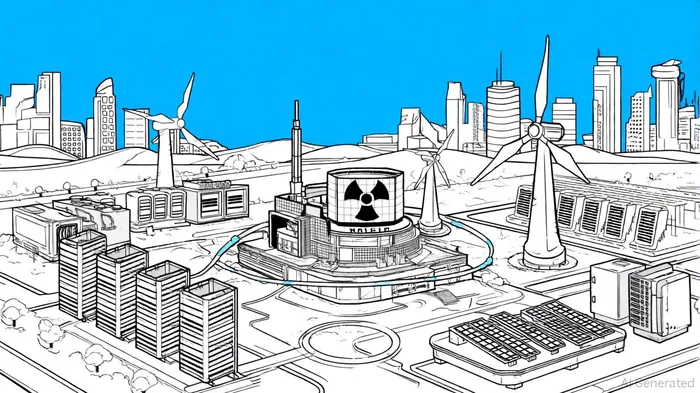
The U.S. advanced nuclear energy sector is undergoing a transformative phase, driven by strategic partnerships that are accelerating clean energy deployment and unlocking long-term infrastructure returns. From public-private collaborations to transatlantic alliances, these partnerships are addressing technical, financial, and regulatory barriers while aligning with the nation's decarbonization goals. As the energy transition gains momentum, investors and policymakers are increasingly recognizing nuclear energy's role in providing reliable, low-carbon power to support AI-driven economies and industrial growth.
Strategic Partnerships: A Catalyst for Deployment
Recent developments underscore the critical role of partnerships in scaling advanced nuclear technologies. The ADVANCE Act (2024) has streamlined licensing processes, enabling faster deployment of small modular reactors (SMRs) and advanced designs at brownfield sites[1]. For instance, NuScale Power became the first company to receive standard design approval for its 77 MWe SMR in May 2025, a milestone achieved through collaboration with the Department of Energy (DOE) and state regulators[1]. Similarly, Kairos Power's partnership with Google to deploy a 500 MW SMR fleet for AI data centers exemplifies how private-sector demand is driving innovation[1].
Transatlantic collaboration is also reshaping the landscape. The U.S. and U.K. renewed their Nuclear Regulatory Commission (NRC)-Office for Nuclear Regulation (ONR) memorandum of understanding (MOU) to harmonize regulatory frameworks, reducing review times for advanced reactor designs[1]. This alignment is critical for companies like Terrestrial Energy, which is leveraging international expertise to commercialize its Integral Molten Salt Reactor (IMSR) at Texas A&M University[1].
Financial Returns and Economic Impact
The economic potential of advanced nuclear projects is substantial. By 2035, cumulative capital investments in U.S. advanced nuclear could reach $220 billion, growing to $1.1 trillion by 2050 as deployment scales[2]. Strategic partnerships are mitigating financial risks through diversified funding models. For example, Amazon's Climate Pledge Fund invested $500 million in X-energy to develop advanced SMRs, while Meta issued a 4 GW request for proposals to secure nuclear power for its AI infrastructure[1]. These commitments provide developers with long-term power purchase agreements (PPAs), enhancing project bankability.
Public-sector support further amplifies returns. The DOE's Advanced Reactor Demonstration Program (ARDP) has allocated $64.89 billion in loan applications for projects like Holtec's Palisades restart and Microsoft-Constellation's Three Mile Island revival[3]. Additionally, the Inflation Reduction Act (IRA)'s tax credits have reduced the levelized cost of nuclear energy, making it competitive with renewables in deregulated markets[4]. However, challenges persist: restrictive provisions in H.R.1, such as Foreign Entity of Concern (FEOC) restrictions, could erase $19 billion in economic value from nuclear projects[4].
Infrastructure and Regional Synergies
Regional hubs are emerging as focal points for nuclear innovation. The Southeast, with its skilled workforce and existing regulatory infrastructure, is projected to generate $42.9 billion annually from advanced nuclear projects[5]. Texas's Fermi America Hypergrid—a 5,800-acre clean energy park with 4.4 GW of nuclear capacity—highlights how state incentives and private investment can coalesce to create scalable infrastructure[1]. Similarly, Michigan's $1.8 billion Palisades restart demonstrates the viability of revitalizing legacy assets to meet modern energy demands[1].
International partnerships are equally vital. Collaborations with South Korea and Japan are addressing supply chain gaps in high-assay low-enriched uranium (HALEU) production and reactor component manufacturing[5]. These alliances not only secure fuel supplies but also enhance U.S. competitiveness in global nuclear markets.
Challenges and the Road Ahead
Despite progress, hurdles remain. High capital costs and long construction timelines continue to deter investors, even with IRA incentives[4]. Regulatory clarity and continued federal support—such as the 25-year nuclear executive order aiming for 400 GW of capacity by 2050—are essential to sustain momentum[1]. Additionally, public-private risk-sharing mechanisms, like the DOE's site preparation initiatives, will be critical to achieving the 30-month deployment timeline set by Executive Order 14299[1].
Conclusion
The U.S. advanced nuclear renaissance is being propelled by strategic partnerships that bridge technological innovation, financial stability, and regulatory efficiency. As these collaborations mature, they are not only accelerating the deployment of clean energy but also generating robust infrastructure returns. For investors, the sector offers a unique opportunity to align with long-term decarbonization goals while capitalizing on the growing demand for reliable, scalable power. However, sustained policy support and international cooperation will be indispensable to realizing the full potential of this transformative energy pathway.





Comentarios
Aún no hay comentarios