
Strategic Partnerships and Fintech Innovation: Reshaping the Future of Cross-Border Payments
The cross-border payments landscape is undergoing a seismic shift, driven by strategic alliances between traditional financial institutions (FIs) and fintech innovators. These partnerships are not merely incremental improvements but foundational reimaginings of global financial infrastructure, leveraging technologies like blockchain, stablecoins, and AI to address long-standing inefficiencies. As demand for faster, cheaper, and more transparent international transactions grows-particularly in emerging markets-investors are witnessing a paradigm shift in how value is transferred across borders.
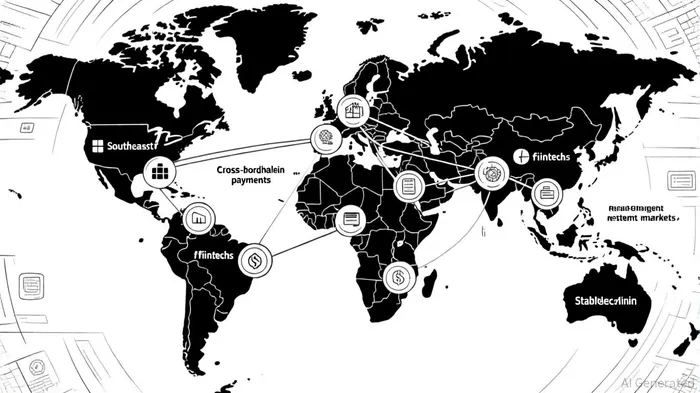
The Rise of Fintech-Backed Infrastructure Modernization
Traditional banks are increasingly collaborating with fintechs to modernize legacy systems. J.P. Morgan ChaseJPM--, for instance, implemented the ISO 20022 standard in 2023, enhancing interoperability and data quality in cross-border transactions. This move, coupled with AI-driven automation, enabled the firm to achieve a 99.3% straight-through processing (STP) rate for daily transactions across 120 currencies and over 200 countries, according to a J.P. Morgan report. Such advancements underscore the critical role of technology in reducing friction and operational costs.
Fintechs are also bridging gaps in real-time payments. Platforms like Banking Circle and VisaV-- Direct leverage local clearing rails to cut settlement times from days to minutes, while HSBC's partnership with Dandelion integrates real-time foreign exchange (FX) tracking, empowering businesses to manage currency risk dynamically, as described in a WNS analysis. These solutions are particularly transformative for small and medium-sized enterprises (MSMEs), which historically faced prohibitive fees and slow processing times.
Stablecoins and Blockchain: A New Era of Efficiency
Stablecoins-blockchain-based tokens pegged to fiat currencies-are emerging as a cornerstone of cross-border innovation. In 2025, 49% of firms in Asia cited market expansion as the primary driver for stablecoin adoption, leveraging the technology to facilitate high-volume trade flows, according to a Fireblocks report. For example, India and Singapore's bilateral payment linkage via QR codes (connecting UPI and PayNow) demonstrates how public-private partnerships can reduce costs and processing times, enabling near-instant transactions, per a CrossRiver insight.
Emerging markets are leading the charge. In Latin America, 71% of respondents use stablecoins for cross-border payments, while platforms like Obita-recently funded with $10 million-are optimizing capital flows for global trade and e-commerce in Southeast Asia and Africa, as reported by a CoinCentral report. Meanwhile, DP World's stablecoin initiative, spanning Singapore, India, and the UAE, aims to streamline transactions for businesses in underbanked regions, offering transparency and speed previously unavailable, according to a Further Africa report.
Regulatory progress is further legitimizing stablecoin use. The U.S. GENIUS Act and Europe's MiCA framework have provided clarity, enabling institutions like Visa to pilot stablecoin-based payments. Visa's program allows businesses to fund international transfers digitally, eliminating the need for pre-deposits in foreign bank accounts-a move that could free up billions in idle capital for multinational corporations, as covered in a Fintech Weekly article.
The Road Ahead: Challenges and Opportunities
Despite rapid adoption, challenges persist. Regulatory fragmentation and liquidity constraints remain barriers to universal integration. However, the G20 Roadmap for Cross-border Payments-aimed at achieving faster, cheaper, and more transparent transactions by 2027-provides a framework for global alignment, according to the FSB report. Meanwhile, agentic AI is automating workflows in fraud detection, dispute resolution, and budgeting, further enhancing efficiency, according to a BCG study.
Investors should also note the scalability of these innovations. In Q1 2025 alone, stablecoins processed $27.6 trillion in transactions, surpassing Visa's total volume, per an Analytics Insight report. With digital wallets projected to handle $25 trillion in transactions by 2027, the convergence of fintech and traditional finance is unlocking unprecedented opportunities in emerging markets, according to a Payments Consulting analysis.
Conclusion
Strategic partnerships between fintechs and FIs are not just modernizing cross-border payments-they are redefining the architecture of global finance. By prioritizing technologies like stablecoins, blockchain, and AI, these collaborations are addressing inefficiencies that have long hindered international trade and financial inclusion. For investors, the key takeaway is clear: the future of cross-border payments lies in hybrid ecosystems where innovation and regulation evolve in tandem. As emerging markets continue to drive adoption, the winners will be those who can scale solutions that balance speed, security, and compliance.







Comentarios
Aún no hay comentarios