
Strategic R&D Partnerships in the Electronics Industry: How Murata and Cadence Forge a Competitive Edge
In an era where technological complexity and time-to-market pressures dominate the electronics industry, strategic R&D partnerships have emerged as a cornerstone of competitive advantage. Murata Manufacturing and Cadence Design SystemsCDNS-- exemplify this trend through their collaboration, which integrates Murata's component libraries into Cadence's Electronic Design Automation (EDA) tools. This partnership not only accelerates design efficiency but also aligns with broader industry shifts toward AI-driven innovation and cloud-native workflows, positioning both firms to capture long-term value in high-growth markets.
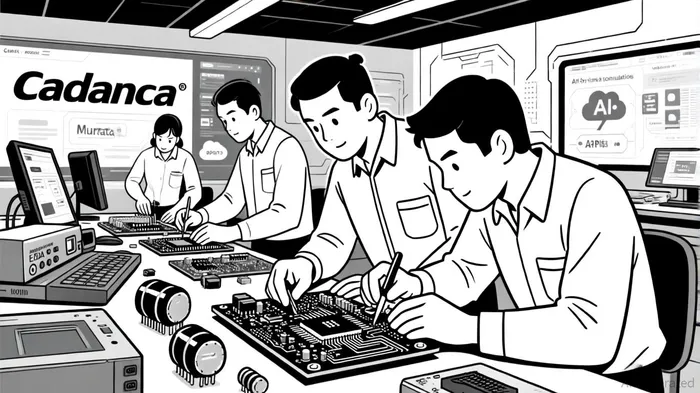
A Synergy of Expertise: Streamlining Design Workflows
Murata's integration of its product libraries into Cadence's OrCAD X Capture, Allegro X System Capture, and AWR Design Environment marks a significant leap in design automation. Engineers can now access Murata's static and dynamic models-ranging from 5,000 RF inductors to 24,000 multilayer ceramic capacitors (MLCCs)-directly within these tools, eliminating manual downloads and enabling real-time simulations, as described in Murata's pre-installed models. This integration reduces design iterations, enhances signal integrity, and ensures compliance with stringent noise suppression requirements in power supply and high-frequency applications, as highlighted by the Moriyama Innovation Center.
The partnership's value is further amplified by Murata's plan to automate model updates via API, ensuring designers always work with the latest component data, according to Murata Open. This proactive approach aligns with Murata's 2027 Mid-Term Direction, which emphasizes leadership in AI-driven electronics and edge computing. By embedding its components into Cadence's ecosystem, Murata strengthens its role as a solutions provider, bridging the gap between passive component design and system-level innovation.
Financial Strength and Market Resilience
Murata's financial health underscores its ability to sustain such strategic initiatives. For FY2023, the company reported a net profit margin of 25.4%, with passive components accounting for 55.2% of revenue, driven by robust demand in automotive electrification and AI hardware, according to Murata's financial health. Meanwhile, Cadence FY2024 results show revenue reached $4.641 billion, with a non-GAAP operating margin of 42.5%, reflecting its dominance in EDA and IP markets. The collaboration between these two firms is not merely technical but also financially symbiotic: Murata gains access to cutting-edge design tools, while Cadence benefits from Murata's market reach in automotive and industrial sectors.
The MLCC market, a critical segment for Murata, is also rebounding. Orders surged by 30.8% in Q1 2024, fueled by Chinese smartphone demand and EV adoption, as reported in MLCC orders surge. With the global MLCC market projected to reach $15.6 billion by 2028, Murata's competitive advantage in this space-bolstered by its R&D partnerships-positions it to capitalize on sustained growth, according to an EDA market analysis.
Industry-Wide Implications and Future Outlook
The EDA market itself is expanding rapidly, with a projected CAGR of 8.5% through 2030, driven by AI/ML accelerators and cloud-native workflows, as discussed in Forbes on Millennium M1. Murata's collaboration with Cadence aligns with these trends, particularly through the use of Cadence Managed Cloud Service, which improved engineering productivity by 10% in a recent automotive sensor project. This cloud-based approach democratizes access to high-end design tools, reducing capital expenditures for smaller firms and accelerating innovation cycles.
Moreover, the integration of AI into EDA tools-such as Cadence's Millennium M1 platform-enhances synthesis, placement, and routing processes, enabling better performance-per-watt metrics, according to an EDA market report. For Murata, this means its components are not just passive elements but integral nodes in AI-optimized systems, further solidifying its value proposition.
Conclusion: A Blueprint for Value Creation
Murata and Cadence's collaboration exemplifies how strategic R&D partnerships can drive competitive advantage through operational efficiency, market expansion, and technological leadership. By embedding Murata's components into Cadence's EDA tools, the partnership reduces design friction, accelerates product development, and aligns with AI and cloud trends. For investors, this synergy signals a durable moat: Murata's strong financials and Cadence's EDA dominance create a flywheel effect, where innovation in one domain fuels growth in another. As the electronics industry grapples with rising complexity, such alliances will likely define the next era of value creation.





Comentarios
Aún no hay comentarios