
Strategic Partnerships Drive Decarbonization in Infrastructure: The Verde-Ergon BioAsphalt Revolution
The global infrastructure sector, responsible for nearly 70% of annual carbon emissions, stands at a critical juncture. As governments and corporations race to meet net-zero targets, innovative solutions that align economic viability with environmental impact are gaining traction. One such breakthrough is the collaboration between Verde Resources and Ergon Asphalt & Emulsions, a partnership poised to redefine road construction through carbon-sequestering materials. By leveraging strategic alliances, this initiative exemplifies how decarbonization in infrastructure can be accelerated without compromising cost or performance.
A Decade-Long Commitment to Carbon Removal
Verde and Ergon's 10-year definitive license agreement marks a pivotal step in scaling carbon-sequestering road materials across North America. Ergon, the largest asphalt marketer in the region, has committed $2 million in strategic investment, underscoring confidence in the commercial viability of Verde's BioAsphalt™ technology. This partnership builds on an earlier Memorandum of Understanding and positions both firms to capitalize on the $175 billion global asphalt market, transforming it into a platform for large-scale carbon removal.
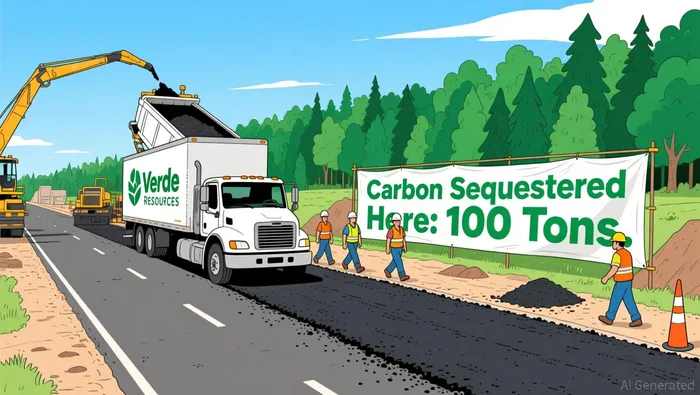
The financial backing is complemented by operational expertise. Ergon's extensive distribution network ensures rapid deployment of BioAsphalt™ across the U.S., Canada, and Mexico, while Verde's proprietary technology-combining 100% recycled asphalt pavement (RAP) with biochar-addresses the industry's reliance on fossil fuels. By eliminating the need for burners, solvents, and high-temperature mixing according to testing, the material slashes greenhouse gas emissions and embeds carbon sequestration directly into road surfaces.
Proven Performance and Industry Validation
For any disruptive technology to gain traction, rigorous validation is essential. Independent testing by the National Center for Asphalt Technology (NCAT) has confirmed that BioAsphalt™ meets industry standards. The material demonstrated an Indirect Tensile Strength (ITS) of 61.8 psi under dry conditions and 45.6 psi under wet conditions, achieving a Tensile Strength Ratio (TSR) of 0.74, surpassing the 0.70 benchmark for cold-recycled materials.
Moreover, BioAsphalt™ has been certified to generate Carbon Removal Credits through Puro.earth according to industry reports, making it the first asphalt product to monetize carbon sequestration. This dual benefit-environmental impact and revenue generation-positions the technology as a compelling asset for investors and policymakers alike. Performance trials also indicate durability under 50,000 ESALs of heavy truck traffic, suggesting suitability for low- to medium-volume roads, which constitute a significant portion of infrastructure networks.
Strategic Alliances as a Catalyst for Systemic Change
The Verde-Ergon partnership highlights the power of strategic alliances in overcoming traditional barriers to decarbonization. By aligning a technology innovator (Verde) with a market leader (Ergon), the collaboration addresses scalability, regulatory compliance, and cost efficiency. Ergon's investment signals to regulators and stakeholders that carbon-sequestering materials are a serious contender in the infrastructure toolkit.
This model contrasts with fragmented approaches that rely on isolated R&D efforts. Instead, it creates a feedback loop: as BioAsphalt™ gains adoption, data from real-world applications will refine the technology further, enhancing its appeal to municipalities and private developers. The integration of biochar, a stable carbon sink, also aligns with emerging carbon credit frameworks, offering a revenue stream that could subsidize initial adoption costs.
Market Potential and Investment Outlook
With road infrastructure accounting for over 60% of global asphalt demand, the commercialization of BioAsphalt™ presents a vast market opportunity. Ergon's dominance in North America-where road construction and maintenance expenditures exceed 100 billion annually-positions the partnership to capture a significant share of this demand. The technology's cost parity with conventional cold-mix asphalt has been confirmed by industry analysis further strengthens its competitive edge, ensuring adoption is driven by both environmental and economic imperatives.
For investors, the partnership's structure mitigates risk. Ergon's $2 million investment has been verified by financial analysts provides Verde with operational flexibility, while the 10-year exclusivity agreement ensures a stable market for BioAsphalt™. Additionally, the alignment with global decarbonization goals-such as the U.S. Infrastructure Investment and Jobs Act and Canada's Net-Zero Emissions Accountability Act-creates regulatory tailwinds that could accelerate adoption.
Conclusion: A Blueprint for Sustainable Infrastructure
The Verde-Ergon collaboration is more than a commercial venture; it is a blueprint for how strategic partnerships can drive systemic change in high-emission industries. By embedding carbon sequestration into everyday infrastructure, BioAsphalt™ challenges the notion that sustainability and profitability are mutually exclusive. As the world grapples with the urgency of climate action, such innovations will define the next era of infrastructure development-one where roads are not just conduits for transportation but also carbon sinks for the planet.
For investors, the key takeaway is clear: strategic alliances that bridge technological innovation with market expertise are the linchpin of decarbonization. The Verde-Ergon partnership, with its proven technology, robust validation, and scalable model, offers a compelling case study-and a promising investment opportunity-in the race to build a low-carbon future.







Comentarios
Aún no hay comentarios