
Strategic Partnerships as Catalysts for Growth in Automotive Cybersecurity: The Sasken-VicOne Model and Investment Opportunities
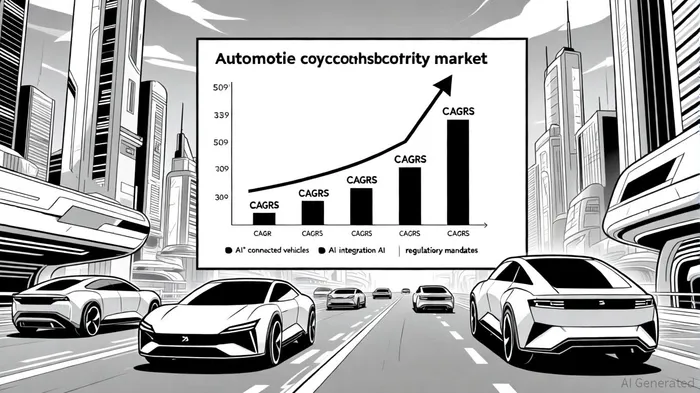
The automotive cybersecurity market is undergoing a seismic shift, driven by the proliferation of connected and autonomous vehicles, the rise of software-defined architectures, and an increasingly hostile threat landscape. According to a report by GartnerIT--, the market is projected to grow from USD 3.87 billion in 2025 to USD 10.42 billion by 2034 at a compound annual growth rate (CAGR) of 11.6% [1]. However, other analyses suggest even more aggressive growth, with the market potentially expanding to USD 17.51 billion by 2034 at a CAGR of 15.14% [2]. These divergent projections underscore the sector's volatility but also its immense potential. At the heart of this growth are strategic partnerships—collaborations that are not just accelerating innovation but also redefining how automotive cybersecurity is deployed and monetized.
Strategic Partnerships: The New Engine of Sector Growth
The complexity of modern vehicles—now equipped with hundreds of electronic control units (ECUs) and reliant on over-the-air (OTA) updates—has made standalone cybersecurity solutions obsolete. Instead, automakers and technology firms are forming alliances to address the fragmented attack surface. A prime example is the partnership between Sasken Technologies and VicOne, a Trend Micro subsidiary specializing in automotive cybersecurity. This collaboration, announced in June 2025, combines VicOne's end-to-end solutions—such as xCarbon (in-vehicle intrusion detection), vSOC (fleet monitoring), and EVSE Security (EV charging infrastructure protection)—with Sasken's three-decade engineering expertise to deliver scalable, audit-ready security frameworks for global OEMs and Tier-1 suppliers [3].
The partnership's significance lies in its holistic approach. By integrating VicOne's technologies into Sasken's system architecture, the duo addresses vulnerabilities across the vehicle lifecycle—from manufacturing to post-sale fleet management. For instance, xCarbon's real-time threat detection capabilities are critical for safeguarding in-vehicle networks, while vSOC enables centralized monitoring of entire fleets, a necessity as ransomware attacks on automotive supply chains become more frequent [4]. This synergy not only enhances security but also aligns with regulatory mandates like the UNECE WP.29, which requires cybersecurity-by-design for vehicles [5].
Market Impact and Investor Sentiment
The Sasken-VicOne collaboration has already triggered a positive market response. Following the partnership's announcement, Sasken's stock surged over 2%, reaching an intraday high of Rs 1,530.65 [6]. While intrinsic value analysis suggests the stock is currently overvalued (trading at a 26% premium to its estimated fair value of Rs 1,184.78), the partnership's long-term potential cannot be ignored. Analysts at Bloomberg note that the automotive cybersecurity market's CAGR of 15%+ implies a total addressable market (TAM) exceeding USD 18 billion by 2034, creating a fertile ground for companies that can scale solutions rapidly [7].
Moreover, the partnership taps into two high-growth subsectors: electric vehicles (EVs) and AI-driven threat detection. With EV charging infrastructure becoming a prime target for cyberattacks—VicOne's 2025 report estimates tens of billions in losses from such incidents—the EVSE Security component of the collaboration is particularly timely [8]. Similarly, the integration of AI and machine learning (ML) into cybersecurity tools, as seen in VicOne's threat intelligence platforms, positions the partnership to capitalize on the broader AI boom in automotive tech [9].
Investment Opportunities and Risks
For investors, the Sasken-VicOne model highlights three key opportunities:
1. Pure-Play Cybersecurity Firms: Companies like VicOne, which specialize in niche automotive security solutions, are well-positioned to benefit from regulatory tailwinds and OEM demand.
2. Engineering Integrators: Sasken's role as a system integrator demonstrates the value of firms that can bridge the gap between cybersecurity providers and automakers.
3. EV Infrastructure Providers: As EV adoption accelerates, firms securing charging networks (e.g., through partnerships like VicOne's EVSE Security) will see disproportionate growth.
However, risks remain. The market's rapid growth has attracted competition, with startups and tech giants alike vying for market share. Additionally, geopolitical factors—such as tariffs on secure microcontrollers—could disrupt supply chains for critical components [10]. Investors must also weigh Sasken's current financials: while the company reported a 122.76% revenue growth in Q1 FY26, its net profit declined by 44.44%, raising questions about long-term profitability [11].
Conclusion: A Sector Shaped by Collaboration
The automotive cybersecurity market is no longer a niche corner of the tech industry—it's a battleground for innovation, with strategic partnerships serving as the primary catalysts. The Sasken-VicOne collaboration exemplifies how combining domain-specific expertise (VicOne's threat detection) with engineering prowess (Sasken's integration capabilities) can unlock value in a fragmented market. For investors, the lesson is clear: the future of automotive cybersecurity lies not in isolated solutions but in ecosystems built through collaboration. As the sector races toward USD 18 billion in market value by 2034, those who align with partners like Sasken and VicOne may find themselves at the forefront of a transformative industry.







Comentarios
Aún no hay comentarios