
Strategic Partnerships as Catalysts for Blockchain Infrastructure and Token Utility Growth
Blockchain infrastructure has entered a new phase of innovation, driven notNOT-- just by technological advancements but by strategic partnerships that amplify validator ecosystem growth and token utility. As institutional and developer interest converges, the interplay between collaboration and tokenomics is reshaping the value proposition of decentralized networks. This analysis explores how targeted alliances are accelerating infrastructure development, enhancing token utility, and creating flywheels of growth for blockchain ecosystems.
Validator Ecosystems: The Infrastructure Flywheel
The validator layer of blockchain networks is no longer a technical afterthought but a strategic asset. Sol StrategiesSTKE-- Inc.'s $1B investment plan exemplifies this shift, with a $34 million allocation to raise its SolanaSOL-- (SOL) delegation to 2.9 million tokens. By acquiring validator nodes and collaborating with 3iQ for regulated staking solutions, the firm has not only bolstered Solana's security but also demonstrated how institutional capital can scale validator infrastructure. Such efforts are critical for networks like Solana, where high throughput and low latency depend on a robust, decentralized validator set.
Broader ecosystem growth is equally dependent on strategic partnerships. The State of Ecosystem Growth report highlights how projects like SuiSUI--, AvalancheAVAX--, and SyscoinSYS-- are leveraging grants, hackathons, and localized outreach to attract developers. For instance, Syscoin's Asia-Pacific partnerships increased wallet retention by 30%, underscoring the value of engaged communities over mere user numbers. These initiatives create a flywheel: stronger infrastructure attracts developers, who build tools that further enhance the network, drawing more users and capital.
Token Utility: From Speculation to Substance
Token utility has evolved from a buzzword to a foundational element of sustainable blockchain ecosystems. A utility-first approach ensures tokens are not just speculative assets but functional components of decentralized applications. Ethereum's governance tokens and Filecoin's storage incentives are classic examples, but newer models are emerging through partnerships, as outlined in the Token Utility Framework.
Verasity (VRA) illustrates this trend. By integrating its Proof of View (PoV) system into Carbon Browser and expanding VeraWallet to support EthereumETH-- and BNBBNB-- Smart Chain, the project has enhanced $VRA's cross-chain utility, as noted in Verasity updates. Collaborations with entities like the MEW memecoinMEME-- and Eclipse L1 protocol further diversify its use cases, offering discounts on NFT presales and fostering community engagement. These partnerships transform $VRA from a passive token into a gateway for Web3 participation.
Tokenomics models are also being reimagined. XDC Network's proposed XDC 2.0 upgrade introduces validator NFTs and decentralized governance, aiming to boost staking liquidity. Meanwhile, AI networks are experimenting with contribution-based reward systems, where tokens incentivize data sharing or computational work, as described in AI tokenomics models. Such innovations align economic incentives with network health, ensuring tokens remain central to ecosystem activity.
Strategic Scarcity and Institutional Legitimacy
Strategic partnerships also enhance token credibility by signaling legitimacy to institutional investors. Binance Coin (BNB) and Ethereum's EIP-1559 burns demonstrate how scarcity management-when paired with utility-can drive value. Similarly, Verasity's collaboration with 3iQ for an ETF staking solution provides a regulated pathway for institutional participation, bridging the gap between decentralized infrastructure and traditional finance.
However, challenges persist. Scalability, regulatory compliance, and economic sustainability remain hurdles for tokenomics models. Projects that prioritize adaptive supply mechanisms and real-world use cases, such as ethical AI compliance tokens, are better positioned to navigate these risks (these themes are explored in the Medium piece referenced above).
Conclusion: The Investor Imperative
For investors, the lesson is clear: blockchain ecosystems that combine strategic partnerships with robust tokenomics are outpacing peers. Validator infrastructure growth and token utility are no longer siloed; they are interdependent forces. Projects like SolSOL-- Strategies, Verasity, and XDC demonstrate that collaboration-whether with institutional players, developers, or cross-chain platforms-can unlock exponential value. As the industry matures, those who prioritize these synergies will define the next era of blockchain innovation.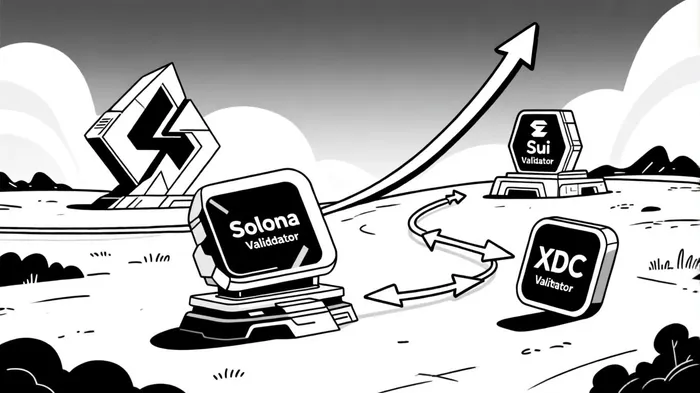





Comentarios
Aún no hay comentarios