
The Strategic Partnership Between NVIDIA and Intel: A Catalyst for AI and PC Market Disruption
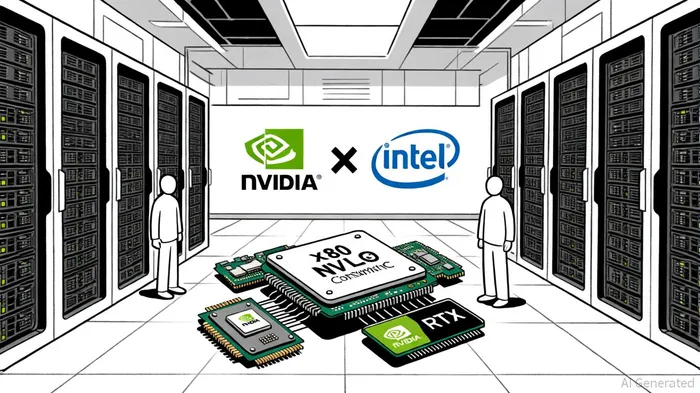
The strategic partnership between NVIDIANVDA-- and IntelINTC--, announced in September 2025, marks a pivotal moment in the convergence of AI infrastructure and consumer computing. By combining NVIDIA's AI and accelerated computing expertise with Intel's x86 ecosystem and manufacturing capabilities, the two tech giants are poised to redefine the computing landscape. This collaboration, supported by a $5 billion investment from NVIDIA into Intel, signals a bold move to accelerate AI adoption across hyperscale, enterprise, and consumer markets while challenging existing industry dynamics [1].
Technical Synergy: Bridging AI and Consumer Computing
At the core of this partnership is the integration of NVIDIA's NVLink technology with Intel's x86 architecture. Intel will design and manufacture custom data center CPUs optimized for NVIDIA's AI infrastructure platforms, enabling faster communication between CPUs and GPUs for AI workloads [2]. For consumer computing, Intel will develop x86 system-on-chips (SOCs) that incorporate NVIDIA RTX GPU chiplets, creating a new generation of PCs with unprecedented CPU-GPU integration [3]. This technical alignment addresses a critical gap in the market: the need for seamless, high-performance solutions that bridge AI-driven data centers with consumer-grade hardware.
NVIDIA's NVLink, a high-speed interconnect technology, will play a central role in this collaboration. By enabling direct, low-latency communication between Intel CPUs and NVIDIA GPUs, NVLink eliminates bottlenecks that have historically hindered AI performance [4]. For example, Intel's recent demonstrations of running large AI models like DeepSeek R1 on standard Xeon processors—combined with optimizations such as Flash Attention—highlight the potential for CPU-based AI solutions to compete with GPU-centric alternatives [5]. This could democratize access to AI, reducing deployment costs for smaller organizations and expanding the market for AI-driven applications.
Financial Implications: A Win-Win for NVIDIA and Intel
NVIDIA's $5 billion investment in Intel is more than a financial transaction—it is a strategic bet on the future of computing. For NVIDIA, this partnership extends its ecosystem beyond GPUs into integrated CPU-GPU solutions, aligning with its broader vision of dominating the AI infrastructure stack [6]. Intel, meanwhile, gains a significant capital injection to bolster its R&D and manufacturing capabilities, particularly for its next-generation 14A process technology [7]. This financial support is critical for Intel, which has faced declining revenue and market share in recent years compared to NVIDIA's explosive growth [8].
The partnership also reshapes competitive dynamics. NVIDIA's CUDA platform, already the gold standard for AI development, will now be embedded in Intel's x86 ecosystem, creating a unified stack that could outperform existing solutions from AMDAMD-- and TSMCTSM-- [9]. Intel's ability to produce cost-effective AI solutions using standard CPUs—demonstrated in recent trials—further threatens NVIDIA's dominance in the AI processor market [10]. However, NVIDIA's investment ensures that both companies remain aligned, mitigating the risk of fragmentation in their joint offerings.
Market Disruption: Reshaping AI and Consumer Computing
The collaboration's impact extends beyond technical and financial metrics. By integrating AI into consumer PCs, NVIDIA and Intel are accelerating the convergence of enterprise-grade AI with everyday computing. For instance, SOCs with RTX GPU chiplets could enable AI-powered features such as real-time language translation, personalized content generation, and advanced gaming analytics in mainstream PCs . This shift mirrors the broader trend of AI becoming a commodity, embedded in hardware rather than confined to specialized data centers.
In the enterprise and hyperscale sectors, the partnership could disrupt traditional supply chains. Intel's custom CPUs, optimized for NVIDIA's AI infrastructure, may reduce reliance on third-party components, streamlining deployment for cloud providers and enterprises . Additionally, the adoption of liquid-cooled data centers and agentic AI—autonomous systems that leverage multiple language models—could redefine how businesses approach AI workloads . Analysts predict that this collaboration will drive a 15–20% increase in AI adoption rates across industries by 2026 .
Investment Outlook: Strategic Risks and Opportunities
While the partnership presents significant upside, investors must weigh potential risks. Intel's historical struggles with innovation and market share could delay the realization of joint products, particularly if manufacturing challenges arise with the 14A process . Additionally, NVIDIA's reliance on Intel for CPU production introduces supply chain vulnerabilities, especially in a geopolitical climate marked by chip shortages and trade restrictions.
Conversely, the partnership offers long-term growth opportunities. NVIDIA's investment positions it as a key stakeholder in Intel's future, ensuring alignment in R&D priorities and market strategies . For Intel, the collaboration provides a lifeline to re-enter the AI race, leveraging NVIDIA's ecosystem to regain relevance in a market it has ceded to competitors .
Conclusion
The NVIDIA-Intel partnership represents a seismic shift in the AI and computing industries. By merging their strengths in AI infrastructure and x86 ecosystems, the two companies are not only addressing technical bottlenecks but also redefining the competitive landscape. For investors, this collaboration offers a compelling case for long-term growth, albeit with risks tied to execution and market adoption. As AI becomes increasingly embedded in both enterprise and consumer technologies, the success of this partnership could determine the next era of computing.





Comentarios
Aún no hay comentarios