
The Strategic Partnership Between Kodiak and Bosch: A Catalyst for Scalable Autonomous Trucking
The autonomous trucking industry is at a pivotal inflection point, with technological advancements and strategic alliances accelerating the transition from pilot programs to commercial viability. Among the most significant developments in 2025-2026 is the collaboration between KodiakKDK-- Robotics and Bosch, a partnership that has positioned both companies to address critical challenges in production scalability, supply-chain robustness, and first-mover advantage. By integrating Bosch's hardware expertise with Kodiak's AI-driven autonomous systems, projected by 2034.
Production Scalability: Modular Integration and Mass Production
A core strength of the Kodiak-Bosch collaboration lies in its ability to scale autonomous trucking at production speed. Bosch's role in supplying redundant sensors, steering systems, and other critical components ensures that Kodiak's autonomous platform can be seamlessly integrated into both new and retrofitted Class 8 trucks. This modularity is critical for addressing the diverse needs of logistics providers, as it allows the same autonomous system to be deployed across different vehicle platforms without requiring extensive re-engineering according to industry reports.
To further accelerate production, Kodiak partnered with Roush Industries, a contract manufacturer with expertise in upfitting commercial vehicles. By establishing a dedicated production line at Roush's Livonia, Michigan, facility, . , marking a milestone in transitioning from prototype to commercial deployment according to company announcements.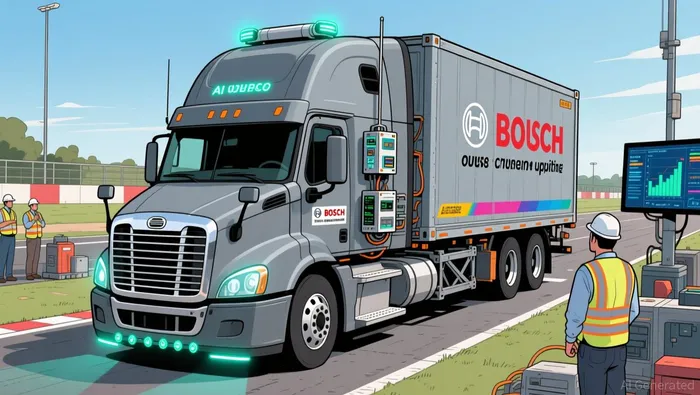 This partnership, combined with Bosch's supply of -compliant components, ensures that Kodiak's systems meet rigorous safety standards while maintaining cost efficiency at scale as reported in company updates.
Supply-Chain Robustness: Strategic Partnerships and Redundancy
The partnership also addresses supply-chain vulnerabilities by leveraging Bosch's global manufacturing network and established supplier relationships. Bosch's involvement provides access to high-quality, production-grade components such as advanced radar systems and steering technologies, which are essential for operating in adverse weather conditions and complex environments. Additionally, Kodiak's integration of 's ISO 26262-compliant processors and 's redundant steering systems further enhances system reliability, reducing the risk of component shortages or performance bottlenecks as detailed in company reports.
This layered approach to supply-chain management is particularly critical in the autonomous trucking sector, where even minor disruptions can delay deployments. By diversifying its supplier base and prioritizing redundancy in safety-critical systems, Kodiak has mitigated risks associated with single points of failure. For instance, the company's collaboration with Verizon Business ensures robust connectivity for remote monitoring and real-time data transmission, a necessity for managing fleets in remote areas like the Permian Basin.
First-Mover Advantage: Real-World Deployments and Revenue Generation
Kodiak's first-mover advantage is underscored by its early commercial deployments and innovative business models. By late 2024, the company had already launched 10 driverless trucks in the Permian Basin, delivering frac sand for Atlas Energy Solutions under a "Driver-as-a-Service" model. , generating revenue while refining operational data and safety protocols. This real-world experience has given Kodiak a significant edge over competitors still in testing phases.





Comentarios
Aún no hay comentarios