
The Strategic Partnership Between Aner Financial and Obligate: Unlocking Trade Finance Liquidity for Global Commerce
The global trade finance landscape in 2025 is defined by a stark dichotomy: while emerging markets account for over 90% of global trade volume, they face a staggering $2.5 trillion financing gap. This gap, exacerbated by geopolitical tensions, supply chain disruptions, and the dominance of dollar-centric financial systems, has left small and medium-sized enterprises (SMEs) in developing economies starved of liquidity. Against this backdrop, strategic partnerships between fintech innovators and traditional financial institutions are emerging as critical catalysts for change. The collaboration between Aner Financial and Obligate-though shrouded in limited public detail-reflects a broader trend of leveraging technology to bridge this divide. By analyzing the mechanics and implications of such partnerships, this article assesses the investment potential of fintech-driven trade finance solutions in emerging markets.
The Mechanics of Fintech-Driven Trade Finance
Trade finance has long relied on the infrastructure of global banking systems, but the 2025 landscape demands a paradigm shift. As Jaime López Heredia of Traydstream notes, digitalization is no longer about automating legacy processes but building interconnected ecosystems involving banks, corporates, and fintechs. Aner Financial and Obligate's partnership, while not explicitly detailed, aligns with this ethos. For instance, the IFC and HSBC's $1 billion risk-sharing facility-launched in late 2024-exemplifies how such collaborations operate. By pooling resources and sharing risks, these partnerships enable emerging market banks to extend credit to SMEs while attracting international investors seeking yield in high-growth regions.
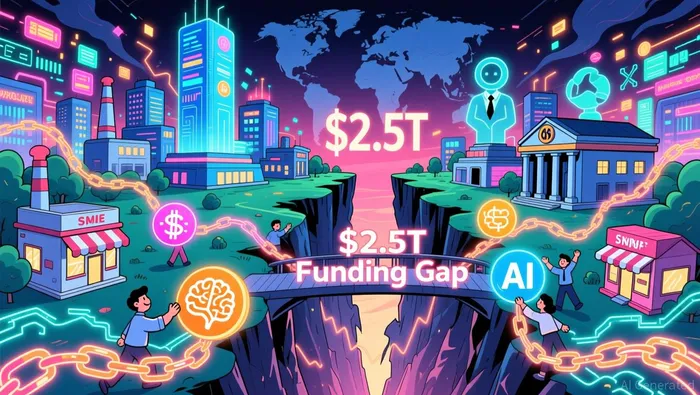 The impact of such mechanisms is profound. In Q3 2025, EM local currency debt returned over 11% annually, driven by rate cuts, dollar weakness, and improved investor sentiment. This performance underscores the viability of trade finance as a tool to unlock liquidity. For example, the IFC-HSBC initiative supports 20 countries across Africa, Asia, and Latin America, directly addressing the $2.5 trillion gap by providing guarantees for trade-related assets. Similarly, Aner and Obligate's fintech-driven approach likely integrates blockchain and AI-driven credit scoring, and real-time cross-border payment systems to reduce transaction costs and counterparty risks.
Investment Potential: A Sector at Inflection Point
The investment case for fintech-enabled trade finance in emerging markets rests on three pillars: scale, resilience, and alpha generation.
Scale: The $2.5 trillion gap represents a vast untapped market. With over 90% of global trade dependent on financial infrastructure, even incremental improvements in liquidity access could yield exponential economic returns. For instance, the IFC-Crédit Agricole CIB $2 billion partnership-announced in 2025-targets SMEs in low-income economies, where limited access to finance stifles growth. By replicating such models, Aner and Obligate could tap into a market segment with high elasticity.
Resilience: Emerging markets are increasingly adopting market-friendly policies to attract trade finance. Financially fragile economies are liberalizing regulations, while stronger ones are loosening fiscal constraints according to IMF analysis. This creates a dual-layered opportunity: fintech platforms can serve both risk-on and risk-off environments. For example, Schroders projects a 12-month return of over 11% for diversified EM local debt portfolios, buoyed by real yields and dollar depreciation.
Alpha Generation: The sector's asymmetry between supply and demand creates alpha opportunities. As of Q3 2025, EM debt saw $7 billion in hard currency inflows and $4.3 billion in local currency inflows, reflecting sustained investor appetite. Fintech-driven solutions, by reducing information asymmetry and operational friction, position investors to capture these flows more efficiently. For instance, digital platforms that automate documentation and compliance can cut transaction costs by up to 40%, as seen in Asia-Pacific banks like UOB.
Risks and Mitigants
While the upside is compelling, risks persist. Geopolitical tensions remain tail risks, such as U.S.-China trade negotiations and regional conflicts. Additionally, the dominance of the U.S. dollar ties many EM economies to external financial cycles they cannot control. However, partnerships like those between Aner, Obligate, and their peers mitigate these risks through diversified funding sources and localized risk assessments. For example, the IFC's Global Trade Liquidity Program (GTLP) has supported $80 billion in trade volume across 30,000 transactions, demonstrating scalability and risk management rigor.
Conclusion: A Strategic Imperative for Investors
The convergence of fintech innovation and strategic partnerships is redefining trade finance in emerging markets. While direct data on Aner Financial and Obligate's collaboration remains sparse, the broader sector's momentum-evidenced by $1 billion+ initiatives from IFC, HSBC, and others-signals a maturing ecosystem. For investors, this represents a unique window to capitalize on a market where liquidity constraints are being systematically dismantled. As UNCTAD emphasizes, modernizing trade rules and financial systems is no longer optional but imperative. Those who align with this shift-through fintech-enabled trade finance-stand to benefit from both economic growth and financial returns in an increasingly interconnected world.





Comentarios
Aún no hay comentarios