
Strategic Outperformance in the S&P 500: Earnings Resilience and Market Positioning in a Diversified Landscape
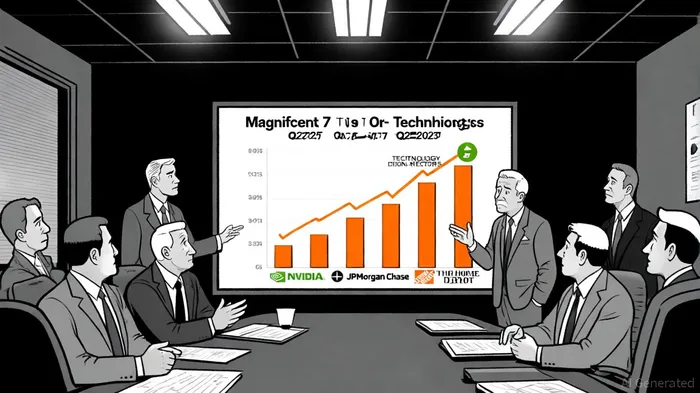
The S&P 500's resilience in 2025 has been defined by a dual narrative: the stratospheric performance of the "Magnificent 7" tech giants and a gradual but meaningful broadening of earnings strength across non-technology sectors. As investors navigate a landscape marked by tariffs, policy uncertainty, and shifting demand, companies demonstrating strategic adaptability-whether through AI-driven innovation, supply chain reengineering, or sector-specific expertise-are emerging as prime candidates for S&P 500 inclusion and long-term outperformance.
The Magnificent 7: Sustaining Dominance Amid Diminishing Margins
The Magnificent 7-Apple, MicrosoftMSFT--, AmazonAMZN--, Alphabet, MetaMETA--, NVIDIANVDA--, and Tesla-continue to anchor the S&P 500's performance, accounting for 34% of its market value as of August 2025, according to a Fool analysis. Their Q2 2025 earnings growth of 26.4% year-over-year, per Home Depot's Q3 2022 report, far outpaced the 7% growth of the remaining 493 S&P 500 companies, underscoring their outsized influence. NVIDIA, for instance, capitalized on surging demand for AI accelerators, while Microsoft's cloud division benefited from AI integration and server deployments, as detailed in an S&P 500 earnings report. However, analysts project a moderation in their growth rates, with expected EPS increases of 9.5% to 11.2% for Q3 2025 through Q1 2026, according to the same report. This signals a potential shift in market dynamics, where the Magnificent 7's dominance may no longer be sufficient to drive the index alone.
Beyond Tech: Earnings Resilience in Industrials, Financials, and Consumer Discretionary
While the Magnificent 7 dominate headlines, non-technology sectors are gaining traction as engines of earnings resilience. In Q2 2025, 80.3% of S&P 500 companies exceeded EPS estimates, according to a MarketMinute article, with sectors like Industrials, Financials, and Consumer Discretionary showing particular strength.
Industrials: Electrification and Supply Chain Adaptation
PACCAR Inc. (PCAR), a leader in commercial truck manufacturing, exemplifies this trend. Despite a 35.5% decline in Q3 2025 EPS compared to the prior year (noted by the Fool analysis), the company's focus on electrification and connected vehicle technologies positions it for long-term growth. Its projected 56.4% earnings growth rate (also highlighted by the Fool analysis) reflects confidence in its ability to navigate macroeconomic headwinds through innovation. Similarly, aerospace and defense firms within the Industrials sector have offset weaknesses in machinery and airlines, driven by sustained government spending and global logistics demands, as covered in the S&P 500 earnings report.
Financials: Navigating Rate Cycles and Regulatory Tailwinds
JPMorgan Chase (JPM) and Goldman Sachs (GS) have demonstrated resilience amid fluctuating interest rates and regulatory shifts. JPMorgan's Q2 2025 results exceeded estimates, with EPS of $4.96 and revenue of $44.91 billion, according to the MarketBeat earnings page, while Goldman Sachs reported a 12.8% annualized return on common equity and $14.6 billion in net revenues in the MarketMinute article. Both firms are benefiting from declining interest rates and a strategic pivot toward AI-driven services. Additionally, the One Big Beautiful Bill Act (OBBBA), expected to lower corporate tax rates, provides a tailwind for financials, particularly small-cap players (as noted on the MarketBeat page).
Consumer Discretionary: Tariff Mitigation and Diversified Demand
The Home Depot (HD) has maintained its dominance in the home improvement sector, reporting $45.3 billion in Q2 2025 revenue-a 4.9% year-over-year increase, as documented in the Fool analysis. Its 52.36% market share in home improvement (reported on MarketBeat) underscores its ability to adapt to tariffs and shifting consumer preferences. Meanwhile, Tesla's expansion into energy storage and automotive software, coupled with Nike's focus on premium product lines, highlights the sector's capacity for innovation-driven growth, a trend reinforced by the MarketMinute article.
Home Depot's historical performance further reinforces its resilience. In Q3 2022, for instance, the company exceeded expectations with $38.87 billion in sales (vs. $38.01 billion consensus) and $4.24 EPS (vs. $4.13 consensus), per the MarketBeat earnings page. Following this earnings beat, HD's stock surged to an all-time high of $420.61 within 13 trading days, according to the stock reaction, though it later declined 1.1% as the company reaffirmed cautious guidance. This pattern underscores how strong earnings can drive short-term momentum, even amid tempered long-term expectations.
Strategic Implications for Investors
The S&P 500's earnings landscape is evolving. While the Magnificent 7 remain critical, their narrowing margins and the broader market's diversification necessitate a balanced approach. Investors should prioritize companies with:
1. Sector-Specific Expertise: Firms like PACCAR and The Home Depot, which leverage industry-specific strengths to mitigate macro risks.
2. Operational Flexibility: Companies such as JPMorgan and Goldman Sachs, which adapt to rate cycles and regulatory changes.
3. AI and Technology Integration: Even non-tech firms, like those in Industrials and Financials, are increasingly adopting AI to enhance margins and efficiency, as noted in the S&P 500 earnings report.
Conclusion
The path to S&P 500 inclusion and strategic outperformance in 2025 lies in a dual focus: capitalizing on the Magnificent 7's innovation-driven growth while diversifying into resilient non-technology sectors. As earnings reports highlight a broadening of corporate performance, investors who balance exposure to tech leadership with sector-specific depth will be best positioned to navigate the index's next phase of evolution.





Comentarios
Aún no hay comentarios