
Strategic Optimism and Market Confidence: Analyzing Insider and Private Shareholder Dynamics at Press Metal Aluminium Holdings Berhad
The recent 3.2% increase in private shareholder holdings at Press Metal Aluminium Holdings Berhad (KLSE: PMETAL) has sparked renewed interest in the company's strategic direction and market positioning. This surge, occurring amid a broader consolidation of ownership by private entities, underscores the significance of shareholder behavior as a signal of confidence—or caution—for investors. While the exact entities and timing of the 3.2% rise remain opaque, the broader ownership structure and corporate developments provide critical insights into the company's trajectory.
Ownership Concentration and Strategic Influence
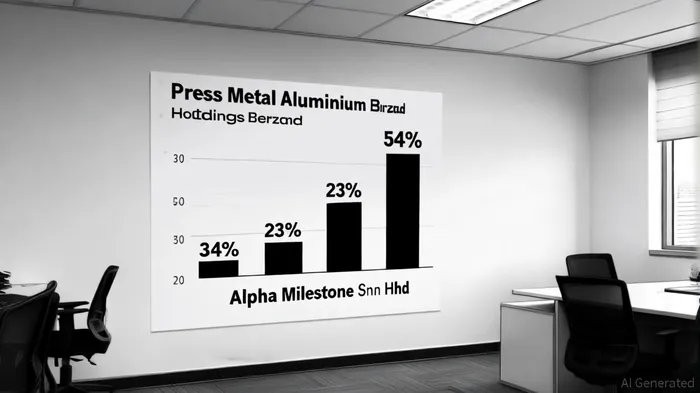
Press Metal Aluminium Holdings Berhad's ownership is highly concentrated, with private companies holding 34% of the shares outstanding and the top four shareholders collectively controlling 54% of the company[1]. Alpha Milestone Sdn Bhd, the largest private entity, owns 34% of the shares, while Poh Koon, a senior executive and second-largest shareholder, holds 7.7%[1]. This concentration implies that strategic decisions are heavily influenced by a small group of stakeholders, whose alignment with management can either stabilize or destabilize the company's operations.
The recent 3.2% increase in private holdings—though not explicitly tied to specific entities—suggests that key shareholders are doubling down on their positions. Such moves often signal confidence in the company's long-term prospects, particularly in sectors like aluminum, where global demand remains resilient. According to a report by Bloomberg, private investors in industrial sectors frequently adjust stakes based on macroeconomic trends and cost advantages, such as Press Metal's long-term energy contracts[2].
The 3.2% Surge: A Confidence Signal?
While the sources do not specify which private entities drove the 3.2% increase, the broader trend of private ownership rising to 34% by 2025 indicates a strategic realignment. This could reflect efforts to consolidate control or capitalize on undervalued assets. For instance, Press Metal's stake in Nanshan Aluminium International Holdings Ltd, which contributes to its estimated $5.1 billion net worth[3], may have attracted private investors seeking exposure to China's aluminum market.
However, the absence of granular data on the 3.2% increase—a gap noted in multiple sources[4]—limits the ability to assess the motivations of specific entities. That said, the fact that private companies now hold the largest single stake (34%) compared to institutional or retail investors suggests a deliberate strategy to influence corporate governance and operational decisions[1].
Insider Activity and Market Sentiment
Insider transactions, a traditional barometer of corporate health, remain inconclusive. As of September 2025, no data was available to determine whether insiders had net purchased shares in the past three months[5]. This opacity contrasts with the recent resignation of Puan Noor Alina Binti Mohamad Faiz, an independent director and chairman of the Remuneration Committee, effective August 29, 2025[6]. While such changes are routine, they may signal internal realignments that could affect investor sentiment.
The lack of insider buying activity, however, does not necessarily indicate pessimism. Insiders may prefer to act discreetly or through secondary markets, and their existing 23% stake already aligns them closely with long-term value creation[1]. Retail investors, who hold 22% of the shares, may find it challenging to influence decisions without coordination with larger stakeholders, but the stability of insider ownership could provide reassurance in volatile markets.
Implications for Retail Investors
For retail investors, the 3.2% increase in private holdings and the concentrated ownership structure present both opportunities and risks. On the positive side, the alignment of private entities and insiders with management suggests a coherent strategy, potentially reducing operational volatility. The company's strong ESG profile and cost advantages, as highlighted by analysts[7], further support its appeal to long-term investors.
However, the dominance of private shareholders also means that retail investors have limited influence over major decisions. This dynamic could lead to price swings if private entities adjust their stakes, as seen in August 2025 when Poh Koon reduced his direct holdings by disposing of 9 million shares[8]. Retail investors should monitor such transactions closely, as they may precede broader market movements.
Conclusion
The 3.2% rise in private shareholder holdings at Press Metal Aluminium Holdings Berhad, while not fully transparent in its specifics, reflects a broader trend of strategic consolidation. The company's ownership structure, dominated by private entities and insiders, signals confidence in its operational resilience and growth potential. For retail investors, the key lies in balancing optimism with caution—leveraging the stability of aligned stakeholders while remaining vigilant to shifts in private ownership. As the aluminum sector navigates global demand and supply chain dynamics, Press Metal's ability to maintain its cost advantages and governance stability will be critical to unlocking value for all shareholders.







Comentarios
Aún no hay comentarios