
Strategic Opportunities in Global Energy Markets Amid Disruption: Assessing the Geopolitical and Economic Impacts on Russian Energy Exports in October 2025
The Sanctions and Immediate Market Reactions
The U.S. sanctions, coordinated with the EU and UK, targeted the core infrastructure of Russian oil and gas exports, effectively cutting off access to Western financial systems and imposing secondary penalties on foreign entities facilitating Russian trade, according to a Jordan News analysis. By October 2025, Russian oil exports had dropped to 7.3 million barrels per day, a decline driven by compliance risks for Indian and Chinese refiners, which previously accounted for 3.6 million barrels per day of Russian crude, as the Jordan News report noted. India, once the largest buyer of discounted Russian oil, announced reduced purchases, while China's cautious approach-amid economic slowdown and high stockpiles-further strained Moscow's ability to secure buyers, according to the same report.
The ripple effects were immediate. Asian oil prices surged by over 5%, with Brent crude climbing above $64 per barrel as markets anticipated tighter supply, the Jordan News analysis reported. Meanwhile, Russia's intensified drone attacks on Ukraine's energy infrastructure-destroying over half of its pre-war generating capacity-added volatility, prompting Ukraine to fortify 100 critical energy sites ahead of winter, as EuroMaidan Press reported.
Market Adaptations and Emerging Opportunities
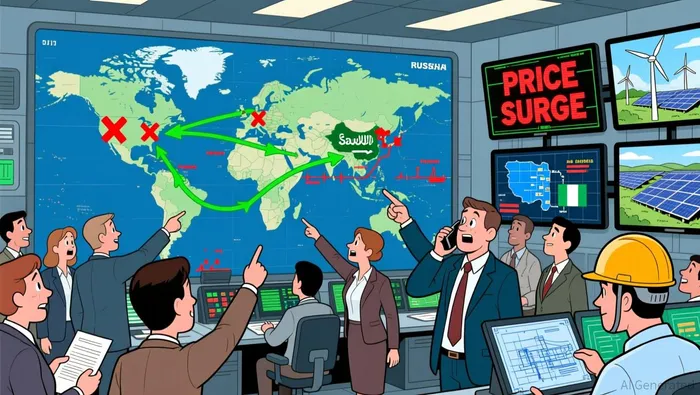
The sanctions have forced a rapid recalibration of global energy markets. Middle Eastern producers like Saudi Arabia, Iraq, and the UAE are poised to fill the supply gap left by Russian exports, particularly in Asia, according to the Jordan News analysis. For investors, this represents an opportunity to target upstream projects in these regions, where production capacity is expanding to meet demand.
Simultaneously, the crisis has accelerated the shift toward renewable energy. Global investment in clean energy reached $3.3 trillion in 2025, with renewables surpassing coal as the largest electricity source by early 2025, according to an IEA report. The EU, for instance, redirected capital toward offshore wind projects in the North Sea, while solar power investments in China and India surged despite policy uncertainties, as noted in a BNEF analysis. For emerging markets, this transition offers a chance to diversify energy portfolios and reduce reliance on volatile fossil fuel imports.
Policy Shifts and Geopolitical Realignment
The sanctions have also triggered a reevaluation of energy diplomacy. Hungary, reliant on Russian pipeline oil, sought a U.S. exemption to continue Druzhba pipeline deliveries, highlighting the growing divide within Western alliances over energy security, according to a Washington Times article. Meanwhile, the EU's 19th sanctions package-banning Russian LNG imports and targeting shadow fleets-underscored the bloc's commitment to isolating Moscow economically, according to a NatlLawReview analysis.
For investors, these policy shifts signal long-term structural changes. The de-dollarization of energy trade, as Russia pivots to barter deals and local-currency contracts with African and Asian partners, could create new corridors for non-traditional trade, according to a Modern Diplomacy report. Additionally, the rise of alternative suppliers-such as African oil producers-presents untapped potential for infrastructure and exploration investments, as the Modern Diplomacy report noted.
Strategic Recommendations for Investors
- Middle Eastern and African Energy Producers: Prioritize investments in upstream projects in Saudi Arabia, Iraq, and Nigeria, where production capacity is expanding to offset Russian supply losses, as the Jordan News analysis noted.
- Renewable Energy Infrastructure: Target solar and wind projects in the EU and India, where policy support and falling costs are driving rapid deployment, according to the IEA report and BNEF analysis.
- Energy Storage and Grid Modernization: Allocate capital to battery storage and smart grid technologies, which are critical for integrating renewable energy and managing supply volatility, as the BNEF analysis observed.
- Emerging Market Energy Security: Support ventures in hydrogen production and green hydrogen trade, particularly in regions like Southeast Asia and the Middle East, as the Modern Diplomacy report suggested.
Conclusion
The October 2025 sanctions on Russian energy exports have not only disrupted a critical pillar of Moscow's economy but also catalyzed a reordering of global energy markets. While the immediate challenges are significant, the resulting opportunities-ranging from expanded fossil fuel production in the Middle East to the acceleration of renewable energy adoption-offer a roadmap for investors seeking to navigate this new era. As the world grapples with the dual imperatives of energy security and decarbonization, the ability to adapt to these shifts will define the next phase of global energy leadership.







Comentarios
Aún no hay comentarios