
Strategic Nationalism and Semiconductor Investment Risks
The semiconductor industry has become a central arena for geopolitical competition, with nations deploying industrial policies, subsidies, and export controls to secure technological dominance. This strategic nationalism is reshaping supply chains, corporate strategies, and shareholder value. For investors, the interplay between national security imperatives and market dynamics presents both opportunities and risks.
Geopolitical Interventions: A New Era of Strategic Competition
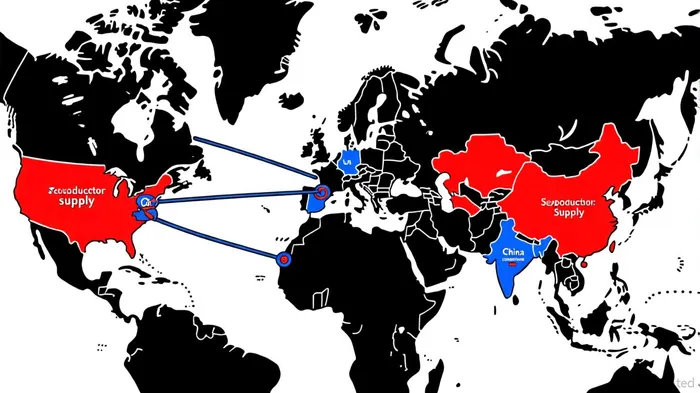
The U.S. CHIPS Act of 2022, allocating tens of billions in subsidies to boost domestic semiconductor manufacturing, exemplifies the shift toward "friend-shoring," according to an NBER digest. Similarly, China's "Made in China 2025" initiative has funneled state capital into self-sufficiency, with companies like SMIC and YMTC advancing 7nm chip production despite U.S. export restrictions on advanced lithography equipment, as described in a Modern Diplomacy analysis. These policies are not isolated: India, the UK, and the EU are also investing heavily, with the European Chips Act aiming to increase regional output to 20% of global capacity by 2030, per a Financial Content analysis.
U.S. export controls, particularly on EUV lithography machines from ASMLASML-- and advanced computing chips from NvidiaNVDA-- and AMDAMD--, have directly disrupted China's access to cutting-edge technology. For instance, ASML reported a projected drop in China sales from 29% of revenue in 2024 to 20% in 2025, reflecting the impact of tightened restrictions, in a CNBC report. Meanwhile, Chinese firms have resorted to workarounds, such as Huawei's use of shell companies to acquire restricted chips, highlighting enforcement challenges in a CSIS analysis.
Shareholder Value: Volatility, Revenue Shifts, and Long-Term Risks
The financial implications of these interventions are stark. ASML's stock plummeted 16% in a single day following revised guidance tied to China sales declines, underscoring the sector's sensitivity to geopolitical shifts, as the CNBC report noted. Similarly, U.S. export controls have forced Nvidia to develop "China-compliant" AI accelerators with capped capabilities, leading to a $10.5 billion revenue loss in 2025, according to a Nasdaq analysis.
TSMC, the world's largest contract chipmaker, has fared better due to its diversified customer base and critical role in manufacturing advanced AI chips. Its Q2 2025 revenues rose 39%, driven by demand for 3nm and 5nm chips, the Nasdaq analysis also noted. However, even TSMCTSM-- faces risks as companies like Intel and Samsung consider reshoring operations to the U.S. or India, altering global production footprints and increasing costs, as discussed in the Modern Diplomacy analysis.
For Chinese firms, the impact has been more severe. A study using a difference-in-differences approach found that U.S. sanctions increased stock volatility for high-tech Chinese semiconductor companies by up to 17%, driven by supply chain disruptions and R&D uncertainty, reported in a ScienceDirect study. This volatility is compounded by China's push for self-sufficiency, which, while reducing long-term reliance on foreign tech, has created short-term financial strains as firms like SMIC scale up, as highlighted in an FPRI article.
Investment Implications: Navigating a Fragmented Landscape
The semiconductor industry's bifurcation into U.S.-aligned and China-aligned ecosystems has profound implications for investors. Companies aligned with U.S. policies, such as ASML and TSMC, benefit from subsidies but face exposure to trade restrictions and shifting demand. Conversely, Chinese firms may gain from domestic market growth but risk isolation in global supply chains.
Investors must also consider the rise of AI and electric vehicles (EVs), which are driving demand for specialized chips. The AI semiconductor market, led by Nvidia, is projected to grow at 29.4% annually through 2032, according to a Silicon Semiconductor projection, but this growth is contingent on navigating geopolitical risks. Similarly, China's dominance in EVs has amplified its influence in the semiconductor sector, creating both competitive and regulatory challenges for global players.
Conclusion: Balancing Nationalism and Innovation
Strategic nationalism in semiconductors is here to stay, driven by the sector's role in national security and technological leadership. For shareholders, the key lies in balancing exposure to state-backed growth opportunities with the risks of fragmented supply chains and regulatory volatility. Companies that can adapt to this dual imperative-leveraging subsidies while mitigating geopolitical risks-will likely outperform in the long term. However, the path forward remains fraught with uncertainty, as nations continue to prioritize strategic interests over market efficiency.





Comentarios
Aún no hay comentarios