
AT&T's Strategic Move into DriveNets and the Future of Telecom Infrastructure
The telecommunications industry is undergoing a seismic shift, driven by the convergence of 5G, artificial intelligence (AI), and cloud-native infrastructure. At the forefront of this transformation is AT&T's recent $650–800 million investment in DriveNets, a company valued at $5 billion following a secondary share purchase that secures a 15% stake for the telecom giant, according to Globes. This move is not merely a financial transaction but a strategic signal of how leading telecom operators are redefining their infrastructure to remain competitive in an era of rapid technological disruption. For investors, the implications are clear: AT&T's bet on DriveNets underscores a broader industry pivot toward software-defined networking (SDN), a market projected to grow at a compound annual rate of 15–20% through 2033, according to a Data Insights Market report.
AT&T's Strategic Rationale: From Hardware to Software-Defined Agility
AT&T's investment in DriveNets is rooted in AT&T's 2025 targets, which emphasize financial discipline and high-impact partnerships. By acquiring a stake in DriveNets-a company whose Network Cloud solution has already been integrated into AT&T's core infrastructure-the telecom operator is aligning itself with a vendor that offers a scalable, open-architecture alternative to traditional hardware-centric systems from CiscoCSCO-- and Mellanox, as reported by Globes. DriveNets' software-defined routers, which reduce total cost of ownership by up to 35% through partnerships with white-box manufacturers, enable AT&T to future-proof its network against the demands of AI-driven analytics and 5G, according to ConsumerSearch.
This partnership also reflects a shift in procurement strategies. Unlike traditional capex-heavy models, DriveNets' cloud-native approach allows telecom providers to adopt a more flexible, opex-driven model. As noted by Deloitte in its 2025 telecom forecast, operators are increasingly prioritizing "platform-driven ecosystems" that leverage AI-enhanced capabilities and intelligent edge networks, a trend discussed in The Silicon Review. AT&T's move positions it to capitalize on these trends while reducing dependency on proprietary hardware-a critical advantage in an industry where margins are under pressure.
A Broader Industry Trend: SDN as the New Standard
AT&T is not alone in its embrace of SDN. The telecom sector is witnessing a wave of consolidation and innovation, with competitors like VodafoneVOD--, Etisalat, and Verizon also adopting SDN to enable 5G services and edge computing, as noted in a LinkedIn post. For instance, Verizon's Edge Transportation Exchange-a 5G multi-access edge computing (MEC) platform-relies on SDN's dynamic resource allocation to support low-latency applications, according to a TS2 roundup. Similarly, Cisco's AI-ready network architecture, unveiled at Cisco Live 2025, highlights how vendors are embedding machine learning into SDN platforms to automate traffic management and optimize performance, as shown in the Cisco Live keynote.
The market's growth trajectory is equally compelling. According to Data Insights Market, the SDN market in telecommunications is valued at $5 billion in 2025, with network slicing and cloud-native architectures driving adoption. This growth is further amplified by the rise of open-source solutions and AI-driven automation, which are reducing the complexity of migrating legacy systems, as detailed by Wipro. For investors, the key takeaway is that SDN is no longer a niche innovation-it is a foundational element of next-generation telecom infrastructure.
High-Growth Opportunities for Investors
The strategic alignment between AT&T and DriveNets opens multiple avenues for investors. First, DriveNets' 40% year-over-year growth in deployments and its 25% market share target for 2026 indicate strong scalability, according to the DriveNets strategy guide. With AT&T's financial backing and access to its global customer base, the company is well-positioned to accelerate its expansion, particularly in emerging markets where cost-effective infrastructure is a priority.
Second, the broader SDN ecosystem offers diversification opportunities. Companies like Arista Networks and Juniper Networks are also investing in AI-driven SDN solutions, while cloud providers such as AWS and Microsoft are integrating virtualized networking into their offerings, as discussed in a Forbes article. For investors seeking exposure to this trend, a basket of SDN-focused firms-alongside telecom operators like AT&T-could provide balanced growth potential.
However, risks remain. The transition to SDN requires significant technical expertise, and interoperability challenges between legacy and cloud-native systems could delay adoption in some regions. Additionally, regulatory scrutiny of data privacy and network security in virtualized environments may introduce friction.
Conclusion: A Defining Moment in Telecom Evolution
AT&T's investment in DriveNets is more than a strategic partnership-it is a harbinger of how telecom infrastructure will evolve in the AI and 5G era. By betting on software-defined agility, AT&T is not only reducing costs but also positioning itself to lead in a market where flexibility and innovation are paramount. For investors, the message is clear: the future of telecom lies in cloud-native, programmable networks, and those who align with this shift stand to reap substantial rewards.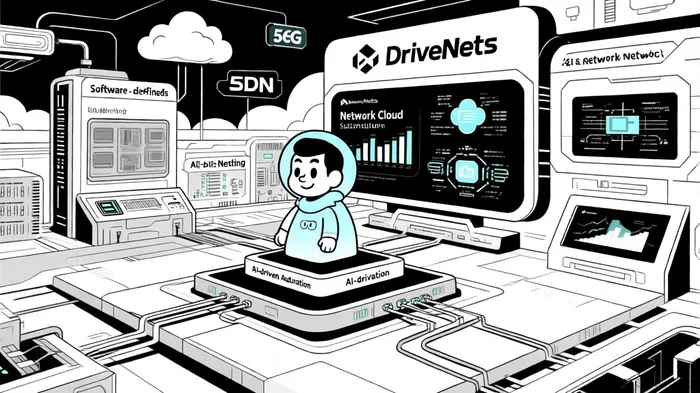





Comentarios
Aún no hay comentarios