
The Strategic Value of Midstream Energy Firms in a Transitioning Energy Landscape
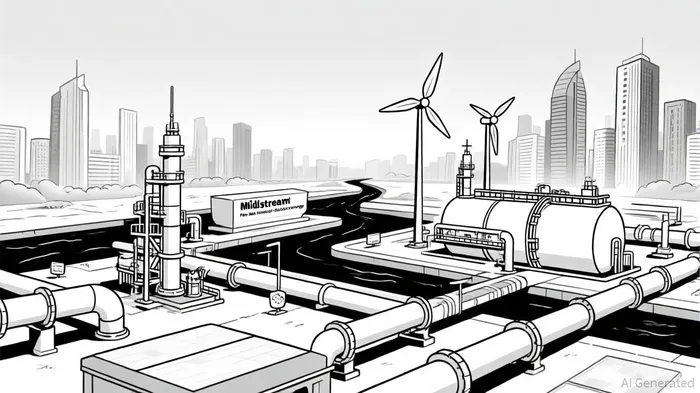
In an energy landscape marked by volatility and the imperative to decarbonize, midstream energy firms stand out as exemplars of capital-efficient growth and resilient cash flows. These companies, which specialize in the transportation, storage, and processing of energy commodities, have demonstrated remarkable adaptability in 2025 despite macroeconomic headwinds. Their strategic value lies in their ability to generate stable returns while aligning with the dual imperatives of energy security and decarbonization.
Fee-Based Models: A Shield Against Commodity Volatility
Midstream firms derive the majority of their revenue from fee-based contracts, which insulate them from the price swings that plague upstream and downstream peers. For instance, Targa ResourcesTRGP-- reaffirmed its 2025 adjusted EBITDA guidance of $4.75 billion at the midpoint, underscoring the stability of its fee-based operations[1]. Similarly, TC EnergyTRP-- maintained its guidance of $10.8 billion, reflecting confidence in long-term infrastructure contracts[2]. These models ensure predictable cash flows, even as oil prices fluctuate—a critical advantage in an era of geopolitical uncertainty and shifting demand patterns.
According to a report by Fitch Ratings, North American midstream energy firms are poised to benefit from a "modestly positive macroeconomic environment" in 2025, driven by structural growth in natural gas demand and the sector's inherent defensiveness[3]. This resilience is further amplified by long-term throughput agreements and regulated cost-of-service models, which provide a floor for earnings.
Capital Efficiency and Shareholder Returns
Midstream firms have also excelled in deploying capital efficiently, prioritizing projects that enhance returns while minimizing risk. For example, Energy Transfer's $5.3 billion Desert Southwest expansion aims to add 1.5 billion cubic feet per day of pipeline capacity by 2029, directly addressing bottlenecks in natural gas takeaway capacity[4]. Such investments are not only aligned with rising demand but also generate incremental cash flows with minimal commodity price exposure.
Dividend growth and buybacks remain central to shareholder returns. While buyback activity varies by firm, companies like Targa Resources have leveraged strong cash flows to repurchase shares, enhancing equity value[2]. This focus on capital efficiency is critical in a transitioning energy landscape, where investors increasingly prioritize returns over speculative growth.
Tailwinds from Natural Gas and LNG Demand
The sector's outlook is further bolstered by surging demand for natural gas, particularly in liquefied natural gas (LNG) exports and AI-driven infrastructure. New LNG projects, such as the 2.5 billion cubic feet per day Matterhorn Express Pipeline, are alleviating takeaway constraints and enabling U.S. producers to access global markets[4]. Meanwhile, shale plays like the Haynesville and Marcellus continue to drive production growth, ensuring robust throughput for midstream operators[3].
Natural gas's role as a "bridge fuel" in the energy transition—balancing reliability with lower carbon intensity—has cemented its relevance. As stated by a Deloitte analysis, midstream firms are uniquely positioned to capitalize on this dynamic, with projected EBITDA growth rates of 5–10% over the next few years[5].
Navigating Risks and Regulatory Uncertainty
Despite these strengths, midstream firms face challenges, including regulatory scrutiny of LNG export permits and potential tax reforms. However, their fee-based models and long-term contracts provide a buffer against such uncertainties. For example, Kinder Morgan's Mississippi Crossing project exemplifies how strategic infrastructure investments can unlock growth while adhering to evolving regulatory frameworks[5].
Conclusion: A Strategic Cornerstone in the Energy Transition
Midstream energy firms are not merely beneficiaries of the current energy transition—they are its architects. Their capital-efficient operations, stable cash flows, and alignment with natural gas demand make them indispensable to a diversified energy portfolio. As the world balances decarbonization with energy security, these firms offer a rare combination of defensive qualities and growth potential. For investors seeking resilience in an uncertain era, midstream energy represents a strategic cornerstone.





Comentarios
Aún no hay comentarios