
The Strategic Merger of Traditional Finance and Crypto: How Visa and Mastercard Are Reshaping the Digital Payment Landscape
Visa and Mastercard: Pioneering Crypto Integration
Visa and Mastercard have taken bold steps to position themselves at the forefront of the digital asset revolution. In 2025, Mastercard expanded its collaboration with Circle to enable stablecoin settlements in the Eastern Europe, Middle East, and Africa (EEMEA) region, allowing acquirers and merchants to transact using USDCUSDC-- and EURC. This move aligns with Mastercard's broader strategy to integrate regulated stablecoins like USDG, FIUSD, and PYUSD into its global payment infrastructure. Meanwhile, Visa has similarly accelerated its stablecoin adoption, reflecting the growing importance of these assets in cross-border and retail transactions.
Mastercard's strategic pivot to direct ownership of crypto infrastructure is exemplified by its potential $1.5–$2 billion acquisition of Zero Hash, a firm specializing in compliant digital asset access. 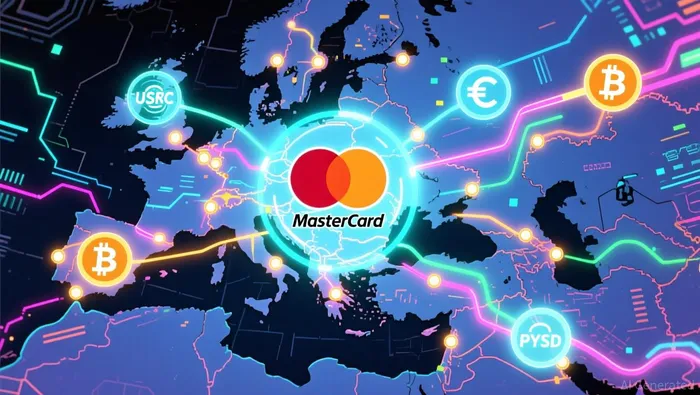 This acquisition, if finalized, would grant Mastercard control over 24/7/365 stablecoin transaction capabilities and institutional-grade crypto services, leveraging ZeroZBT-- Hash's existing partnerships with Stripe, Shift4, and Morgan Stanley. Such moves underscore a shift from cautious experimentation to aggressive integration, positioning both Visa and Mastercard as critical nodes in the global crypto network.
Stablecoin Issuers: Scaling Utility and Revenue
Stablecoin issuers like CircleCRCL-- and Paxos are central to this transformation. Circle, the issuer of USDC, reported Q3 2025 revenue of $740 million-a 66% year-over-year increase-driven by robust demand for its stablecoin, which now commands a 29% market share in stablecoin circulation. The company's growth is further bolstered by its institutional partnerships and interest on USDC reserves, with its June 2025 IPO signaling heightened investor confidence.
Paxos, while less dominant in circulation, has carved a niche through its compliance-focused approach and innovative solutions. Its Post-Trade and Settlement services deliver an average 300% ROI for clients within two years, while its expansion into the precious metals market-enabling automation and cost savings-positions it as a leader in blockchain-based infrastructure. Despite challenges like the forced wind-down of Binance's BUSD in 2023, Paxos remains a key player in the stablecoin space, particularly through its USDG and partnerships with PayPal.
Legacy Institutions: Adapting to a Tokenized Future
Legacy financial institutions are also redefining their roles in the crypto era. JPMorgan Chase reported a Q2 2025 net income of $15 billion, with its digital asset division benefiting from elevated trading activity and institutional demand for tokenized solutions. The bank's Onyx network and collaborations with platforms like AaveAAVE-- Arc highlight its push into permissioned DeFi, blending smart contract efficiency with regulatory compliance.
Citigroup, meanwhile, has capitalized on the surge in Bitcoin ETFs, which saw $36.4 billion in net inflows by late 2024. The firm's research underscores the link between ETF outflows and BitcoinBTC-- price movements, illustrating the growing influence of institutional players in crypto markets. Both JPMorgan and Citigroup are also navigating a regulatory landscape reshaped by the GENIUS Act, which has provided clarity for crypto custody and tokenized assets.
Investment Opportunities in the New Financial Ecosystem
For investors, the intersection of TradFi and crypto offers multiple avenues:
1. Stablecoin Issuers: Circle's scalable infrastructure and Paxos's compliance-driven model present opportunities in a market projected to grow alongside tokenized assets and global trade.
2. Legacy Institutions: JPMorgan's digital asset division and Citigroup's ETF management capabilities are poised to benefit from the mainstreaming of crypto, particularly as tokenized bonds and DeFi-like platforms gain traction.
3. Payment Networks: Visa and Mastercard's strategic bets on stablecoin settlements and crypto infrastructure acquisitions position them as gatekeepers in the evolving digital economy.
The regulatory tailwinds, coupled with institutional adoption and technological maturation, suggest that this convergence is not a passing trend but a structural shift. As traditional financial systems increasingly embrace crypto, the winners will be those who adapt earliest and most effectively.







Comentarios
Aún no hay comentarios