
Strategic Merger Synergies in Regional Banking: The Huntington Bancshares and Veritex Deal
Strategic Merger Synergies in Regional Banking: The Huntington BancsharesHBAN-- and VeritexVBTX-- Deal
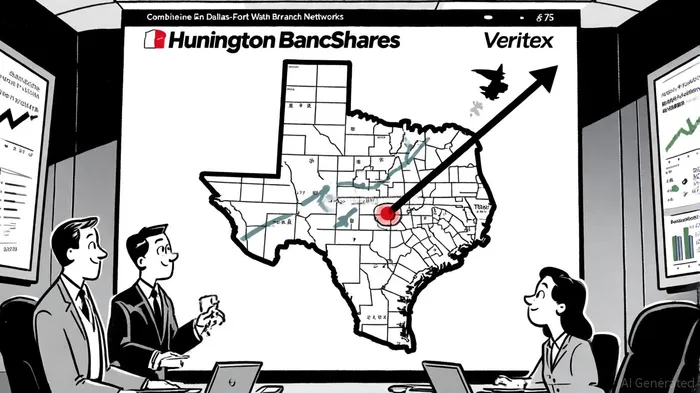
The $1.9 billion merger between Huntington Bancshares and Veritex Holdings represents a bold strategic move to capitalize on the explosive growth potential of Texas' commercial banking sector. Announced on July 14, 2025, and set to close on October 20, 2025, the all-stock transaction-valuing Veritex at $33.91 per share-positions Huntington to expand its footprint in one of the U.S.'s most dynamic economies, according to a SignalBloom report. This analysis examines the capital efficiency and growth potential of the deal, focusing on post-merger integration, cost-income ratios, and the long-term implications for return on equity (ROE) and return on assets (ROA).
Strategic Rationale: Texas as a Growth Engine
Huntington's acquisition of Veritex is driven by a clear strategic imperative: to deepen its presence in Texas, where the state's $2.7 trillion GDP in 2024 and robust corporate relocation trends create a fertile ground for expansion, according to a U.S. News article. Veritex's 30+ branches in Dallas-Fort Worth and Houston-markets with some of the nation's highest population and economic growth rates-provide Huntington immediate access to a commercial real estate and middle-market lending ecosystem, as noted in StockTitan coverage. By retaining Veritex's leadership, including Malcolm Holland as Texas Chairman, Huntington aims to preserve local relationships while leveraging its scale to enhance service offerings, as the U.S. News article noted.
The merger also aligns with Huntington'sHBAN-- broader geographic diversification strategy. Having previously expanded into North and South Carolina, the bank is now doubling down on Texas, a state projected to add over 1 million residents annually through 2030, a demographic tailwind the U.S. News article highlighted. This demographic tailwind, combined with Texas' business-friendly regulatory environment, makes the state a critical long-term growth lever.
Capital Efficiency and Synergy Realization
The transaction is structured to maximize capital efficiency. Huntington's preliminary Q2 2025 results-13% year-over-year EPS growth to $0.34 and a 12% rise in net interest income to $1.5 billion-underscore its strong financial foundation, according to a Yahoo Finance article. The merger is expected to be modestly accretive to Huntington's earnings per share, with tangible book value dilution projected to pay back in approximately one year; StockTitan coverage also highlighted that projected payback period. This rapid payback period is a testament to the cost synergies anticipated from combining operations, including streamlined back-office functions and cross-selling opportunities across the combined $260 billion asset base, a point emphasized in a Fortune interview.
However, Veritex's standalone financials reveal areas of concern. As of June 30, 2025, Veritex reported a ROE of 1.55% and a ROA of 0.19%, well below industry averages, according to a Nasdaq analysis. Its efficiency ratio deteriorated to 61.15%, driven by rising expenses outpacing revenue growth, a trend that the SignalBloom report also noted. Huntington's CFO, Zachary Wasserman, has emphasized that the integration will prioritize cost-income ratio improvements, targeting a "neutral to regulatory capital" outcome at closing, as he told Fortune.
Post-Merger Growth Projections and Risks
While specific ROE and ROA projections for the combined entity are not publicly disclosed, the merger's strategic logic suggests upside potential. Huntington's Q2 2025 ROE of 9.71% is a strong baseline for accretion, particularly if Veritex's underperforming segments are rationalized, according to Macrotrends data. The addition of $13 billion in assets, $9 billion in loans, and $11 billion in deposits-details noted in StockTitan coverage-will also broaden the combined entity's balance sheet, enhancing its ability to weather economic cycles.
Risks remain, however. Veritex's recent core profitability decline-3.9% year-over-year shrinkage in pre-tax, pre-provision operating earnings-raises questions about its pre-merger operational health, a point the SignalBloom report highlighted. Additionally, the integration of 30+ branches in competitive Texas markets could strain resources if not executed smoothly. Legal challenges, including shareholder lawsuits alleging misleading merger disclosures, have been reported in Fortune and could also delay synergies.
Conclusion: A Calculated Bet on Scale and Geography
The Huntington-Veritex merger is a calculated bet on Texas' economic momentum and Huntington's ability to execute a disciplined integration. While Veritex's standalone inefficiencies present near-term challenges, the combined entity's expanded scale, enhanced commercial banking capabilities, and rapid tangible book value payback position it to outperform regional peers. For investors, the key will be monitoring post-merger cost-income ratio improvements and the pace of deposit and loan growth in Texas. If Huntington can leverage Veritex's local expertise while tightening operational margins, the deal could serve as a blueprint for capital-efficient M&A in regional banking.





Comentarios
Aún no hay comentarios