
Strategic Long-Positioning in Altcoins: Decoding Whale Activity and Institutional Trends in the Post-2024 Crypto Market
The ZEC Whale's $1.25M Exit: A Case Study in Liquidity and Volatility
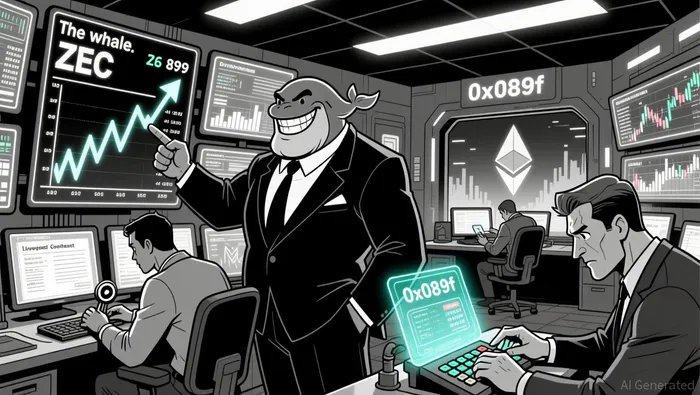
On November 9, 2025, a ZcashZEC-- (ZEC) whale closed a long position of 20,800 ZEC, initially opened at $509.5 (approximately $12.12 million), realizing a $1.25 million profit as ZEC traded at $585-a 6.2% 24-hour gain, according to a Lookonchain report. This event, while a short-term liquidity event, underscores the interplay between whale activity and market structure. The closure coincided with a new whale address, "0x089f," depositing 3.54 million USDCUSDC-- into Hyperliquid to set a limit long position for 7 million ZEC at $508.5, according to the Lookonchain report. Such coordinated activity suggests that while one whale harvested gains, others were layering in, signaling a potential continuation of upward momentumMMT--.
This duality-profit-taking and accumulation-highlights the importance of monitoring on-chain data for contrarian signals. For instance, the same period saw ZEC whale deleveraging cut profits for other participants, according to a CoinMarketCap article, illustrating how whale behavior can create both opportunities and risks for retail investors.
Institutional Capital and the Rise of "Dinosaur" Altcoins
Post-2024, institutional flows have increasingly targeted older altcoins with regulatory clarity and utility-driven narratives. XRPXRP-- and CardanoADA-- (ADA) have emerged as prime candidates for ETF approvals, with XRP ETFs like BlackRock's iShares XRPI and Fidelity's XRPR amassing over $1.9 billion in assets under management, according to a Investing.com analysis. These funds are not merely speculative-they reflect a strategic shift toward assets with real-world infrastructure, such as Ripple's cross-border payment solutions and Cardano's smart contract upgrades.
The broader trend is one of "selective altseason," where liquidity is concentrated in a handful of projects rather than diffusing across the 26,000+ token ecosystem, according to a Cardano feed. This dynamic is amplified by ETF structures, which provide institutional investors with regulated access to crypto assets while reducing volatility clustering. For example, BitcoinBTC-- and EthereumETH-- ETFs have collectively attracted $75 billion in assets by September 2025, with ETFs leading spot price formation in 85% of cases, according to a Yellow research report.
Whale Activity: Catalyst or Chaos?
While ETFs provide stability, whales retain the power to trigger acute volatility. Large transactions-such as the August 2025 flash crash caused by a 24,000 BTC sell-off-demonstrate their disruptive potential, according to a Yellow research report. However, whales also act as liquidity providers during downturns, accumulating undervalued assets. For instance, SolanaSOL-- (SOL) and AaveAAVE-- (AAVE) have seen increased smart money accumulation, with Aave's $24.4 billion TVL and multi-chain strategy attracting institutional capital, according to a PowerDrill AI blog.
The ZEC whale's exit also aligns with broader patterns. Whale addresses like "BTC OG Whale" and "Brother" Huang Lizhong have maintained leveraged long positions in Ethereum and Bitcoin, while others, like James Wynn, face margin calls, according to a Lookonchain report. This divergence underscores the importance of risk management: while some whales amplify trends, others exacerbate drawdowns.
Strategic Positioning: Balancing ETFs and Whale Signals
For investors, the key lies in synthesizing ETF-driven trends with whale activity. Here's how to approach it:
1. Prioritize ETF-Eligible Altcoins: Focus on projects with clear regulatory pathways, such as XRP, Cardano, and potentially Solana. These assets are likely to benefit from systematic institutional inflows.
2. Monitor Whale Accumulation: Use on-chain tools to track large deposits and limit orders. For example, the "0x089f" address's Hyperliquid activity suggests a bullish bet on ZEC's $508.5 support level.
3. Diversify Across Liquidity Pools: Allocate capital to both ETF-eligible assets and emerging projects with strong fundamentals, such as Aave's DeFi ecosystem or DeepSnitch AI's AI-driven trading tools, according to a Financefeeds article.
Conclusion: Navigating the New Crypto Paradigm
The post-2024 crypto market is defined by two forces: the institutionalization of ETFs and the enduring influence of whales. While ETFs provide a floor for long-term price discovery, whales act as both catalysts and contrarians in the short term. The ZEC whale's $1.25 million exit is a case study in this duality-offering lessons on liquidity management, risk mitigation, and the importance of aligning with macro trends. For investors, the path to alpha lies in leveraging these insights to balance systematic flows with opportunistic positioning.






Comentarios
Aún no hay comentarios