
Strategic Lithium Partnerships and Balance Sheet Strength: How MinRes' POSCO Deal Reshapes Its Growth Trajectory
Capital Structure Optimization: A Win-Win for MinRes and POSCO
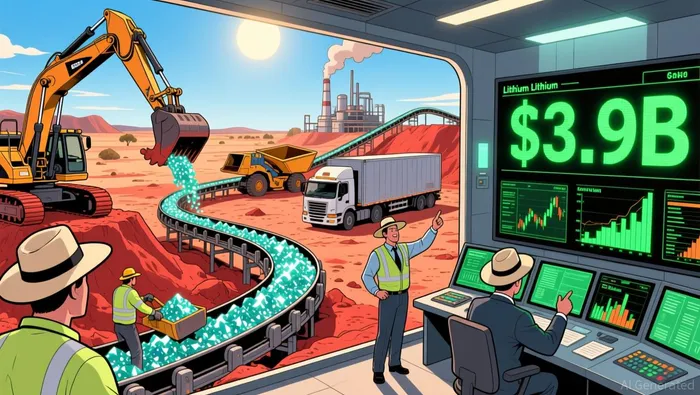
POSCO's investment for a 30% stake in MinRes' Wodgina and Mount Marion lithium operations isn't just a financial transaction-it's a structural reset. By injecting $1.2 billion into the joint venture, POSCOPKX-- effectively de-risks MinRes' balance sheet while granting itself a foothold in a critical raw material market. For MinRes, this means reduced leverage and a $3.9 billion valuation for the combined entity, which now operates under a 70%-owned joint venture structure, according to a MinRes-POSCO deal analysis.
This move is particularly smart in a lithium market that's just emerged from a slump. Prices have nearly doubled since June 2024, hitting $1,012 per tonne by November 2025, according to a POSCO investment breakdown. POSCO's timing-locking in long-term access to spodumene concentrate-shows confidence in sustained demand, especially for Korean battery manufacturers. Meanwhile, MinRes retains operational control, ensuring it can scale production without diluting its strategic autonomy.
Supply Chain Diversification: Dodging the China Conundrum
The geopolitical stakes in critical minerals have never been higher. China's dominance in lithium processing has long been a vulnerability for global supply chains, but MinRes' partnership with POSCO addresses this head-on. By anchoring a major Asian player to its Australian assets, MinRes is not just selling spodumene-it's building a regional supply chain that bypasses traditional bottlenecks, as noted in the MinRes-POSCO deal analysis.
POSCO's broader strategy-aggressively raising $691 million in corporate bonds for next-gen battery materials and robotics-further underscores the deal's strategic depth. This isn't a one-off investment; it's part of a multi-pronged effort to vertically integrate energy materials, as described in a KED Global bond report. For MinRes, aligning with such a capital-rich partner ensures steady demand and reduces exposure to volatile spot markets.
The Bigger Picture: Why This Matters for Investors
The MinRes-POSCO deal is a blueprint for how critical minerals companies can thrive in a fragmented market. By optimizing capital structure, MinRes has positioned itself to reinvest in growth without overleveraging. By diversifying its supply chain, it's insulating itself from geopolitical shocks. And with lithium prices on an upward trajectory, the timing couldn't be better.
For investors, the takeaway is clear: Strategic partnerships aren't just about today's headlines-they're about tomorrow's resilience. MinRes has shown that with the right ally, even a cyclical commodity like lithium can become a cornerstone of long-term value creation.





Comentarios
Aún no hay comentarios