
The Strategic Use of Leverage and Rollover Profits in High-Volatility Crypto Assets
The cryptocurrency market in 2025 was defined by extreme volatility, with BitcoinBTC-- and memecoins experiencing sharp price swings that tested the resilience of even seasoned traders. As leverage became a double-edged sword-amplifying both gains and losses-the industry witnessed a strategic pivot toward risk-adjusted returns and structured recovery mechanisms. This analysis explores how traders navigated these challenges, focusing on the tactical use of leverage, rollover profits, and risk-recovery strategies in high-volatility environments.
The 2025 Derivatives Pivot: From Perpetual Futures to Options
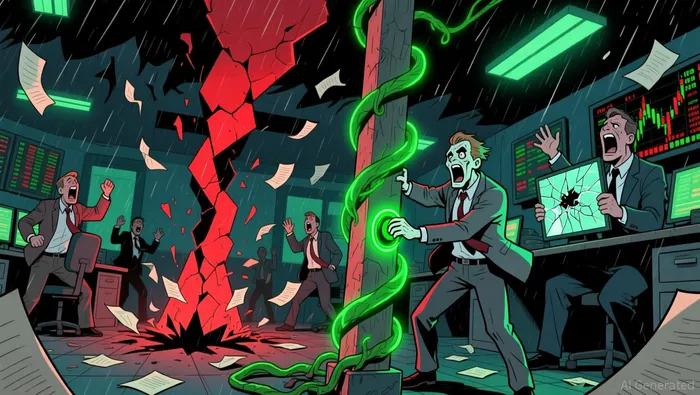 The structural recalibration of the crypto derivatives market in 2025 marked a critical shift in trading paradigms. Perpetual futures, once the dominant leveraged instrument, proved ill-suited for a market characterized by non-linear price movements and cascading liquidations. For instance, during the October 2025 crash, over $19 billion in leveraged positions were liquidated in 24 hours, triggered by external shocks like Trump's proposed 100% tariff on Chinese imports and the de-pegging of synthetic stablecoins. This event exposed the fragility of linear instruments, as leveraged longs were wiped out at the bottom of declines, leaving no capital for recovery.
In response, traders increasingly adopted options trading, which offered defined risk and convex returns. Options allowed participants to hedge against downside volatility while retaining upside potential-a critical advantage in a market where sharp corrections became routine. By 2025, institutional capital had shifted toward compliant options platforms, with total derivatives trading volume reaching $85.70 trillion annually. This pivot underscored a broader maturation of the crypto asset class, as Bitcoin's behavior aligned more closely with macro assets like equities rather than speculative hype.
Position Sizing and Risk Management: The 2025 Lessons
Position sizing emerged as a cornerstone of risk management in 2025. Traders who survived the volatility spikes prioritized strict collateral requirements and volatility-adjusted position sizes. For example, systematic trend-following strategies using Donchian channels and volatility-based sizing achieved a Sharpe ratio above 1.5 and an annualized alpha of 10.8% versus Bitcoin. These strategies emphasized liquidity management, avoiding overexposure to illiquid memecoins that often experienced erratic price swings.
Retail traders also adopted tools like liquidation price calculators and automated rebalancing to mitigate emotional decision-making. During the September 2025 "Red Monday" crash, which liquidated $1.5 billion in leveraged longs, traders who had pre-set stop-loss orders and diversified portfolios fared significantly better than those relying on speculative, high-leverage bets. The lesson was clear: in a market where 30-day volatility exceeded 45%, disciplined position management was non-negotiable.
Rollover Profits and Compounding: A Path to Recovery
The strategic reinvestment of rollover profits became a key tactic for compounding gains in 2025. Traders who survived the October crash, for instance, shifted to bullish spreads and naked put selling to capitalize on market rebounds while limiting downside risk. These strategies were particularly effective in the context of year-end options expiry, where liquidity constraints created asymmetric opportunities.
Institutional investors further demonstrated the power of compounding by prioritizing risk-adjusted metrics like the Sharpe and Sortino ratios. Bitcoin's Sharpe ratio of 2.42 in 2025 highlighted its strong risk-adjusted performance, even amid volatility. By preserving capital during downturns and reinvesting profits during recoveries, these strategies outperformed those focused solely on headline returns. For example, the U.S. government's establishment of a "Strategic Bitcoin Reserve" in early 2025 signaled institutional confidence in Bitcoin's long-term value, encouraging long-term holders to compound gains through dollar-cost averaging.
Case Studies: Navigating 2025's Volatility Spikes
BTC Trend Chart
The October 2025 crash serves as a textbook example of leverage's risks and the efficacy of recovery strategies. When Bitcoin plummeted 14% in a single day, over $20 billion in leveraged positions were liquidated. However, traders who had hedged with options or maintained diversified portfolios avoided catastrophic losses. One hedge fund, 319 Capital, preserved capital by avoiding high-risk speculative positions and focusing on collateral management as reported by OpenExo.
Similarly, memecoinMEME-- traders who survived the 2025 volatility spikes adopted a disciplined approach. Joe McCann, a hedge fund manager, used technical analysis to identify opportunities in BonkBONK-- coin, leveraging inflows to SolanaSOL-- and historical patterns from DogecoinDOGE--. By combining leverage with strict stop-loss orders, he navigated the market's unpredictability while compounding gains.
The Institutionalization of Crypto: A New Era
The 2025 market also saw the rise of institutional participation, which brought both stability and new challenges. ETF approvals and regulatory developments added legitimacy to Bitcoin, reducing its volatility to levels comparable to Nvidia. However, this institutionalization also introduced systemic risks, as concentrated ownership and fragmented order books exacerbated liquidity crunches during downturns.
In response, institutions began stress-testing portfolios and adopting market-neutral strategies, such as balancing long and short positions. These approaches allowed them to capture alpha independent of market direction, a critical advantage in a landscape where black swan events became routine.
Conclusion
The 2025 crypto market underscored the importance of strategic leverage use, disciplined risk management, and structured rollover profit reinvestment. As volatility persisted, traders who adapted to the new paradigm-shifting from perpetual futures to options, prioritizing position sizing, and embracing risk-adjusted metrics-emerged as the market's survivors. For investors in 2026 and beyond, the lessons of 2025 remain clear: in high-volatility environments, survival hinges on preparation, adaptability, and a relentless focus on compounding outcomes.






Comentarios
Aún no hay comentarios