
Strategic Investment in Wide-Bandgap Semiconductors: Powering the Future of EVs and Renewables
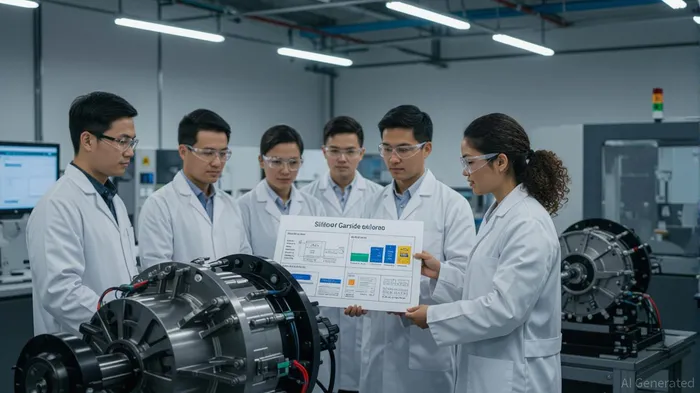
The global energy transition and the surge in electric vehicle (EV) adoption have ignited a paradigm shift in power electronics, with wide-bandgap (WBG) semiconductors—specifically silicon carbide (SiC) and gallium nitride (GaN)—emerging as linchpins of innovation. These materials, capable of handling high voltages, temperatures, and frequencies with minimal energy loss, are redefining efficiency benchmarks in EVs and renewable energy systems. For investors, the strategic positioning within this value chain hinges on understanding the interplay between technological advancements, market adoption, and sector-specific demand.
Technological Advancements: The WBG Edge
SiC and GaN outperform traditional silicon-based semiconductors in critical metrics. SiC, for instance, enables a 90% reduction in switching losses through innovations like integrated SiC CMOS power modules, which combine gate drivers and power transistors for seamless control [1]. Meanwhile, GaN’s high-frequency switching capabilities make it ideal for compact, high-efficiency power supplies in EV fast chargers and renewable energy inverters [1]. These attributes are not merely incremental improvements but foundational shifts, enabling EVs to achieve faster charging times and longer battery life while solar and wind systems optimize power conversion [2].
Market Adoption: A Dual-Driven Growth Story
The WBG semiconductor market is expanding at an unprecedented pace. In 2024, the global market for SiC and GaN power semiconductors reached $1.42 billion, with projections of $1.71 billion by 2025—a compound annual growth rate (CAGR) of 20.3% [1]. The automotive sector dominates this growth, accounting for 73.4% of the market, as EVs increasingly adopt SiC for motor drives and GaN for onboard chargers [1]. Concurrently, renewable energy systems are accelerating WBG adoption: solar inverters and wind turbines now leverage these materials to reduce power losses and enhance grid stability [3].
Geographically, the U.S. leads in EV adoption, with 7.8% of total vehicle sales in 2023, while regions like San Francisco report EV penetration as high as 34% [1]. This regional disparity underscores the importance of localized investment strategies, particularly in markets with aggressive decarbonization policies.
Strategic Positioning for Investors
Investors seeking exposure to this sector must prioritize two axes: material specialization and application focus.
Material Specialization: While SiC currently dominates the market (87.7% by material type in 2024), GaN’s device mix (42%) highlights its complementary role in high-frequency applications [1]. Companies like Mitsubishi Electric, which has commercialized Full-SiC modules for domestic appliances and hybrid-SiC solutions for industrial systems, exemplify the potential for cross-sector scalability [1].
Application Focus: The EV power semiconductor market alone is valued at $12.2 billion (2023) and is projected to grow at a 22.2% CAGR through 2030 [2]. Meanwhile, the renewable energy segment, with a $2.065 billion market value in 2024, is forecasted to expand at 13.4% CAGR, reaching $4.29 billion by 2033 [3]. This dual growth trajectory suggests that portfolios balancing EV and renewable energy exposure will mitigate sector-specific risks.







Comentarios
Aún no hay comentarios