
Strategic Investment Opportunities in Madagascar's Evolving Telecom Sector
Madagascar's telecommunications sector is undergoing a transformative phase, driven by regulatory interventions, operator-led innovations, and a shift in consumer demand toward data-centric services. As the market navigates affordability challenges and infrastructure expansion, investors are presented with compelling opportunities to capitalize on regulatory-driven market shifts and the rising dominance of mobile data and fixed broadband.
Regulatory Dynamics: Balancing Affordability and Sustainability
The Madagascar Communications Regulator (ARTEC) has taken center stage in reshaping the sector's trajectory. In late 2024 and 2025, ARTEC initiated a review of data pricing structures, urging operators to lower internet prices to address public concerns over affordability. However, operators have pushed back, citing high sector taxes and regulatory fees as unsustainable burdens. For instance, mobile internet expenses account for 6.28% of gross national income per capita, a figure that underscores the financial strain on consumers. While ARTEC does not set retail prices, its role in facilitating dialogue between operators and government agencies is critical to achieving a balance between consumer protection and operator profitability.
This regulatory tension highlights a key investment consideration: operators that can secure tax relief or optimize cost structures will be better positioned to pass on savings to consumers without eroding margins. Such scenarios could catalyze broader market adoption of data services, particularly as ARTEC's national broadband plans and fiber expansion initiatives gain momentum.
Operator Strategies: Infrastructure Expansion and 5G Leadership
The competitive landscape is dominated by three key players-Orange Madagascar, Airtel Madagascar, and Yas (formerly Telma)-each pursuing aggressive strategies to capture market share in the data-driven era.
Orange Madagascar, the third-largest operator with 3.3 million subscribers, is prioritizing network coverage expansion. The company has secured a €30 million global license to increase population coverage from 56% to 90% by 2024, deploying 500 rural telecommunication sites under the Network-as-a-Service (NaaS) model. Its investments in a local 5G Lab and multi-technology deployment further underscore its commitment to innovation.
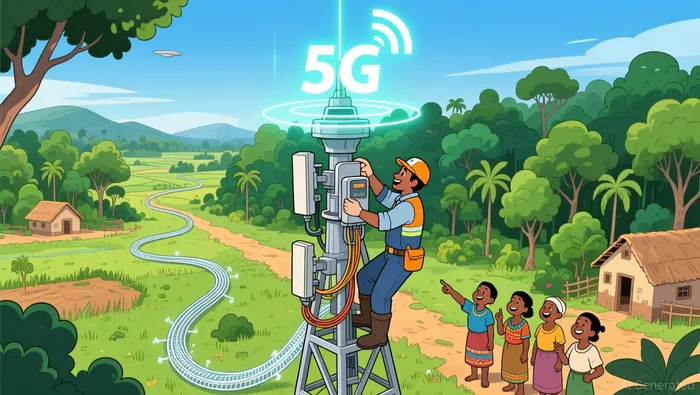
Yas, the market leader with 50% share, has pioneered 5G adoption in Madagascar, launching Africa's first commercial 5G service in 2020. The company's 5,000-km fiber backbone and partnerships with independent tower-sharing firms are reducing capital expenditures while accelerating infrastructure rollout according to industry analysis.
Airtel Madagascar, with 4.9 million users, has secured a $32.5 million 15-year license to reinvest in network upgrades and sales improvements according to market reports. Its focus on data-centric plans aligns with the sector's broader shift toward higher-margin services.
These operator strategies are not only expanding connectivity but also driving revenue growth. Mobile data service revenue is projected to grow at a 15.9% CAGR from 2024 to 2029, while fixed broadband revenue is expected to follow a similar trajectory, supported by government-led fiber expansion.
ARPU Growth: Data-Centric Services as a Catalyst
Average Revenue Per User (ARPU) trends in Madagascar's telecom sector are increasingly tied to mobile data and fixed broadband adoption. While overall telecom service revenue is forecasted to decline at a 3.5% CAGR due to shrinking mobile voice and messaging segments according to a 2025 report, data-centric services are bucking this trend.
Airtel Madagascar has already demonstrated strong ARPU growth, with its average revenue per user rising to $2.9 in H1 2025, driven by a 37% surge in data service revenue. Similarly, Orange Madagascar reported a 17.7% growth in mobile data revenue and 16.7% in fixed broadband in 2023 according to financial disclosures, reflecting the effectiveness of data-centric pricing models.
For Yas, the combination of 5G deployment and fiber infrastructure investments positions it to capitalize on higher-ARPU services. The operator's ability to leverage its existing 5G leadership and expand into underserved urban and rural areas could further differentiate its offerings according to market analysis.
Challenges and Mitigation Strategies
Despite these opportunities, investors must remain mindful of structural challenges. Low disposable incomes, high excise taxes (up to 20% on telecom services), and frequent power outages constrain affordability and operational efficiency. Additionally, the entry of untaxed players like Starlink has intensified competition, prompting regulatory debates on fair market practices.
Operators that can mitigate these risks through cost optimization, tax relief negotiations, and partnerships with energy providers will be best positioned to thrive. For example, Orange's collaboration with NuRAN Wireless and AMN to deploy energy-efficient infrastructure could serve as a blueprint for sustainable expansion according to industry reports.
Actionable Investment Opportunities
The Madagascar telecom MNO market, valued at $0.84 billion in 2025, is projected to grow at a 5.45% CAGR to $1.09 billion by 2030 according to market research. Investors should focus on:
1. Operators with robust infrastructure expansion plans, such as Orange's rural coverage initiatives or Yas's 5G leadership.
2. Data-centric service providers benefiting from rising mobile internet subscriptions and 4G/5G adoption.
3. Partnerships with government-led fiber projects, which are critical to unlocking fixed broadband growth.
In particular, Airtel's recent license renewal and Orange's strategic investments in 5G and fiber infrastructure present near-term opportunities. Yas's dominance in 5G and its fiber backbone also offer long-term potential, especially as mobile money adoption now exceeding 10 million accounts deepens financial inclusion.
Conclusion
Madagascar's telecom sector is at a pivotal juncture, where regulatory reforms, operator innovation, and consumer demand for data services are converging to create a dynamic investment landscape. While challenges persist, the sector's resilience and growth projections-driven by 15.9% CAGR in mobile and fixed broadband-underscore its appeal for investors seeking exposure to emerging markets with transformative potential.
By aligning with operators that prioritize affordability, infrastructure expansion, and regulatory engagement, investors can position themselves to capitalize on Madagascar's evolving telecom ecosystem.







Comentarios
Aún no hay comentarios