
Strategic Investment in Hybrid Solar+Storage Projects: Powering French Guiana's Energy Transition and Grid Resilience
French Guiana, a French overseas territory in South America, is emerging as a pivotal case study in the global . , the region is rapidly scaling solar and storage infrastructure. Central to this transformation are projects, which are not only accelerating decarbonization but also enhancing grid resilience in the face of climate volatility and energy demand growth.
A Decarbonized Vision: Current Projects and Progress
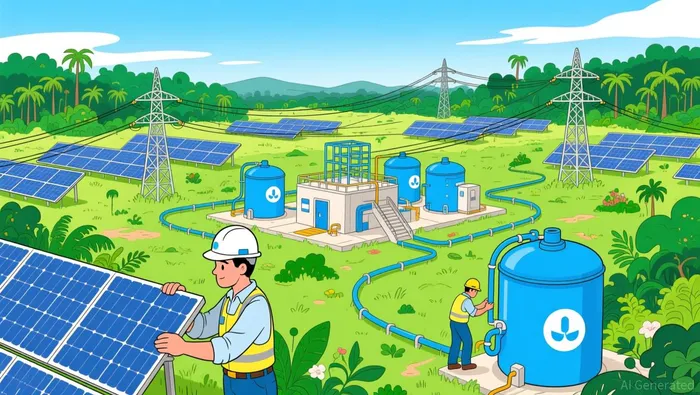
French Guiana's renewable energy landscape is anchored by flagship projects such as the Centrale Électrique de l'Ouest Guyanais (CEOG), . Developed by HDF Energy, , demonstrating the viability of hybrid systems in overcoming solar intermittency. Complementing this, , , while Voltalia's Sable Blanc project , . These projects align with the PPE's goal of achieving full energy autonomy by 2030 and underscore the region's commitment to diversifying its energy mix.
Technological Innovation: The Hybrid Edge
Hybrid solar+storage systems are increasingly recognized as foundational to . Technologies such as and advanced control strategies, including (MRAC), are being deployed to stabilize voltage, manage frequency, and optimize energy flows. For instance, VRFBs offer long-duration storage capabilities, enabling French Guiana to address peak demand surges and maintain reliability during outages. The integration of production, as seen in CEOG, further future-proofs these systems by creating a circular energy economy that stores excess solar energy for continuous dispatch.
Funding and Investment: Navigating Challenges
While specific 2025 funding allocations for hybrid projects in French Guiana remain opaque, broader trends indicate robust support. France's national , , reflect a policy environment conducive to investment. Additionally, European public funding agencies . However, challenges persist. -canceled due to lack of public support and revised PPE priorities-highlights the risks of policy shifts and regulatory uncertainty. Investors must navigate these dynamics while capitalizing on the region's strategic potential.
: Metrics and Outcomes
Hybrid systems are proving critical to French Guiana's grid stability. Studies emphasize their role in rotor angle stability, voltage control, and decentralized energy management, all of which are vital for a region prone to extreme weather events. For example, Voltalia's Sable Blanc project has enhanced the Toco complex's resilience by integrating battery storage with solar, reducing transmission losses and improving load balancing. While granular resilience metrics for French Guiana remain unpublished, regional projects like Guyana's 5 MWp Onderneeming Solar Farm-a hybrid facility launched in November 2025-offer a benchmark for how such systems can strengthen energy security in similar contexts.
Strategic Opportunities and Regional Synergies
French Guiana's energy transition is not occurring in isolation. The region's proximity to Guyana, , creates opportunities for cross-border collaboration and shared infrastructure. Moreover, Days held in June 2025 underscored the urgency of climate-resilient energy systems, with discussions on urban planning, coastal risk mitigation, and to enhance territorial resilience. These initiatives align with global trends, , signaling a shift toward decentralized, renewable-powered ecosystems.
Conclusion: A Call for Sustained Investment
French Guiana's hybrid solar+storage projects represent a strategic cornerstone for its energy transition and grid resilience. While challenges such as land use constraints and policy shifts persist, the region's progress-bolstered by and regional momentum-positions it as a compelling investment destination. For stakeholders, the imperative is clear: sustained funding, adaptive policy frameworks, and cross-sector collaboration will be essential to realizing French Guiana's vision of a decarbonized, resilient energy future.







Comentarios
Aún no hay comentarios