
Strategic Investment in AI-Driven Manufacturing: U.S. Industrial Leadership in the Global AI Race
The U.S. manufacturing sector stands at a pivotal crossroads, where strategic investments in artificial intelligence (AI) infrastructure could redefine its global competitiveness. With the Biden-Harris administration prioritizing domestic industrial revival, the confluence of federal funding, private-sector innovation, and evolving global dynamics presents a compelling case for investors. This analysis examines the trajectory of AI-driven manufacturing in the U.S., evaluates the impact of recent policy initiatives, and situates American efforts within the broader context of global AI adoption.
Federal Catalysts: Government Funding as a Strategic Lever
The U.S. government has deployed a multi-pronged strategy to accelerate AI adoption in manufacturing. Notably, the National Institute of Standards and Technology (NIST) launched a $70 million initiative in 2024 to establish an AI-focused Manufacturing USA Institute, aiming to enhance supply chain resilience and process optimization[3]. This effort is complemented by the National Science Foundation's (NSF) $140 million investment in seven new National AI Research Institutes, which emphasize workforce development and responsible innovation[4]. These programs are part of a broader ecosystem of support, including the CHIPS Act and Inflation Reduction Act, which have spurred over $1 trillion in private-sector investments in key manufacturing sectors[2].
The Small Business Administration's (SBA) Made in America Manufacturing Initiative further amplifies this momentum by reducing regulatory barriers and expanding capital access for small manufacturers[2]. Such coordinated federal action underscores a deliberate effort to bridge the gap between AI research and industrial application—a critical step for maintaining U.S. leadership in an increasingly competitive global landscape.
Market Dynamics: AI Adoption and Productivity Gains
The U.S. manufacturing sector is witnessing a surge in AI integration. According to industry data, 51% of manufacturers already utilize AI in their operations, with 61% anticipating increased investment by 2027[3]. Applications such as AI-powered safety monitoring, digital twins for product development, and supply chain analytics are reshaping operational efficiency. By 2030, 80% of manufacturers are projected to depend on AI for core functions[3].
The economic impact is equally striking. The AI manufacturing market, valued at $3.2 billion in 2023, is expected to grow to $20.8 billion by 2028, reflecting a compound annual growth rate (CAGR) of 45.4%[2]. This expansion is driven by AI's ability to reduce costs, optimize throughput, and enhance quality assurance. For instance, real-time AI orchestration of manufacturing processes has already demonstrated improvements in accuracy and cost efficiency[1].
Global Comparisons: U.S. vs. China vs. EU
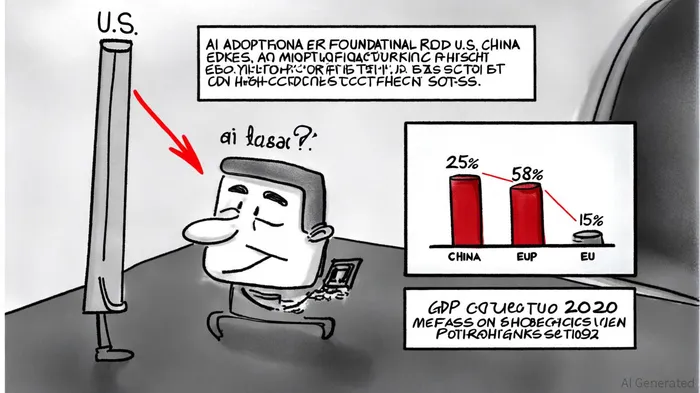
While the U.S. excels in foundational AI research and high-end manufacturing, its adoption rate (25%) lags behind China (58%) and India (57%)[1]. China's state-driven AI strategy, emphasizing application-driven growth and industrial internet platforms, has positioned it to contribute 26.1% to its GDP by 2030[1]. In contrast, the U.S. leads in AI compute infrastructure (73% of global capacity) and high-adoption sectors like finance (61%) and tech (85%)[1].
The European Union's approach, meanwhile, prioritizes ethical AI through the EU AI Act—a risk-based regulatory framework that differentiates between unacceptable, high, and minimal risk applications[5]. While this strategy fosters public trust, it has slowed AI adoption, with the EU's AI market accounting for just 15% of the global share[1]. The U.S. occupies a middle ground, balancing innovation with sector-specific regulations that allow for rapid deployment in manufacturing.
Challenges and Opportunities
Despite progress, challenges persist. Workforce readiness remains a critical bottleneck, as older firms face a “productivity paradox” where AI implementation initially reduces efficiency before yielding long-term gains. Additionally, data accessibility and regulatory alignment require further attention to ensure seamless AI integration[3].
For investors, these challenges represent opportunities. Private-sector partnerships, such as those facilitated by the Manufacturing USA Institute, offer avenues to address technical and operational hurdles. Similarly, the U.S. focus on foundational R&D—exemplified by projects like Alibaba's DAMO Academy in China—positions it to lead in next-generation AI applications[2].
Conclusion: A Strategic Imperative
The U.S. is poised to reclaim its position as a global leader in AI-driven manufacturing, but sustained investment and policy alignment are essential. With federal funding, private-sector collaboration, and a growing market, the U.S. has the tools to overcome adoption barriers and outpace competitors. For investors, the intersection of AI infrastructure and industrial innovation represents not just a growth opportunity, but a strategic imperative in shaping the future of manufacturing.







Comentarios
Aún no hay comentarios