
Strategic Investment in 3D Content Creation Tools and High-Performance Computing Hardware Synergy
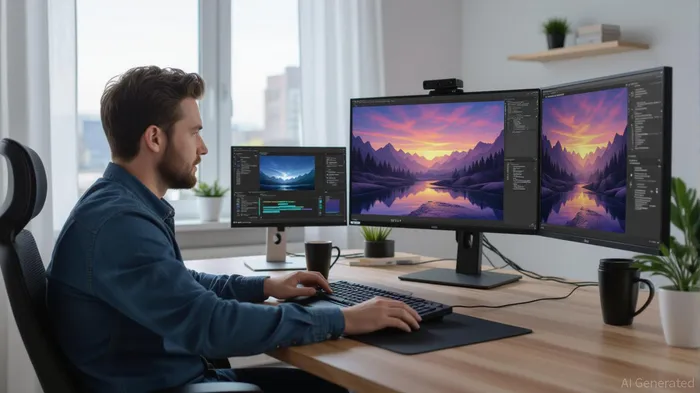
The convergence of 3D creative software and GPU-driven rendering technologies is reshaping industries ranging from entertainment to engineering. As demand for immersive digital content accelerates, the synergy between advanced graphics processing units (GPUs) and 3D content creation tools is unlocking new investment opportunities. This analysis explores how strategic alignment with this technological partnership can yield long-term value for investors.
The GPU Market: A Foundation for Innovation
The GPU market in 2023–2025 is dominated by three key players: NVIDIA, AMD, and Intel. NVIDIA's GeForce RTX 5000 and 4000 series have set benchmarks for real-time ray tracing and AI-enhanced upscaling, making them indispensable for both gaming and professional creative workflows [1]. AMD's Radeon RX 9000 and 7000 series offer competitive performance at mid- to high-end price points, while Intel's Arc series, though newer, leverages technologies like Resizable BAR to challenge established leaders [1]. Workstation-class GPUs, such as NVIDIA's RTX Pro 6000 Blackwell and AMD's Radeon Pro offerings, further underscore the growing reliance on GPU parallel processing for tasks like simulation and high-fidelity rendering [1].
3D Creative Software and GPU Synergy
The integration of high-performance GPUs into 3D creative software is revolutionizing content production. Real-time rendering, once constrained by CPU limitations, is now achievable through GPU acceleration. For instance, real-time ray tracing—enabled by NVIDIA's RTX architecture—allows artists to visualize photorealistic scenes instantaneously, reducing production timelines by up to 70% in some workflows [2]. Similarly, AI-driven tools like AMD's FidelityFX Super Resolution (FSR) enhance upscaling efficiency, enabling creators to work with high-resolution assets without compromising performance [1].
This synergy is particularly critical in industries such as gaming, film, and virtual reality, where demand for high-quality 3D content is surging. According to IBMIBM--, GPUs are uniquely designed to handle the computational intensity of rendering tasks, making them “indispensable” for modern 3D design and animation [2]. As virtual production and metaverse development gain traction, the need for GPU-powered creative tools will only intensify.
Market Growth and Investment Potential
While specific CAGR projections for the 3D creative software and GPU-driven rendering market remain elusive, the broader GPU market's trajectory offers indirect insights. The increasing adoption of GPUs in professional workflows—spanning architecture, automotive design, and medical imaging—highlights a structural shift toward hardware-software integration. For example, workstation-class GPUs now account for over 30% of NVIDIA's revenue, reflecting their critical role in industries beyond gaming [1].
Investors should also consider the indirect benefits of GPU advancements. As 3D creative software becomes more accessible via cloud-based platforms, the demand for scalable GPU infrastructure will rise. This creates opportunities in both hardware manufacturing and SaaS models that bundle GPU resources with creative tools.
Strategic Considerations for Investors
To capitalize on this trend, investors should prioritize companies that:
1. Leverage AI and ray tracing: Firms like NVIDIANVDA-- and AMDAMD--, which integrate AI into rendering pipelines, are well-positioned to lead the next wave of innovation.
2. Expand into professional markets: Workstation GPU providers with strong partnerships in architecture, engineering, and media production will benefit from long-term demand.
3. Enable cloud-based workflows: Companies offering GPU-as-a-Service (GaaS) or hybrid on-premise/cloud solutions will address scalability needs in 3D content creation.
Conclusion
The synergy between 3D creative software and GPU-driven rendering technologies is not merely a technical advancement—it is a catalyst for redefining creative and industrial workflows. While precise growth metrics remain underreported, the dominance of key GPU players and the expanding use cases for real-time rendering suggest a compelling investment horizon. By aligning with firms that bridge hardware innovation and creative software, investors can position themselves at the forefront of this transformative market.







Comentarios
Aún no hay comentarios