
The Strategic Value of Investing in U.S. Rail Modernization: A Case Study of Hitachi Rail's Hagerstown Factory
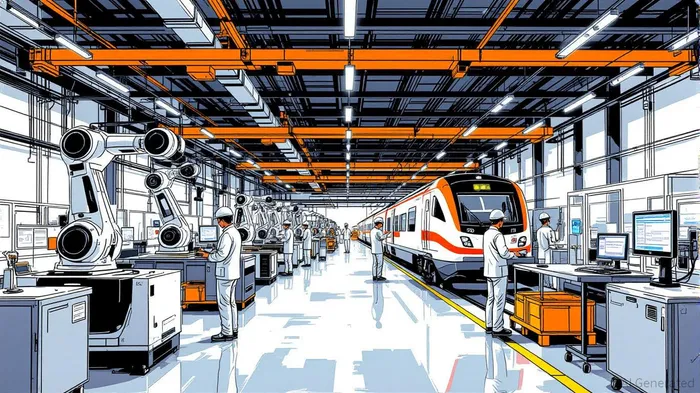
The U.S. rail sector is undergoing a transformative phase, driven by infrastructure policy, technological innovation, and a renewed focus on domestic manufacturing. At the forefront of this movement is Hitachi Rail’s Hagerstown factory in Maryland, a $100 million investment that exemplifies how strategic infrastructure projects can catalyze economic recovery while enhancing supply chain resilience. By analyzing this facility’s operational and economic impact, investors can gain insights into the long-term value of aligning with U.S. rail modernization efforts.
Economic Recovery Through Domestic Production
Hitachi Rail’s Hagerstown factory, which opened in September 2025, is a lighthouse for domestic manufacturing in the post-pandemic era. The facility, equipped with over $30 million in digital enhancements, produces 20 railcars monthly for major U.S. metropolitan areas, including Washington D.C., Baltimore, and Philadelphia [1]. This capacity is critical for fulfilling large-scale contracts, such as the $2.2 billion agreement to supply 256 8000-series railcars for the Washington Metro system, with pilot operations slated for late 2027 [2].
The economic ripple effects of this investment are substantial. The factory is projected to generate $350 million in annual added value for the region and create 460 direct jobs, with an additional 840 indirect roles supported through local supply chains [1]. These figures align with broader trends in reshoring, as highlighted in a CQ Researcher report, which notes that domestic manufacturing investments are bolstering regional economies amid global supply chain disruptions [3]. By prioritizing local production, Hitachi Rail reduces reliance on foreign imports, a strategy that mitigates geopolitical risks and accelerates project timelines for transit agencies.
Supply Chain Resilience and Technological Integration
The Hagerstown factory’s integration of advanced technologies—such as AI-driven quality control, 3D printing, and robotics like the “Spot” robot for defect detection—demonstrates how digital transformation can fortify supply chains [1]. These innovations not only improve production efficiency but also reduce lead times, a critical factor for transit systems facing aging infrastructure. For instance, the factory’s carbon-neutral design and zero-landfill operations underscore its alignment with sustainability goals, a growing priority for infrastructure funding under the Bipartisan Infrastructure Law [4].
Moreover, Hitachi Rail’s recent $724.3 million contract with SEPTA to supply 200 railcars for Philadelphia’s Market-Frankford Line further illustrates the scalability of its domestic production model [4]. By centralizing manufacturing in Hagerstown, the company avoids bottlenecks associated with overseas suppliers, ensuring consistent delivery of high-capacity, accessible railcars. This resilience is particularly valuable in an era where transit agencies must balance fiscal sustainability with service reliability amid shifting commuter patterns [3].
Policy Alignment and Long-Term Investment Potential
The Hagerstown factory’s success is inextricably linked to federal infrastructure policy. The Bipartisan Infrastructure Law, which allocates $66 billion for rail vehicle replacement, provides a robust funding framework for projects like Hitachi Rail’s [4]. Investors should note that such policies create a predictable demand environment, reducing the risk profile of infrastructure-related investments. Additionally, the factory’s emphasis on workforce development—through partnerships with local educational institutions—ensures a steady talent pipeline, further solidifying its long-term viability.
Conclusion
Hitachi Rail’s Hagerstown factory represents a confluence of strategic priorities: economic recovery, supply chain resilience, and policy-driven growth. By leveraging digital technologies and domestic production, the facility not only addresses immediate infrastructure needs but also positions itself as a cornerstone of the U.S. rail modernization agenda. For investors, this case study underscores the value of aligning with projects that combine technological innovation with alignment to national policy goals—a formula that promises both societal impact and financial returns.
Source:
[1] Hitachi Rail opens lighthouse digital factory in the US, [https://finance.yahoo.com/news/hitachi-rail-opens-lighthouse-digital-163000817.html]
[2] Washington Metro Unveils Livery for New 8000-Series Fleet, [https://railway-news.com/washington-metro-unveils-new-livery/]
[3] CQ Researcher - Reimagining Mass Transit, [https://cqpress.sagepub.com/cqresearcher/report/reimagining-mass-transit-cqresrre20240614]
[4] Hitachi Rail awarded SEPTA contract, [https://www.railwaypro.com/wp/hitachi-rail-awarded-septa-contract/]







Comentarios
Aún no hay comentarios