
Strategic Innovation in Energy Storage: Partnerships Powering the Future of Scalable, Efficient Grid Solutions
The global energy transition is accelerating, but its success hinges on one critical enabler: scalable, efficient energy storage. As renewable energy penetration surges, the need for advanced power conversion systems and long-duration storage solutions has never been more urgent. Recent industry partnerships are redefining the landscape, merging cutting-edge technologies with strategic alliances to address efficiency, scalability, and grid resilience. This analysis explores how these collaborations are unlocking new value chains and investment opportunities.
Partnerships as Catalysts for Innovation
The most transformative energy storage advancements are no longer born in isolation. Strategic partnerships are bridging gaps between material science, power electronics, and grid integration.
Form Energy and Iron-Air Batteries: Form Energy's 1.5MW/150MWh iron-air battery pilot in Minnesota exemplifies low-cost, long-duration storage. By leveraging iron, water, and air-materials with negligible cost-this technology could reduce storage costs to $0.02/kWh, a 90% drop from lithium-ion equivalents, according to a Power-Technology feature. The project's scalability is further amplified by its compatibility with modular power conversion systems, enabling seamless grid integration, as noted in the Power-Technology feature.
Eos Energy and Unico's Znyth™ Integration: Eos Energy's partnership with Unico to integrate high-efficiency DC-to-DC converters into its Znyth™ aqueous zinc battery systems is a case study in synergy. This collaboration reduces the physical footprint of utility-scale storage by 30% while boosting energy utilization to 95% efficiency, according to a MarketChameleon article. The U.S.-based manufacturing focus aligns with federal clean energy incentives, making it a prime candidate for IRA-driven growth, as the MarketChameleon article observes.
Google and Salt River Project's LDES Pilots: Google's collaboration with Arizona's Salt River Project (SRP) to deploy long-duration energy storage (LDES) underscores the role of tech giants in de-risking emerging technologies. These projects aim to provide 10+ hours of clean power at $0.05/kWh, a threshold critical for replacing fossil fuel peaker plants, according to a Google blog post. The partnership's emphasis on AI-driven grid management also highlights the growing importance of software in storage scalability, a point emphasized in the Google blog post.
Technological Breakthroughs: Power Conversion and Hybrid Systems
The heart of modern energy storage lies in power conversion efficiency and system flexibility. Innovations in wide-bandgap semiconductors and hybrid architectures are setting new benchmarks.
SiC and GaN Power Converters: Silicon carbide (SiC) and gallium nitride (GaN) devices are revolutionizing power electronics. Recent studies show GaN-based converters achieving 99% efficiency, a 75% reduction in energy losses compared to silicon-based systems, as reported in a ScienceDirect study. For example, GaN quasi-impedance source inverters outperform SiC counterparts in high-frequency applications, enabling compact, high-power-density designs, as shown in a comparative analysis. These advancements are critical for hybrid AC/DC microgrids, where bidirectional power flow and real-time control are essential, as noted in an MDPI article.
Hybrid Energy Storage Systems (HESS): Combining batteries, supercapacitors, and photovoltaics, HESS architectures optimize for both energy density and power response. A 2025 study demonstrated a hybrid system achieving 90% charging/discharging efficiency while extending battery lifespans by 40% through transient power management. Such systems are particularly valuable in isolated grids, where reliability and redundancy are paramount, according to a SpringerOpen article.
Policy and Market Dynamics: From Tariffs to Tax Credits
Policy frameworks are shaping the economics of energy storage. The Inflation Reduction Act (IRA) has been a game-changer, offering a 30% investment tax credit (ITC) for standalone storage projects-a first in U.S. policy, according to an Infolink analysis. This has spurred a 63 GW pipeline of utility-scale storage by 2027, with states like California and Texas leading the charge, as outlined in a Morgan Lewis roadmap. However, challenges persist: high import tariffs on lithium-ion components have increased costs by 15–20%, delaying projects in the U.S. market, per a BloombergNEF insight.
Investment Opportunities: Where to Focus
The most compelling opportunities lie at the intersection of technology leadership, strategic partnerships, and policy alignment:
- SiC/GaN Semiconductor Firms: Companies supplying materials and devices for next-gen converters (e.g., Wolfspeed, Infineon).
- Hybrid Storage Integrators: Firms like Eos EnergyEOSE-- and Alsym Energy, which combine proprietary chemistry with advanced power electronics.
- Grid Software Platforms: AI-driven energy management systems (e.g., Google's LDES pilots) that optimize hybrid storage networks.
Conclusion
Energy storage is no longer a niche sector-it is the backbone of the decarbonized grid. Partnerships like those between Eos and Unico, Google and SRP, and the U.S. Energy Storage Coalition are not just advancing technology; they are redefining the economics of scalability and efficiency. For investors, the key is to identify players at the nexus of innovative chemistry, next-gen power conversion, and policy tailwinds. The next decade will belong to those who can turn these collaborations into sustainable, grid-transforming solutions.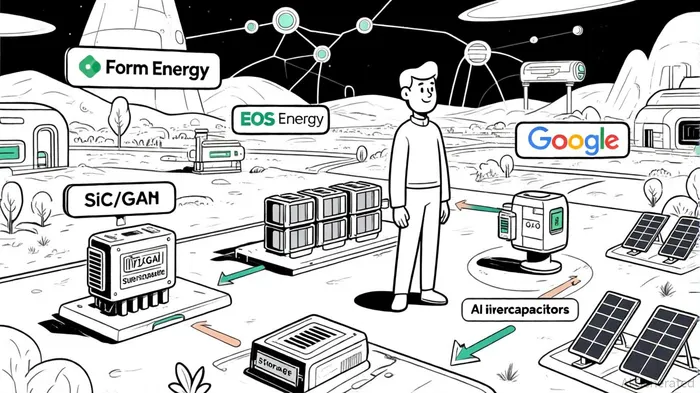







Comentarios
Aún no hay comentarios