
Strategic Industrial Investment in the UK's Modular Nuclear Energy Revolution: A Pathway to Decarbonization-Driven Growth
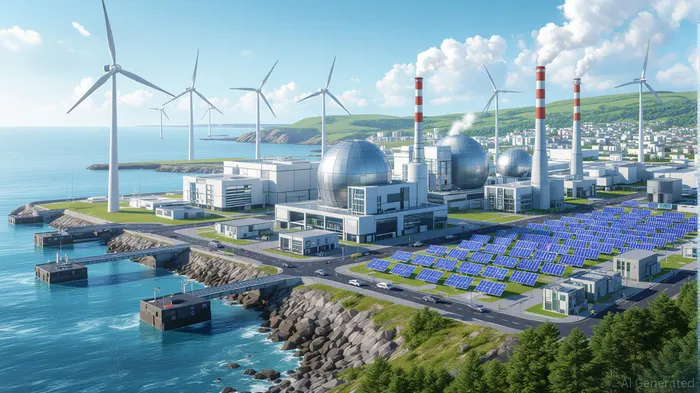
The United Kingdom is emerging as a global leader in the deployment of modular nuclear energy, positioning itself at the intersection of strategic industrial investment and decarbonization-driven growth. With a suite of government policies, private-sector partnerships, and technological advancements, the UK is accelerating the development of Small Modular Reactors (SMRs) and Advanced Modular Reactors (AMRs) to meet its net-zero targets while fostering economic resilience. This analysis explores the investment potential of the UK's modular nuclear sector, emphasizing its alignment with industrial strategy and climate goals.
Government-Led Momentum and Policy Frameworks
The UK's recent Atlantic Partnership for Advanced Nuclear Energy with the United States has catalyzed a transformative shift in nuclear deployment. By streamlining licensing processes—reducing approval timelines from three to four years to just two—the partnership addresses a critical bottleneck for first-of-a-kind projects [1]. This initiative is part of the UK's broader “golden age of nuclear” strategy, which aims to secure energy independence while reducing reliance on fossil fuels [4].
Central to this strategy is the selection of Rolls-Royce SMR as the preferred bidder for the UK's first SMR deployment, backed by £2.5 billion in government funding. The project, expected to power 3 million homes and create 3,000 jobs, underscores the government's commitment to scaling modular nuclear technology [5]. Complementing this, the updated national policy statement (EN-7) removes deployment time limits for SMRs and AMRs, enabling flexible siting at existing or decommissioned nuclear sites [3]. These policy changes reduce regulatory uncertainty, a key barrier for investors.
Private Sector Synergy and Economic Value
Private-sector engagement is amplifying the UK's modular nuclear ambitions. For instance, Centrica and X-Energy have committed to building 12 advanced modular reactors in Hartlepool, targeting 6 GW of capacity by 2030. This project alone is projected to generate £40 billion in economic value and 2,500 jobs, while transitioning Hartlepool's legacy nuclear site into a hub for advanced reactor technology [2]. Similarly, partnerships between Holtec and EDF, and Last Energy and DP World, are advancing SMR-powered data centers and micro modular reactors, diversifying nuclear applications beyond electricity generation [4].
Rolls-Royce SMR's supply chain strategy further illustrates the sector's industrial potential. By securing agreements with Curtiss-WrightCW-- and ŠKODA JS for reactor components and collaborating with CEZ on Czech deployments, the company is localizing manufacturing and creating cross-border economic synergies [3]. These efforts align with the UK's goal to develop a robust domestic supply chain, reducing costs through standardized, factory-based production [5].
Decarbonization Impact and Technological Innovation
Modular nuclear energy is pivotal to the UK's decarbonization roadmap. According to the 2025 Progress in Reducing Emissions report, the UK has achieved a 50.4% reduction in emissions compared to 1990 levels, with nuclear energy playing a growing role in displacing fossil fuels [1]. SMRs and AMRs are uniquely positioned to decarbonize hard-to-abate sectors, such as heavy industry and transportation, through applications like green hydrogen production and synthetic fuel manufacturing [5].
Technoeconomic analyses highlight the versatility of SMRs in hybrid systems. When combined with renewables, SMRs can reduce lifecycle CO₂ emissions by over 90% in urban energy systems, making them a cornerstone for smart cities [5]. Additionally, the UK Nuclear National Laboratory (UKNNL) is advancing R&D for AMRs, including their integration with industrial heat networks, which could avoid 4.6 million tons of CO₂ annually by displacing natural gas in industrial processes [1].
Challenges and Mitigation Strategies
Despite its promise, modular nuclear deployment faces challenges, including supply chain constraints and first-of-a-kind project risks. A 2025 report by HSF Kramer notes that regulatory complexities and construction delays could hinder timelines [6]. However, the UK government is proactively addressing these issues by streamlining permitting and investing in workforce training. For example, the Nuclear Strategic Plan, expected to outline interim targets and institutional roles, will provide clarity for investors and developers [1].
Investment Outlook and Future Trajectory
The UK's modular nuclear sector presents a compelling case for strategic industrial investment. With government funding, private-sector collaboration, and a clear policy framework, the sector is poised to deliver both economic and environmental returns. By 2050, the UK aims to generate 24 GW of nuclear capacity, a target that requires sustained investment in R&D, supply chain development, and regulatory agility [1].
Conclusion
The UK's modular nuclear energy revolution is not merely a technological shift but a strategic industrial investment opportunity. By aligning with net-zero goals, fostering cross-sector partnerships, and leveraging policy innovation, the UK is setting a global precedent for decarbonization-driven growth. For investors, the sector offers a unique convergence of long-term energy security, job creation, and climate action—a trifecta that is increasingly rare in today's energy landscape.







Comentarios
Aún no hay comentarios