
Strategic Industrial Alliances: Unlocking AI-Driven Semiconductor Manufacturing's Investment Potential Through Siemens and GlobalFoundries' Collaboration
The semiconductor industry stands at a pivotal inflection point, driven by the exponential demand for AI-enabled technologies across sectors ranging from autonomous systems to energy infrastructure. At the heart of this transformation lies a critical question: How can manufacturers scale production efficiency while addressing the complexities of next-generation chip design? The answer, increasingly, lies in strategic industrial partnerships that integrate AI-driven automation and digitalization. The collaboration between Siemens and GlobalFoundriesGFS-- (GF) exemplifies this trend, offering a blueprint for how cross-industry alliances can catalyze competitive advantage and unlock new investment opportunities in AI-enabled industrial transformation.
The Siemens-GF Collaboration: A Strategic Convergence of Expertise
Siemens and GF have forged a strategic partnership to deploy AI-driven manufacturing technologies, aiming to strengthen global semiconductor supply chains and enhance operational efficiency in chip production according to reports. This collaboration leverages Siemens' industrial automation and digitalization capabilities with GF's advanced process technology and design expertise, including RISC-V processor IP. Key focus areas include centralized AI-enabled automation, predictive maintenance, and advanced energy and building automation solutions. By integrating real-time control systems and AI-enabled software into semiconductor fabrication (fab automation), the partnership seeks to increase equipment availability by up to 40% and reduce downtime, while extending these innovations to broader advanced industries.
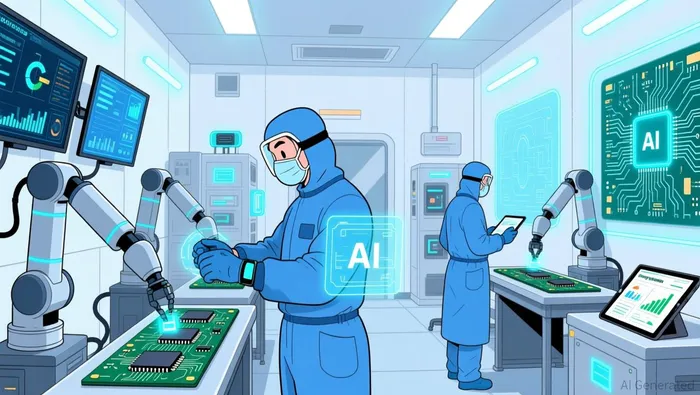
The strategic alignment between the two firms is not merely technological but also financial. For Q3 2025, GF reported revenue of $1.688 billion, with a gross margin of 24.8% and a non-IFRS gross margin of 26.0% according to financial reports. These metrics underscore the financial viability of AI-driven manufacturing, as GF's communications infrastructure and data center unit saw a 32% revenue increase to $175 million during the same period according to market analysis. Siemens, meanwhile, demonstrated robust performance with €2.9 billion in free cash flow for Q3 2025 and a 14.9% profit margin in its industrial business as reported in earnings. Such financial synergy highlights the potential for cross-industry partnerships to amplify returns in AI-enabled manufacturing.
Operational and Financial Outcomes: Quantifying the Impact
The Siemens-GF collaboration has already yielded measurable operational improvements. According to industry case studies, AI-driven automation can reduce production downtime by up to 40%, improve product quality by 32%, and boost worker productivity by 70% as research shows. These outcomes align with GF's recent focus on energy-efficient solutions, such as its 12LP+ FinFET and 22FDX® FD-SOI technologies, which reduce memory access energy consumption by 75% as noted in partnership announcements. By addressing the energy demands of AI systems-a critical challenge for data centers and edge IoT devices-GF is positioning itself as a leader in sustainable semiconductor manufacturing according to industry reports.
Financially, the partnership's impact is equally compelling. GF's Q3 2025 results revealed a 24.2% gross margin and an 11.6% operating margin, with net income reaching $249 million as reported in financial disclosures. These figures reflect the scalability of AI-driven manufacturing, as GF's Automotive and Communications Infrastructure markets contributed to double-digit year-over-year revenue growth according to market intelligence. Siemens' Q3 FY2025 earnings further reinforce this trend, with €2.2 billion in net income and a 14.9% profit margin in its industrial segment as detailed in earnings releases. Together, these metrics illustrate how strategic alliances can drive both operational efficiency and financial resilience in an increasingly competitive landscape.
Broader Implications and Investment Opportunities
The Siemens-GF collaboration is emblematic of a larger industry shift toward AI-enabled industrial transformation. As noted by Cedrik Neike, CEO of Digital Industries at Siemens, such partnerships are essential for making global semiconductor supply chains more resilient and enabling localized manufacturing according to company statements. This is particularly relevant in light of geopolitical tensions and the growing demand for secure, locally produced semiconductors as highlighted in industry analysis. GF's acquisition of MIPS, a leading supplier of AI and processor IP, further underscores the strategic value of IP integration in capturing market share according to market reports.
For investors, the implications are clear. The AI in semiconductor manufacturing market is projected to grow at a CAGR of 22.7% through 2033, driven by AI's role in improving yield and reducing defects as forecasted by industry analysts. Companies that prioritize cross-industry collaborations-like Siemens and GF-are well-positioned to capitalize on this growth. Additionally, GF's optimism about the physical AI market, which it estimates will surpass $18 billion by 2030 according to company projections, highlights the long-term potential of AI-driven manufacturing.
Conclusion: Strategic Alliances as a Catalyst for Competitive Advantage
The Siemens-GF collaboration demonstrates that strategic industrial partnerships are not just a competitive advantage but a necessity in the AI-driven semiconductor era. By combining Siemens' digitalization expertise with GF's process innovation, the partnership addresses critical challenges in efficiency, sustainability, and supply chain resilience. For investors, this model offers a roadmap for identifying high-potential opportunities in AI-enabled industrial transformation. As the semiconductor industry continues to evolve, those who prioritize strategic alliances will likely lead the charge in shaping the future of manufacturing-and reaping the financial rewards that come with it.





Comentarios
Aún no hay comentarios