
The Strategic Value of India's Delivery Tech Boom: A Deep Dive into Swiggy's $1.1B Opportunity
India's delivery tech sector is no longer a nascent experiment-it is a hypergrowth engine reshaping the e-commerce and logistics landscape. With the e-commerce logistics market projected to surge from USD 3.98 billion in 2024 to USD 10.4 billion by 2033 at a 10.10% CAGR, and hyperlocal delivery gross order values expected to hit Rs. 2,00,000 crore (US$ 23.34 billion) by FY28 according to data, the stakes for players like Swiggy have never been higher. At the heart of this transformation lies a critical question: How is Swiggy leveraging its $1.1 billion opportunity in 2025 to secure dominance in a fiercely competitive market?
The Hyperlocal Gold Rush: Swiggy's 25–27% Market Share and Strategic Expansion
Swiggy's Instamart segment currently holds 25–27% of India's quick-commerce market share, trailing only Blinkit and Zepto. This position is not accidental but a result of aggressive expansion into Tier 2 and Tier 3 cities, where 60% of new e-retail customers have emerged since 2020. By scaling its dark store network to 127 cities and introducing 15-minute delivery options, Swiggy is capitalizing on the hyperlocal delivery boom.
The company's financials reflect this ambition. In Q2 FY25, Swiggy reported a 54% revenue surge to ₹49.61 billion, driven by Instamart's 108% growth in gross order value. However, this growth comes at a cost: a near-doubling of net losses to ₹11.97 billion, underscoring the high burn rates typical of hypergrowth sectors according to analysis. Yet, these losses are a calculated risk. As one analyst notes, "The quick-commerce race is a marathon, not a sprint. Swiggy's ability to scale infrastructure while maintaining operational flexibility will define its long-term success" according to industry insights.
The $1.1B Opportunity: Budget-Focused Innovation and AI-Driven Efficiency
Swiggy's $1.1 billion opportunity in 2025 is anchored in two pillars: budget-focused innovation and AI-driven logistics optimization. The launch of Toing, a budget food delivery app in Pune, exemplifies the former. By targeting price-sensitive consumers-a demographic representing over 60% of India's population-Swiggy is diversifying its revenue streams while mitigating margin pressures. This mirrors broader industry trends, where brands are adopting hyper-local targeting and dynamic pricing to align with real-time demand.
On the technology front, Swiggy's AI and automation initiatives are redefining last-mile delivery. The company's route optimization algorithms, powered by machine learning, have reduced delivery times by 15–20% in pilot cities. Meanwhile, its adoption of electric vehicles (EVs) and micro-fulfillment centers aligns with India's sustainability mandates and consumer preferences for eco-friendly logistics according to market analysis. These innovations are not just operational upgrades-they are strategic differentiators in a market where delivery speed and cost efficiency are non-negotiable.
Competitive Positioning: Navigating a Crowded Field
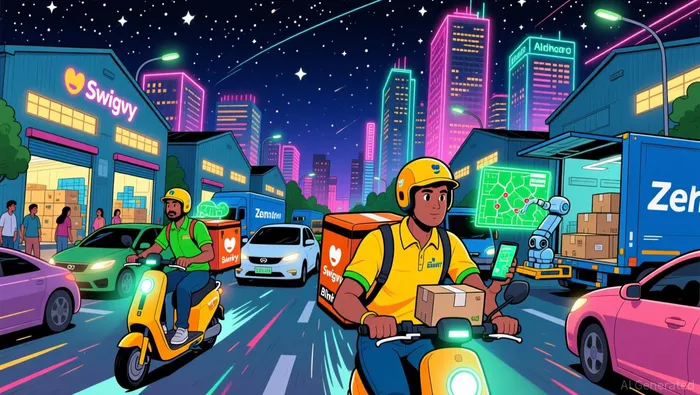 Swiggy's competitive edge lies in its multi-vertical ecosystem-food delivery, Instamart, Genie, and now, budget-focused Toing. This diversification contrasts with rivals like Blinkit and Zepto, which remain hyper-focused on quick commerce. By integrating AI-driven logistics across all verticals, Swiggy creates a flywheel effect: data from food delivery informs Instamart inventory management, while Genie's on-demand services refine last-mile delivery algorithms according to Q4 financial reports.
However, the path to dominance is fraught with challenges. Competitors are adopting aggressive pricing strategies, and profit margins in quick commerce remain razor-thin. To counter this, Swiggy is leveraging data-driven marketing and omnichannel pricing strategies. For instance, its Swiggy One subscription program enhances customer retention through personalized benefits, while dynamic pricing rules adjust in real time to competitor moves. These tactics mirror industry best practices, where brands use historical sales data and competitor intelligence to anticipate market shifts.
The Road Ahead: Sustainability and Scalability
Swiggy's $1.1 billion opportunity hinges on its ability to balance scalability with sustainability. While its current losses are a concern, the company's strategic acquisitions (e.g., Lynk for food retailing) and focus on green logistics position it for long-term resilience according to financial analysis. Moreover, India's government initiatives-such as digital transaction infrastructure upgrades and last-mile delivery partnerships with India Post-provide a tailwind for growth according to market reports.
Yet, the risks are real. Regulatory hurdles, infrastructure gaps, and the high cost of customer acquisition could derail progress. As one report warns, "The quick-commerce sector is a high-stakes game. Only players with deep pockets and operational agility will survive the next 18–24 months" according to industry forecasts. For Swiggy, this means maintaining its aggressive R&D spend on AI and automation while prudently managing capital expenditures.
Conclusion: A High-Stakes Bet with High Rewards
India's delivery tech boom is a testament to the power of innovation in emerging markets. For Swiggy, the $1.1 billion opportunity represents more than a financial target-it is a strategic inflection point. By leveraging AI, hyperlocal expansion, and budget-focused innovation, the company is positioning itself as a leader in a sector projected to grow at a 24.44% CAGR. However, success will require navigating intense competition, maintaining operational discipline, and staying ahead of the curve in sustainability and technology.
As the dust settles on this hypergrowth phase, one thing is clear: Swiggy's ability to adapt and execute will determine whether it becomes a market leader or a cautionary tale in India's delivery tech race.







Comentarios
Aún no hay comentarios