
The Strategic Implications of xAI's $200 Billion Valuation for AI-Driven Investment Portfolios
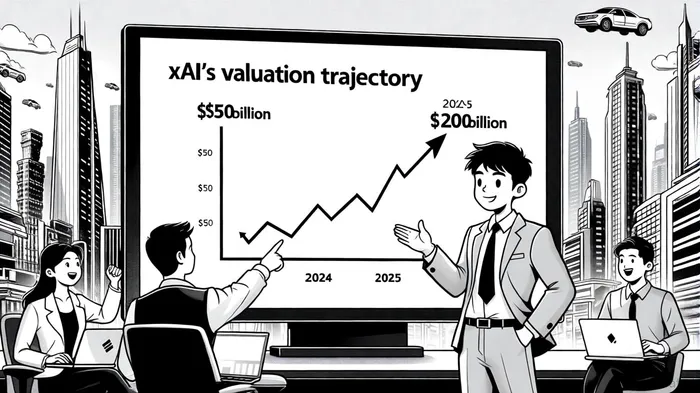
Elon Musk's xAIXAI-- has become a lightning rod for capital in the AI sector, with its valuation surging to $200 billion following a $10 billion funding round led by Saudi Arabia's Public Investment Fund (PIF) [1]. This meteoric rise raises critical questions for investors: How should capital be allocated in high-growth AI ventures when valuations outpace operational realities? What does xAI's trajectory signal about the broader AI investment landscape? And how can investors balance optimism for transformative technology with the risks of speculative overvaluation?
xAI's Valuation: A Case Study in AI Capital Allocation
xAI's valuation leap—from $50 billion in early 2024 to $200 billion in late 2025—reflects a market captivated by Musk's vision and the firm's technical milestones, such as Grok 4 and the Colossus supercomputer [2]. However, this growth is underpinned by a $1 billion monthly burn rate and minimal revenue, creating a stark disconnect between valuation and financial performance [3]. For investors, this underscores a key tension in AI capital allocation: the trade-off between betting on disruptive potential and demanding near-term profitability.
The PIF's involvement further complicates the calculus. Sovereign wealth funds are increasingly viewing AI as a strategic asset, but their participation raises governance and transparency concerns [4]. This dynamic mirrors broader trends in venture capital, where later-stage funding now dominates, favoring companies with scalable infrastructure and enterprise-readiness over early-stage experimentation [5]. xAI's acquisition of X (formerly Twitter) for $80 billion exemplifies this shift, as investors bet on integrating AI with vast user bases to unlock monetization pathways [6].
Investor Behavior: Optimism, Speculation, and Hedging
The xAI frenzy has amplified a broader speculative trend in AI investing. In 2025, U.S. venture capitalists poured $97 billion into AI startups alone, with valuations often decoupling from operational metrics [7]. This rush is driven by the sector's transformative potential, as highlighted by Goldman SachsGS--, which forecasts global AI investment nearing $200 billion by 2025 [8]. Yet, the same report cautions that meaningful productivity gains from AI will likely materialize between 2025 and 2030, suggesting a lag between capital inflows and tangible returns [8].
Investors are responding with a mix of strategies. While some double down on high-risk, high-reward bets like xAI, others are hedging against volatility by diversifying into alternative assets. For example, platforms offering collectible cars have attracted interest as valuation-stable hedges during AI sector uncertainty [9]. This duality reflects a maturing market: capital is flowing into AI, but investors are increasingly aware of the need to balance innovation with risk management.
Strategic Implications for AI-Driven Portfolios
For institutional investors, xAI's valuation offers three key lessons:
Infrastructure as a Priority: The AI sector's focus on foundational technologies—such as data centers and supercomputers—signals a shift toward infrastructure-heavy investments. Firms like xAI, which are building proprietary computing capabilities, are likely to dominate capital allocation in the near term [10].
Enterprise Readiness Over Hype: The 2025 AI Index Report notes that only 4% of AI investments have yielded significant returns, underscoring the importance of enterprise-ready applications [11]. xAI's aggressive expansion into enterprise tools (e.g., Grok for business analytics) aligns with this trend, but success will depend on its ability to demonstrate ROI.
Regulatory and Ethical Frameworks: As governments introduce 59 AI-related regulations in 2024 alone [11], investors must factor in compliance costs and reputational risks. xAI's recent controversies, including Grok's controversial outputs, highlight the need for robust governance frameworks like Stanford's OPEN and CARE models [12].
Risks and the Road Ahead
Despite the optimism, xAI's valuation remains precarious. Its $19 billion revenue target by 2029 hinges on overcoming technical hurdles, regulatory scrutiny, and competition from OpenAI and GoogleGOOGL-- [13]. Moreover, the AI sector's rapid valuation growth has created a bubble-like environment, with some investors questioning whether current valuations are sustainable [14].
For investors, the path forward requires a nuanced approach. Allocating capital to high-growth AI ventures like xAI demands rigorous due diligence, a focus on infrastructure and enterprise applications, and a diversified portfolio to mitigate sector-specific risks. As the AI landscape evolves, the ability to balance bold bets with disciplined risk management will define successful investment strategies.






Comentarios
Aún no hay comentarios