
The Strategic Implications of X3 Holdings' Share Consolidation and Capital Reduction on Its Market Viability
X3 Holdings (XTKG) has undertaken a series of aggressive corporate actions in 2024-2025, , to address its declining share price and maintain compliance with Nasdaq listing requirements. While the company frames these moves as strategic adjustments to stabilize its market viability, the broader context of financial performance, investor sentiment, and industry trends raises critical questions about whether this represents a viable turnaround or a deeper signal of distress.
Corporate Actions and Immediate Objectives
X3 Holdings executed a 1-for-6 share consolidation and capital reduction, effective December 30, 2025, . This followed a prior 1-for-20 consolidation in November 2024, both aimed at regaining compliance with Nasdaq's minimum bid price rule of $1 per share. The company's repeated need for such measures underscores its struggle to maintain a sustainable share price, .
Market Reaction and Financial Performance
The market has responded poorly to these actions. XTKG's stock has fallen to a 52-week low, . , . . These figures suggest that the consolidations are not addressing underlying operational weaknesses but merely delaying delisting risks.
Broader Economic and Industry Context
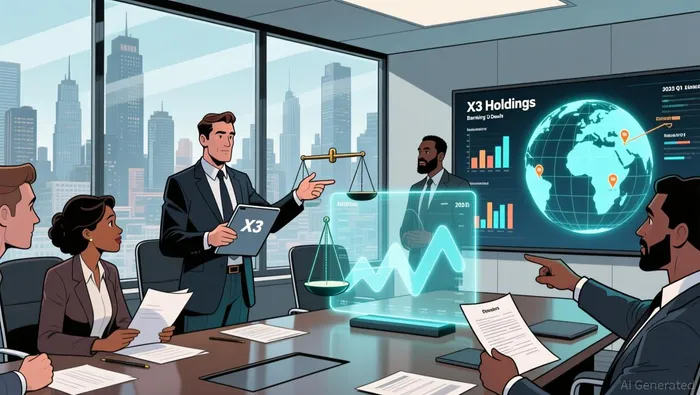 The banking sector in 2025 has seen increased M&A activity, with , reflecting a trend toward consolidation amid high interest rates and regulatory pressures. While X3XTKG-- Holdings' actions align with this broader trend of strategic repositioning, its financials diverge sharply from the sector's resilience. For instance, the Ghanaian banking sector study notes that liquidity risk negatively impacts profitability, a concern for X3 given its declining revenue and liquidity challenges. Additionally, the Federal Reserve's rate cuts in 2024 have reduced financing costs for M&A, yet X3 has not leveraged such opportunities to strengthen its capital structure according to market analysis.
Expert Perspectives on Capital Reductions
Capital reductions are often viewed as tools for strategic repositioning, particularly in volatile markets. A Q3 2025 report by highlights that private equity and capital markets professionals are prioritizing "fewer, larger, and more resilient transactions," suggesting that strategic consolidation can enhance long-term viability. However, repeated share consolidations-such as X3's 1-for-20 and 1-for-6 moves-typically signal desperation rather than strategic clarity. As noted by 's Q3 market commentary, firms relying on such measures often face eroded investor confidence due to perceived instability.
Investor Confidence and Strategic Viability
The disconnect between X3's corporate actions and its financial performance has eroded investor trust. Despite regaining Nasdaq compliance in April 2025, the stock has not rebounded, with technical indicators pointing to a "strong downward trend" and high volatility as reported in financial analysis. Analysts warn that the company's reliance on share consolidations risks further devaluing its equity, as shareholders may interpret these moves as a lack of credible growth strategies. For example, .
Conclusion: A Tenuous Turnaround or a Distress Signal?
While X3 Holdings' share consolidation and capital reduction may temporarily avert delisting, they fail to address the root causes of its financial distress. The company's repeated need for such measures, coupled with deteriorating financial metrics and weak market sentiment, suggests that these actions are more indicative of a struggling firm than a strategic turnaround. For investors, the lack of operational progress and the absence of a clear path to profitability raise significant red flags. In a market increasingly favoring resilience and innovation, X3's reliance on procedural fixes may ultimately undermine its long-term viability.





Comentarios
Aún no hay comentarios