
The Strategic Implications of Whale Activity in the Ethereum Market
Whale Accumulation and Market Sentiment
Whale activity has long been a barometer of institutional confidence in crypto markets. , with much of this supply staked to reduce circulating liquidity. This accumulation, coupled with regulatory clarity (e.g., the SEC's informal classification of Ethereum as a commodity), has reinforced a bullish narrative. However, retail investor psychology remains a mixed signal. While informed traders are drawn to Ethereum's deflationary supply dynamics, many retail participants remain cautious, waiting for confirmation of a sustained upward trend.
The , a key metric for gauging retail sentiment, now incorporates whale movements as a core component. For instance, a high ratio of Ethereum-to-stablecoin transfers signals selling intent and aligns with "extreme greed," while stablecoin-to-Ethereum flows indicate buying intent and "fear-driven" accumulation. This duality highlights how whale actions can both validate and distort market psychology. , which triggered debates about whether it reflected bearish conviction or leveraged speculation.
Timing Risks: False Breakouts and Rapid Reversals
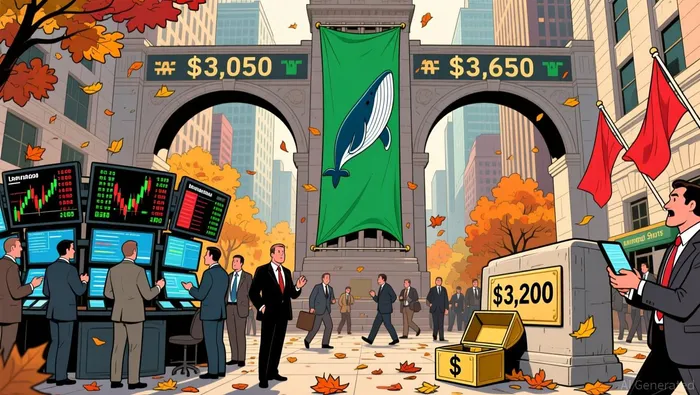
Whale-driven volatility introduces acute timing risks, particularly during critical price levels. For example, Ethereum's recent bullish harami pattern-a potential reversal signal-has been clouded by conflicting whale signals. , others are liquidating, reducing mega-whale addresses since November. This divergence creates fertile ground for false breakouts and rapid reversals.
Data from the Federal Reserve Bank of Philadelphia underscores this risk: with next-day returns, suggesting their trades often trigger short-term price dislocations. Unlike ETF-driven trends, , , . For instance, a whale's leveraged short position on Hyperliquid could exacerbate volatility if unexpected macroeconomic events-such as interest rate hikes-trigger panic selling.
ETFs vs. Whales: A New Market Equilibrium
The rise of Ethereum ETFs has introduced a stabilizing force to a market historically dominated by whale activity. Institutional flows via ETFs create sustained price trends, smoothing out the acute volatility caused by whale transactions. For example, , dwarfing the immediate impact of whale-driven trades. This shift suggests a maturing market where institutional adoption and whale behavior coexist, but with ETFs providing a more predictable baseline.
However, whales retain strategic influence during key inflection points. signaled a potential local bottom. Analysts like caution that Ethereum must hold the $3,000-3,400 support range to transition into a low-volatility accumulation phase, avoiding a repeat of 2023's sharp reversals.
Conclusion
The Ethereum bull cycle of 2024-2025 is defined by a delicate interplay between whale activity, retail sentiment, and institutional flows. While whales continue to act as both catalysts and contrarians, their influence is increasingly tempered by ETF-driven stability. For investors, the key lies in distinguishing between whale-driven noise and structural trends-particularly as the market approaches critical psychological and technical levels. As the Federal Reserve's data and on-chain metrics suggest, the next phase of Ethereum's journey will likely hinge on whether whales and ETFs can align their trajectories.






Comentarios
Aún no hay comentarios