
The Strategic Implications of Warner Bros. Discovery Rejecting Paramount's Hostile Bid
The recent decision by Warner Bros.WBD-- Discovery (WBD) to reject Paramount Skydance's $108 billion hostile takeover bid has ignited a critical debate about the interplay between shareholder value and strategic fit in media consolidation. This move, announced amid a broader industry shift toward streaming dominance and regulatory scrutiny, underscores the delicate balance companies must strike between short-term financial incentives and long-term strategic alignment. By examining WBD's rationale and contextualizing it within historical media merger trends, this analysis explores how the rejection of Paramount's offer reflects a calculated prioritization of strategic coherence over speculative financial gains.
Strategic Fit: The NetflixNFLX-- Merger as a Counterpoint
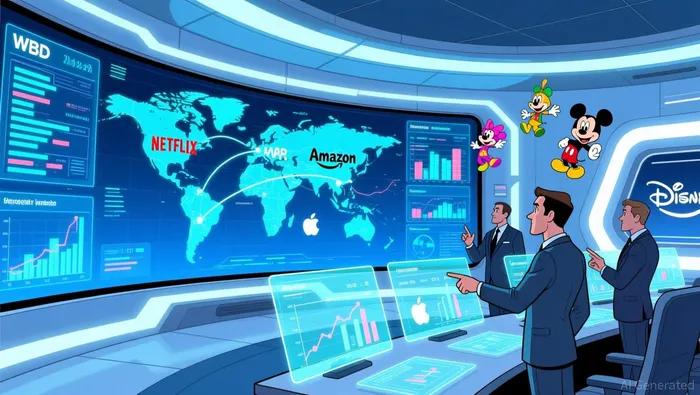
WBD's decision to pursue a $72 billion merger with Netflix Inc. rather than accept Paramount's bid highlights a clear emphasis on strategic fit. The Netflix deal, which includes the acquisition of HBO and HBO Max, aligns with WBD's goal of consolidating its streaming assets into a single, globally competitive platform. This move mirrors the success of Disney's strategic acquisitions of Pixar, Marvel, and Lucasfilm, which not only expanded its intellectual property (IP) library but also revitalized its creative output and market dominance. By integrating Netflix's established streaming infrastructure with WBD's content pipeline, the merger aims to create a unified entity capable of competing with Amazon and Apple in the high-stakes streaming wars.
In contrast, Paramount's bid-while financially ambitious-lacked the same level of strategic coherence. The financing structure, backed by a revocable trust managed by Larry Ellison, introduced significant uncertainty, as the assets could be withdrawn at any time. Additionally, the withdrawal of Affinity Partners, a key financial backer, further eroded confidence in the bid's stability. These structural weaknesses contrast sharply with the Netflix deal, which offers a more predictable path to integration and operational synergy.
Shareholder Value: The Risks of Speculative Offers
While Paramount's $30-per-share offer represented a premium over WBD's stock price, the board's rejection signals skepticism about the bid's ability to deliver long-term shareholder value. Historical media mergers, such as the 2000 AOL-Time Warner collapse, demonstrate that high-profile deals often fail to materialize promised synergies when strategic misalignment exists. WBD's leadership appears to have drawn lessons from such precedents, prioritizing a deal with Netflix that offers tangible cost synergies and revenue diversification over a speculative offer with uncertain execution.
Financial data from past media mergers further supports this approach. According to EY research, companies engaging in frequent, strategically aligned M&A activity between 2020 and 2025 achieved enterprise values three times higher than non-buyers and total shareholder returns (TSR) double that of their peers according to EY research. WBD's decision to separate into two entities-a streaming-focused division and a traditional media division-also aligns with this principle, as it allows for more targeted value creation by addressing distinct market dynamics.
The Role of Financing and Regulatory Dynamics
The rejection of Paramount's bid also reflects broader concerns about financing structures and regulatory risks. The involvement of Larry Ellison's revocable trust, coupled with the withdrawal of Affinity Partners, introduced volatility that could destabilize the deal post-closure. This contrasts with the Netflix merger, which leverages Netflix's existing financial strength to fund the acquisition, reducing reliance on external financing mechanisms.
Regulatory scrutiny further complicates the landscape. The Writers Guild of America (WGA) has already raised concerns about potential job cuts and wage reductions under a Paramount-led WBDWBD--, signaling potential pushback from labor groups. In contrast, the Netflix merger aligns with a more established corporate culture, potentially mitigating regulatory and reputational risks.
Conclusion: A Blueprint for Media M&A in the Streaming Era
WBD's rejection of Paramount's bid and its pivot toward a Netflix merger exemplifies a strategic approach that prioritizes alignment of business models, operational synergy, and long-term value creation over short-term financial premiums. This decision aligns with broader industry trends, where successful media mergers-such as Disney's IP-driven acquisitions and Walmart's e-commerce expansion-have demonstrated that strategic fit is a stronger predictor of shareholder returns than deal size alone according to industry analysis.
As the media landscape continues to consolidate, companies must heed these lessons. The WBD-Netflix deal, if executed effectively, could set a new benchmark for how strategic coherence and disciplined integration drive sustainable value in an increasingly fragmented market.





Comentarios
Aún no hay comentarios