
The Strategic Implications of the Venezuela Oil Blockade for Global Energy Markets
The Venezuela oil sector, once a cornerstone of global energy supply, remains a focal point of geopolitical tension and market volatility. As of 2025, Venezuela's oil production has rebounded to approximately 1.11 million barrels per day, with exports reaching 784,000 bpd in November alone, according to a report by the Foundation for Defense of Democracies. While this marks a recovery from the 2020 trough, it still lags far behind the country's historical peak. 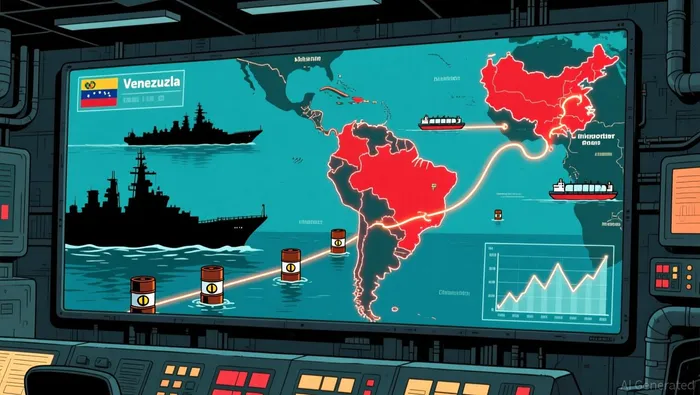 The resurgence, however, has been shadowed by U.S. sanctions and military actions, including the seizure of a sanctioned supertanker and expanded restrictions on vessels linked to the Maduro government. These measures aim to choke Venezuela's revenue streams, yet the country has persisted in exporting crude, with China absorbing 81% of its Q3 2025 shipments according to analysis. This dependency underscores both the resilience of Venezuela's oil sector and the risks of overreliance on a single buyer.
Energy firms are recalibrating their strategies in response to the Venezuela oil blockade. The U.S.-led disruption of sanctioned tankers in late 2025 triggered a 2.4% surge in West Texas Intermediate prices, as highlighted by OilPrice.com. This volatility has forced refiners, particularly in China, to demand steep discounts-up-to $21 per barrel below Brent benchmarks-for Venezuelan crude to offset the risk of U.S. interception according to analysis. The situation has also created a logistical bottleneck, with 11 million barrels of crude stranded on tankers awaiting shipment. Chevron, the sole U.S. firm unaffected by disruptions, exemplifies the uneven impact of sanctions, raising questions about the efficacy of selective enforcement according to market analysis.
The broader implications for global energy markets are profound. Energy firms are accelerating diversification of supply chains to mitigate exposure to politically unstable regions. This trend is evident in the increased procurement of Russian and Iranian oil, as noted in a report by Discovery Alert. However, Venezuela's heavy crude, which requires specialized processing infrastructure, limits the ability of other countries to substitute for its supply. This technical constraint, combined with geopolitical risks, has created a niche market for Venezuelan oil that remains both lucrative and precarious.
The Trump administration's approach to Venezuela's OPEC membership further complicates the landscape. Despite U.S. criticism of OPEC, the administration has avoided pushing for Venezuela's expulsion, recognizing that such a move could undermine U.S. influence over a post-Maduro government. This strategic ambiguity reflects a broader calculus: maintaining pressure on Maduro while preserving leverage in potential future negotiations. For investors, this duality highlights the importance of hedging against both political and technical risks.
Long-term recovery in Venezuela's oil sector hinges on the lifting of sanctions and renewed international investment. Wood Mackenzie estimates that production could rebound to 2 million bpd within one to two years if operational and financial support is secured according to analysis. However, this scenario assumes a stabilization of the geopolitical environment-a condition far from guaranteed. Academic research further suggests that sanctions often spur adaptive responses, such as Venezuela's use of shadow fleets and clandestine export networks according to studies. These tactics, while effective in the short term, underscore the fragility of the current system.
For energy investors, the Venezuela oil blockade serves as a case study in the interplay of geopolitics and market dynamics. The key takeaway is the necessity of strategic flexibility: diversifying supply sources, securing insurance against geopolitical disruptions, and closely monitoring policy shifts in both the U.S. and OPEC. While the immediate risks are significant, the potential for a rebound in Venezuelan production-should sanctions ease-presents a compelling, albeit high-risk, opportunity.







Comentarios
Aún no hay comentarios