
The Strategic Implications of Trump's 15% Revenue Cut on U.S. Tech Giants in China: Balancing Profit and Power in the AI Era
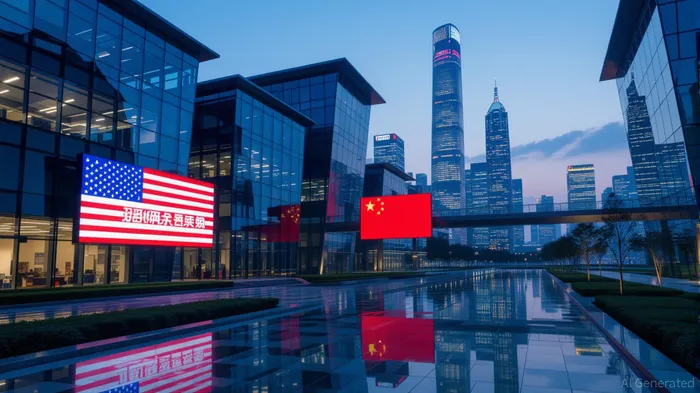
The Trump administration's 15% revenue-sharing agreement with U.S. tech firms like NvidiaNVDA-- and AMDAMD-- for AI chip sales in China has ignited a fierce debate about the future of global trade, corporate profitability, and the role of government in shaping technological competition. This policy, which requires companies to cede 15% of their revenue from specific AI chips (e.g., Nvidia's H20 and AMD's MI308) to the U.S. government, marks a radical departure from traditional export controls. While it secures immediate access to China's $400 billion AI infrastructure market, it also raises critical questions about long-term profitability, geopolitical risk, and the precedent it sets for U.S. export policy in the AI era.
Profitability: A Double-Edged Sword
The 15% cut directly impacts the bottom lines of U.S. semiconductor firms. For Nvidia, which generated $17 billion in Chinese revenue in its last fiscal year (13% of total sales), the policy could reduce gross margins by 8–10 percentage points. AMD, with $6.2 billion in Chinese revenue (24% of total sales), faces a similar margin drag of 5–7 percentage points. Bernstein analysts estimate that Nvidia's H20 sales alone could generate $23 billion in 2025, translating to a $3.45 billion annual payment to the U.S. government.
The market has already priced in this margin compression. Nvidia's price-to-earnings (P/E) ratio fell from 50x in early 2025 to 42x by August, while AMD's dropped from 60x to 52x. Investors are recalibrating expectations, factoring in the structural drag on earnings. However, the policy also preserves access to a market growing at a 35% compound annual growth rate (CAGR), which could offset margin pressures if AI infrastructure demand in China continues to surge.
Geopolitical Risk: A Precipice of Uncertainty
The arrangement introduces a new layer of geopolitical risk. By monetizing export permissions, the U.S. government has blurred the line between national security and fiscal policy. Critics argue this creates a “pay-to-play” model that could erode the credibility of export controls as a security tool. For instance, if China retaliates by imposing similar fees on U.S. imports or accelerating its self-reliance in semiconductor technology, U.S. firms could face a dual threat: reduced profitability and diminished market share.
Chinese rivals like Huawei and AlibabaBABA-- are already capitalizing on this shift. Huawei's Ascend 910D and Alibaba's CloudMatrix 384 are challenging U.S. designs in niche applications, signaling a broader push toward indigenous innovation. The U.S. government's own rationale—that controlled access to American chips is preferable to China developing alternatives—risks backfiring if it accelerates this transition.
Moreover, the policy's constitutionality is under scrutiny. The U.S. Constitution prohibits export taxes, and legal challenges could force the administration to revise or abandon the arrangement. Such uncertainty complicates long-term planning for tech firms, which must now factor in the possibility of abrupt regulatory shifts.
Precedent: A New Era of Export Policy?
The 15% model sets a dangerous precedent. By embedding financial concessions into export licenses, the U.S. government has created a template that could be replicated in other industries or extended to more advanced chips (e.g., Nvidia's Blackwell line, which could face 30–50% cuts). This approach risks transforming export controls into a revenue-generating mechanism, undermining their strategic purpose.
The administration's broader “reciprocal tariff” strategy—where U.S. companies pay for access to foreign markets—further complicates the landscape. While this aims to level the playing field against countries like China, it also introduces a zero-sum dynamic that could escalate trade tensions. For investors, the key question is whether this model will be sustained or abandoned under future administrations, adding another layer of volatility to tech sector valuations.
Investment Implications: Navigating the New Normal
For long-term investors, the 15% policy presents a complex trade-off. On one hand, it ensures continued access to a critical growth market, which is essential for sustaining AI innovation. On the other, it introduces financial and regulatory risks that could erode margins and deter R&D investment.
- Monitor Key Metrics: Track quarterly revenue from China, R&D spending, and geopolitical developments. A decline in China sales or a spike in R&D costs could signal deteriorating profitability.
- Diversify Exposure: Consider hedging against geopolitical risks by investing in firms with diversified supply chains or those focusing on non-China markets (e.g., Europe, Southeast Asia).
- Assess Strategic Resilience: Prioritize companies that are investing in U.S. AI infrastructure (e.g., Nvidia's $500 billion pledge to build AI servers) to offset the financial burden of the 15% cut.
The Trump administration's 15% revenue-sharing policy is a bold experiment in monetizing trade policy. While it offers short-term access to China's AI market, its long-term success hinges on the ability of U.S. firms to adapt to a bifurcated global landscape and the government's capacity to balance profitability with strategic interests. For investors, the path forward requires a nuanced understanding of both the opportunities and risks inherent in this new era of U.S.-China tech competition.





Comentarios
Aún no hay comentarios