
Strategic Implications of TotalEnergies and RWE Winning the Centre Manche 2 Offshore Wind Tender
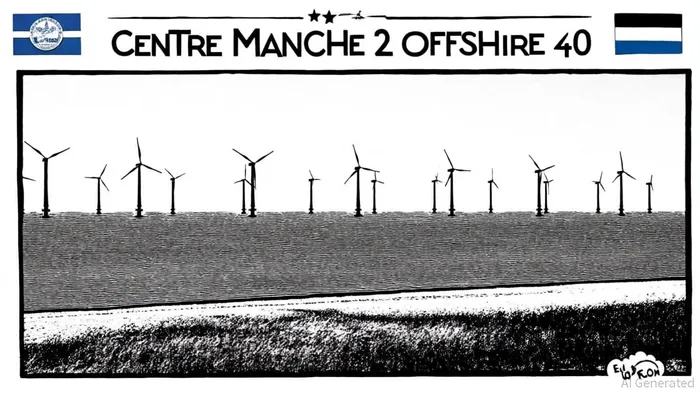
The recent awarding of the Centre Manche 2 offshore wind tender to a consortium of TotalEnergiesTTE-- and RWE marks a pivotal moment in Europe's energy transition. This 1.5 gigawatt (GW) project, located 40 kilometers off the coast of Normandy, represents a €4.5 billion investment—the largest by TotalEnergies in France in three decades—and is expected to power over one million households by 2033 at a competitive rate of €66/MWh [1]. While RWE's planned exit from the consortium introduces uncertainty, TotalEnergies' commitment to proceed underscores its strategic pivot toward renewable energy leadership in Europe.
The EU's Energy Transition: A Booming Market
Europe's offshore wind sector is poised for explosive growth, driven by ambitious policy frameworks and technological innovation. According to a report by the EU Blue Economy Report 2025, the bloc aims to achieve 111 GW of offshore wind capacity by 2030 and 317 GW by 2050, with renewables accounting for 42.5% of the energy mix by 2030 [2]. The market itself is projected to expand at a compound annual growth rate (CAGR) of 8.112% from 2025 to 2035, reaching €21.0 billion by 2035 [3]. This growth is fueled by floating wind turbine technology, energy security concerns, and the global push for decarbonization.
TotalEnergies and RWE: Strategic Moves in a Competitive Landscape
TotalEnergies and RWE are deepening their footholds in Europe's offshore wind sector through high-impact projects. The Centre Manche 2 tender, awarded to the duo, is the largest renewable energy initiative in France to date [1]. However, RWE's decision to exit the consortium highlights the sector's evolving dynamics. TotalEnergies, now the sole operator, is exploring new partners to ensure the project's completion, a move that signals its long-term commitment to France's energy transition [1].
Simultaneously, TotalEnergies is expanding its German portfolio by acquiring a 50% stake in two 2 GW North Sea projects (N-9.1 and N-9.2), scheduled to come online in 2031 and 2032 [4]. These projects align with its broader strategy to integrate offshore wind with green hydrogen production and flexible assets, creating a decarbonized industrial ecosystem. RWE, meanwhile, remains a key player in Germany and the Netherlands, where it co-owns the 760 MW OranjeWind project [4].
Environmental and Economic Impact: A Win for Europe
The Centre Manche 2 project is not just a technical feat but a socio-economic catalyst. It will create 2,500 jobs during construction and prioritize European suppliers for wind turbines and electrical cables, reinforcing local supply chains [1]. Environmentally, TotalEnergies has pledged €45 million for impact mitigation and a €15 million biodiversity fund, alongside a 95%+ recycling rate for components [1]. These measures align with the EU's stringent sustainability criteria and position the project as a model for future offshore developments.
Investment Opportunities and Risks
For investors, the Centre Manche 2 project and similar initiatives represent long-term value creation. The EU's policy-driven growth, coupled with TotalEnergies' and RWE's strategic partnerships, offers exposure to a sector with strong tailwinds. However, risks such as regulatory shifts, supply chain bottlenecks, and technological uncertainties (e.g., floating wind scalability) must be monitored.
Conclusion: A Wind of Change
The Centre Manche 2 tender is more than a win for TotalEnergies and RWE—it's a testament to Europe's resolve to lead the global energy transition. As the EU races toward its 2030 targets, companies that combine scale, innovation, and sustainability will outperform. For investors, the message is clear: offshore wind is not just a trend but a transformative force.





Comentarios
Aún no hay comentarios