
The Strategic Implications of Tether's $1B Ethereum USDT Mint and the $6B Weekly Stablecoin Surge
Tether's recent $1 billion USDTUSDT-- mint on the EthereumETH-- blockchain and the broader $6 billion weekly stablecoin surge in July 2025 represent pivotal moments in the evolution of stablecoin-driven liquidity and institutional adoption. These events underscore Tether's strategic dominance in the $300 billion stablecoin market and its role as a linchpin for DeFi growth. By analyzing the interplay between liquidity injections, regulatory developments, and institutional partnerships, we can assess the long-term implications for decentralized finance and institutional crypto integration.
Tether's Ethereum USDT Mint: A Liquidity Catalyst for DeFi
On September 14, 2025, TetherUSDT-- executed a $1 billion USDT mint on Ethereum, a move described by crypto analysts as a “strategic liquidity injection” to meet surging demand from exchanges and DeFi protocols[1]. This action aligns with historical patterns where large USDT mints precede increased trading activity in BTC/USDT and ETH/USDT pairs, often signaling bullish momentum[2]. The timing coincided with Ethereum's resurgence as the leading blockchain for stablecoin activity, hosting $166 billion in stablecoin supply by September 2025—57% of the global market[3].
Ethereum's dominance in DeFi infrastructure amplifies the impact of such liquidity injections. USDT serves as a critical asset for lending, derivatives trading, and yield farming, with protocols like UniswapUNI-- and Curve Finance experiencing direct inflows following Tether's mint[4]. The freshly minted tokens, held in reserve for deployment, are poised to fuel further TVL growth as DeFi users capitalize on Ethereum's layer-2 solutions (e.g., ArbitrumARB--, Optimism) to reduce costs and scale operations[5].
The $6B Weekly Surge: DeFi TVL and Institutional Confidence
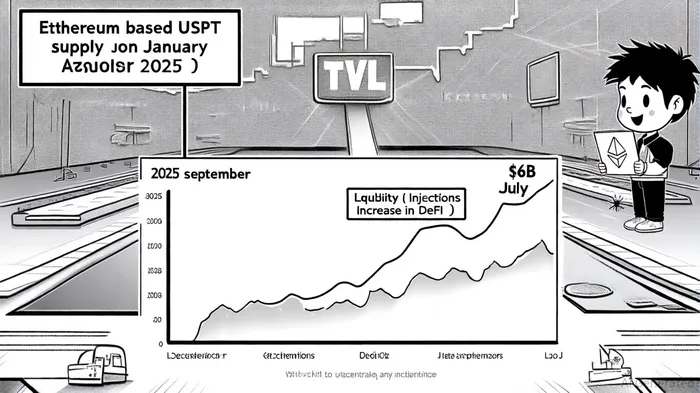
Tether's $6 billion USDT issuance in July 2025—a 5.33% monthly increase in the stablecoin market—catalyzed broader liquidity expansion. By August, total stablecoin supply had reached $267 billion, with USDT's market share climbing to 61.60%[6]. This surge was driven by regulatory clarity from the U.S. GENIUS Act, which mandated full reserve backing and monthly audits for stablecoins, addressing institutional concerns about transparency[7].
The influx of liquidity directly boosted DeFi TVL. Platforms leveraging Ethereum's infrastructure saw a 12–15% increase in TVL during Q3 2025, as USDT became the primary collateral for yield-generating strategies[8]. For instance, Ethereum-based protocols like AaveAAVE-- and CompoundCOMP-- reported a 20% rise in USDT deposits, reflecting renewed investor appetite for stablecoin-pegged returns[9]. This trend aligns with broader capital shifts from BitcoinBTC-- to Ethereum, as altcoin projects in DeFi and NFTs attracted diversified portfolios[10].
Institutional Adoption: Partnerships and Regulatory Alignment
Tether's institutional adoption has accelerated through strategic partnerships and regulatory alignment. Cantor Fitzgerald, a Wall Street brokerage, now serves as Tether's primary custodian for U.S. Treasuries and holds a 5% equity stake in the company[11]. This collaboration enhances Tether's credibility, offering institutional-grade oversight and aligning its interests with traditional finance stakeholders.
Additionally, Tether's launch of USA₮—a U.S.-regulated stablecoin—positions it to capture institutional demand for compliance-driven assets[12]. The GENIUS Act's framework further supports this, as institutions increasingly adopt stablecoins for cross-border payments and interbank settlements[13]. By September 2025, Ethereum's USDT supply had grown by $17 billion since May, driven by institutional-grade use cases like PayPal's PYUSD integration[14].
Strategic Implications for Investors
For investors, Tether's liquidity strategies and institutional partnerships signal a maturing stablecoin ecosystem. The $1B Ethereum mint and $6B weekly surge highlight:
1. DeFi Resilience: Increased TVL and trading volumes demonstrate stablecoins as a backbone for decentralized finance, even amid regulatory scrutiny[15].
2. Institutional Trust: Regulatory alignment and custodial partnerships reduce risks for institutional investors, paving the way for mainstream adoption[16].
3. Market Dynamics: Tether's dominance ensures continued volatility dampening in crypto markets, with USDT acting as a liquidity anchor for both CeFi and DeFi[17].
However, risks persist. Regulatory challenges, such as ongoing litigation and potential reserve transparency demands, could disrupt Tether's growth trajectory. Investors must monitor reserve audits and compliance updates to gauge long-term stability.






Comentarios
Aún no hay comentarios