
Strategic Implications of Taiwan's Chip Export Restrictions on South Africa
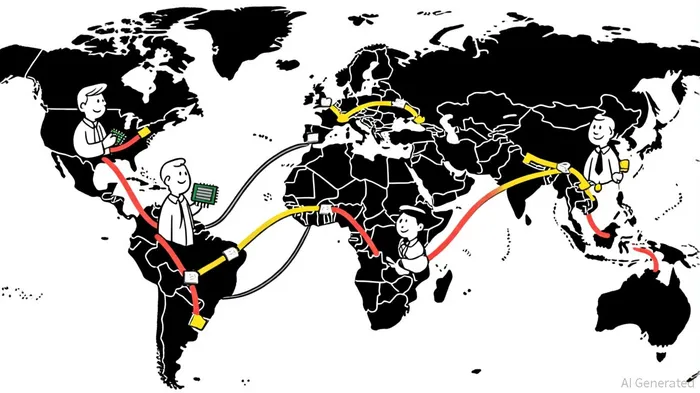
The global semiconductor industry is undergoing a seismic shift, driven by geopolitical tensions and strategic realignments. At the center of this transformation is Taiwan, whose 2025 export restrictions on advanced chips have reverberated across international markets, particularly in South Africa. These policies, framed as measures to protect national security and technological sovereignty, underscore the growing entanglement of technology and diplomacy. For investors, the implications are profound: supply chain disruptions, shifting trade dependencies, and new opportunities in regions like Africa are reshaping the semiconductor landscape.
Geopolitical Leverage and the "Silicon Shield"
Taiwan's export restrictions, including the "N-1" rule and the addition of Huawei and SMIC to its entity list, are part of a broader strategy to align with U.S. and Western efforts to curb China's access to advanced technologies[1]. By mandating that overseas semiconductor manufacturing facilities operate with at least one generation behind Taiwan's most advanced nodes, the island nation has effectively weaponized its role as the world's leading chip producer. This move reinforces Taiwan's identity as the “silicon shield,” a critical node in global supply chains for defense, AI, and high-tech manufacturing[3].
For the U.S., this alignment is both a blessing and a constraint. While Taiwan's policies help limit China's technological rise, they also highlight the U.S.'s continued dependence on Taiwanese manufacturing for cutting-edge chips. As one analyst noted, “The U.S. can't localize 2nm production without Taiwan, but it can't fully trust Taiwan to prioritize American interests either”[3]. This tension creates a volatile environment for investors, where geopolitical shifts directly impact supply chain stability.
South Africa's Semiconductor Dilemma
South Africa's semiconductor industry, though modest in scale, is strategically positioned to benefit from global diversification efforts. The country's market is projected to grow at a 6.60% CAGR through 2030, driven by demand in automotive, 5G, and AI sectors[2]. However, recent diplomatic tensions with Taiwan—triggered by South Africa's decision to relocate its liaison office—have led to export restrictions on 47 categories of semiconductors, memory, and integrated circuits[4].
The immediate impact is twofold. First, South African firms reliant on advanced chips for AI development and electric vehicle (EV) manufacturing now face supply chain uncertainties. TSMCTSM--, which produces 90% of the world's most advanced chips, is central to this disruption[5]. Second, the restrictions have forced South Africa to accelerate diversification efforts, seeking alternative suppliers in the U.S., Europe, and Asia[5]. While this could reduce long-term dependency on a single source, it also introduces short-term costs and logistical challenges.
Investment Opportunities in a Fractured Supply Chain
The crisis in South Africa highlights a broader trend: the semiconductor industry is pivoting toward regionalization and resilience. For investors, this creates opportunities in three key areas:
Semiconductor Assembly, Testing, and Packaging (ATP): South Africa's growing technical workforce and strategic location make it an attractive hub for ATP, a lower-capital-intensive segment of the supply chain[1]. Government incentives, including tax breaks and special economic zones, further enhance its appeal[1].
Critical Minerals and Green Manufacturing: South Africa's reserves of cobalt, tantalum, and rare earth elements position it as a key supplier for semiconductor materials[1]. Investments in sustainable extraction and processing could align with global ESG trends.
Diversified Supplier Networks: As countries seek to reduce reliance on any single region, firms that facilitate cross-border partnerships—such as those connecting South African manufacturers with European or Japanese suppliers—stand to gain[5].
The Bigger Picture: Africa's Role in the Global Semiconductor Ecosystem
While South Africa's challenges are acute, they reflect a larger opportunity for Africa. The continent's abundant natural resources, combined with its growing technical workforce, could make it a critical player in the semiconductor supply chain[1]. However, success will depend on addressing infrastructure gaps—such as electricity instability—and fostering public-private partnerships to scale capacity[2].
For investors, the key takeaway is clear: the semiconductor industry is no longer a monolith. It is a fragmented, geopolitically charged ecosystem where strategic foresight and adaptability are paramount. Taiwan's export restrictions are a case study in how technology policy can reshape markets—and how investors must navigate these shifts with both caution and ambition.





Comentarios
Aún no hay comentarios