
The Strategic Implications of SBI Digital Markets' Chainlink CCIP Integration for Global Digital Asset Infrastructure
A New Era for Institutional-Grade Blockchain Infrastructure
SBIDM, a subsidiary of Japan's SBI Group, has transitioned from a digital asset issuance platform to a comprehensive hub for compliant tokenized asset operations. By adopting Chainlink's CCIP, the firm is enabling secure, cross-chain transfers of tokenized real-world assets (RWAs) such as real estate, bonds, and funds. The CCIP's ability to facilitate private transactions-hiding sensitive data like transaction amounts and counterparties-addresses a critical barrier to institutional adoption: privacy and compliance, according to a Panewslab report. This is particularly relevant in markets like Singapore and Japan, where regulators prioritize data confidentiality while fostering innovation, as noted in a Coinotag report.
The CCIP's interoperability layer also supports payment-versus-payment (PvP) mechanisms for cross-border transactions, a feature that aligns with the growing demand for efficient FX settlements. For instance, SBIDM's collaboration with UBS Asset Management under Singapore's Project Guardian demonstrates how CCIP can automate fund administration workflows using smart contracts, reducing settlement times from days to minutes, as detailed in an SBIDM press release. Such innovations are not just technical upgrades-they are strategic moves to bridge traditional finance (TradFi) and decentralized infrastructure, a gap that has long hindered institutional participation in digital assets, as described on the Chainlink Ecosystem page.
Regulatory Compliance as a Competitive Advantage
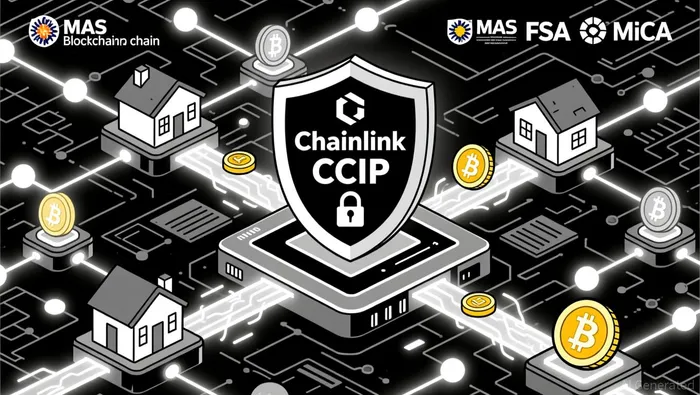
The CCIP's design explicitly addresses the compliance requirements of major regulatory frameworks, including the EU's Markets in Crypto-Assets (MiCA) regulation, Singapore's Monetary Authority of Singapore (MAS) guidelines, and Japan's Financial Services Agency (FSA) standards. For example, CCIP Private Transactions ensure that transaction details remain confidential, a feature critical for adhering to MAS's Project Guardian requirements for tokenized fund settlements, as explained in a Chainlink blog post. Similarly, the protocol's burn-and-mint model for stablecoins, as seen in AllUnity's EURAU euro-backed stablecoin, maintains 1:1 parity across chains while complying with MiCA's transparency mandates, according to an Asset Servicing Times report.
In Japan, where the FSA is preparing to approve yen-backed stablecoins, the CCIP's cross-chain capabilities could accelerate the adoption of regulated digital yen. By embedding compliance rules directly into smart contracts-such as investor eligibility checks and transaction validation-Chainlink enables SBIDM to automate regulatory adherence, reducing operational risk for institutions, as noted in a Chainlink Today article. This is a stark contrast to legacy systems, where compliance is often a manual, post-hoc process.
Real-World Use Cases and Market Validation
The strategic value of CCIP is further underscored by its real-world applications. SBIDM's work with UBS on tokenized money market funds, for instance, leverages Chainlink SmartData to bring net asset value (NAV) data on-chain, enhancing liquidity and operational efficiency, as the SBIDM press release describes. This use case is particularly compelling for institutional investors, as 76% of surveyed financial institutions plan to invest in tokenized securities due to their lower costs and faster settlement times, a trend highlighted in a PR Newswire release.
Another example is the EURAU stablecoin's expansion across EthereumETH--, ArbitrumARB--, and SolanaSOL-- via CCIP. By enabling cross-chain interoperability, EURAU can serve as a medium for B2B payments and treasury management while maintaining MiCA compliance, according to a Markets.com article. These examples highlight how CCIP is not just a technical tool but a catalyst for institutional adoption, addressing both functional and regulatory hurdles.
Strategic Implications for Global Digital Asset Infrastructure
SBIDM's CCIP integration signals a broader shift in digital asset infrastructure. By prioritizing interoperability and compliance, the firm is positioning itself as a key player in the tokenization of global markets. This is especially relevant in Asia and Europe, where regulatory clarity is accelerating adoption. For investors, the partnership underscores the importance of infrastructure providers that can navigate complex regulatory landscapes while delivering scalable solutions.
However, challenges remain. The success of CCIP depends on widespread adoption by other institutions and regulators. If competitors develop alternative interoperability protocols, the market could fragment. Nonetheless, Chainlink's first-mover advantage and SBIDM's regulatory expertise create a strong moat.
Conclusion
The integration of Chainlink CCIP by SBI Digital Markets is more than a technological upgrade-it is a strategic masterstroke that aligns institutional-grade blockchain adoption with global regulatory standards. By enabling secure, compliant cross-chain transactions, the partnership addresses the core pain points of tokenized asset markets, from privacy to interoperability. As digital assets mature from speculative assets to foundational infrastructure, SBIDM and Chainlink's collaboration offers a roadmap for the future.






Comentarios
Aún no hay comentarios