
The Strategic Implications of Samsung's Coinbase Partnership for the Crypto Ecosystem
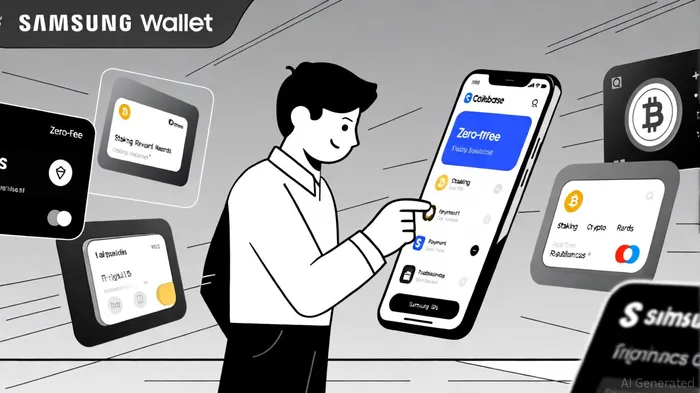
The partnership between Samsung and CoinbaseCOIN--, announced in October 2025, marks a seismic shift in the crypto ecosystem's trajectory toward mainstream adoption. By embedding Coinbase's services into the Samsung Wallet app-reaching over 75 million U.S. Galaxy users-Samsung and Coinbase are notNOT-- merely expanding access to digital assets; they are redefining how consumers interact with crypto in their daily lives. This integration, which includes zero-fee trading, boosted staking rewards, and seamless Samsung Pay functionality, represents a masterstroke in market expansion and retail adoption, leveraging Samsung's global infrastructure to normalize crypto as a utility rather than a speculative asset, according to a FinancialContent report.
Market Expansion: Scaling Crypto Through Mobile Ecosystems
Samsung's Galaxy devices already command a dominant share of the global smartphone market, with over 1.6 billion active devices as of 2025, per CoinLaw statistics. By integrating Coinbase into its native wallet, Samsung is effectively turning its hardware into a crypto on-ramp. The partnership's initial focus on the U.S. market-a region where crypto adoption has stagnated due to regulatory uncertainty and user friction-highlights its potential to reignite growth. For instance, the inclusion of a $25 trading credit and a free three-month Coinbase One subscription directly addresses cost barriers for first-time users, as outlined in a Samsung announcement.
The strategic value extends beyond user acquisition. Samsung Pay, which processes over 1.6 billion transactions annually, now enables users to purchase crypto with the same ease as splitting a coffee tab, according to a CoinDesk report. This frictionless integration mirrors Apple Pay's role in accelerating contactless payments, suggesting a parallel trajectory for crypto adoption. Analysts estimate that the global rollout-targeting over one billion Galaxy users-could inject $10–$15 billion in annual trading volume into Coinbase's platform within 18 months, per a BitcoinEthereumNews analysis.
Retail Adoption: From Novelty to Necessity
The partnership's true innovation lies in its ability to transform crypto from a niche asset class into a utility embedded in everyday financial behavior. By consolidating crypto balances, payment cards, and digital IDs within the Samsung Wallet, the collaboration simplifies asset management for users who might otherwise find blockchain technology intimidating, as reported by Brave New Coin. This approach aligns with behavioral economics principles: repeated, low-effort interactions (e.g., staking rewards or crypto-based purchases) foster habit formation, increasing long-term engagement, as CoinSpeaker notes.
Moreover, the integration's emphasis on security-leveraging Samsung's Knox platform to protect private keys-addresses a critical trust barrier, according to a TalkAndroid article. This is particularly impactful in markets like South Korea, where crypto adoption is high but security skepticism persists, as covered by Cointelegraph.
Competitive Landscape: Samsung vs. Apple in the Crypto Arms Race
The partnership also positions Samsung as a direct competitor to Apple in the race to dominate the digital asset ecosystem. While Apple has remained cautious, Samsung's aggressive integration of crypto into its wallet and payment systems signals a bold bet on Web3's future. This rivalry could spur innovation, with both companies vying to offer deeper integrations (e.g., in-app staking, NFT marketplaces) to lock in user loyalty, according to Daily Hodl.
Coinbase, meanwhile, gains a de facto distribution network. By piggybacking on Samsung's hardware sales and software updates, the exchange bypasses the need for costly user acquisition campaigns. This symbiotic relationship mirrors PayPal's early adoption of crypto, which leveraged its existing user base to drive mass adoption, as noted in an Invezz article.
Future Implications: A New Era for DeFi and Web3
The partnership's long-term impact could extend beyond retail trading. With plans to introduce full staking and DeFi capabilities within the Samsung Wallet, the collaboration may catalyze broader participation in decentralized finance. For example, users could soon earn yields on their crypto holdings without leaving their phone's home screen, democratizing access to financial tools previously reserved for institutional investors, as discussed in a CryptoNews report.
However, challenges remain. Regulatory scrutiny of embedded crypto services-particularly in the U.S.-could delay global expansion. Additionally, the partnership's success hinges on user retention: while incentives drive initial adoption, sustaining engagement will require continuous innovation (e.g., gamified staking rewards, merchant partnerships).
Conclusion
Samsung's partnership with Coinbase is more than a corporate collaboration-it is a tectonic shift in the crypto ecosystem's evolution. By embedding digital assets into the fabric of mobile technology, the duo is dismantling barriers to entry, fostering habit formation, and positioning crypto as a utility for the next billion users. For investors, this represents a dual opportunity: Samsung's hardware-driven distribution model and Coinbase's expanding user base could generate outsized returns as the partnership scales. In a world where adoption is the ultimate bottleneck, this alliance may prove to be the catalyst that turns crypto from a speculative asset into a mainstream financial infrastructure.





Comentarios
Aún no hay comentarios